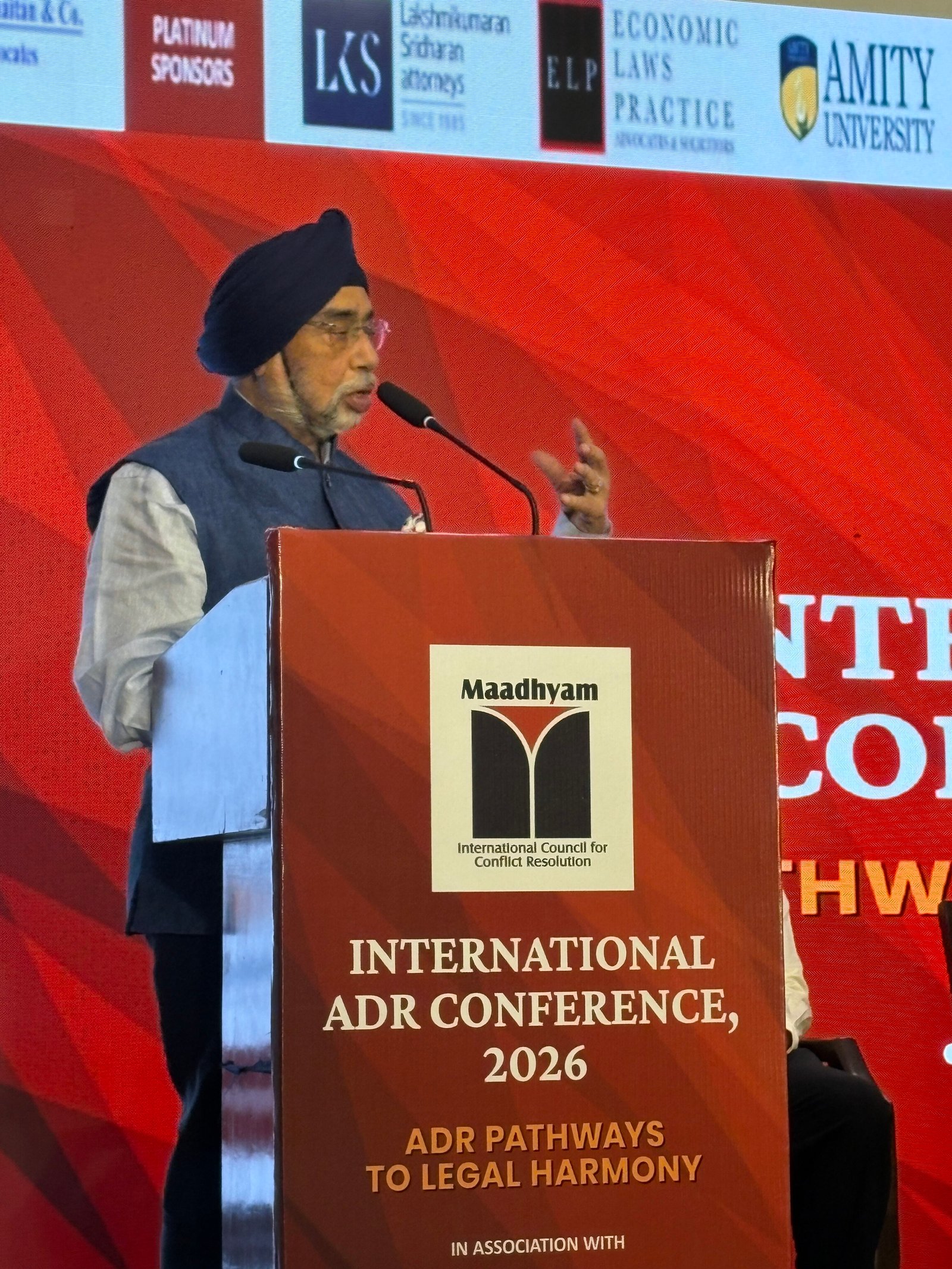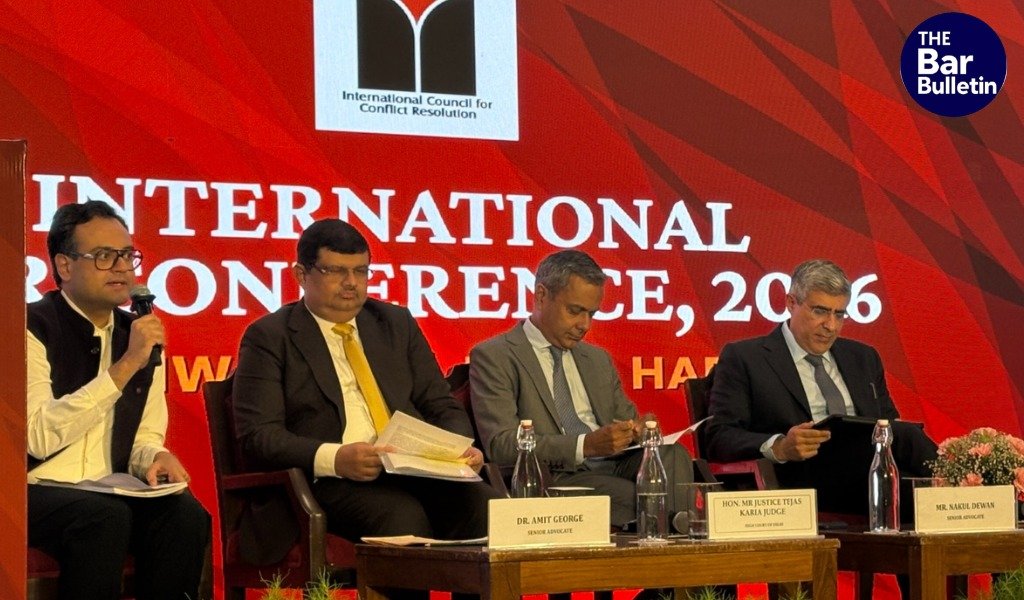
The next phase of India’s arbitration reforms must focus on implementing existing legislative changes, recognising emergency arbitration and third-party funding, strengthening institutional arbitration, and reducing judicial delays if the country is to emerge as a preferred global arbitration destination, speakers observed during a panel discussion at MAADHYAM’s International ADR Conference 2026 – “ADR Pathways to Legal Harmony.”
The session on “Amendments to the Arbitration & Conciliation Act, 1996: Aligned to the Global Standards” was chaired by Justice Tejas Karia, Judge, Delhi High Court, moderated by Dr. Amit George, Advocate, and featured Senior Advocates Amit Sibal and Nakul Dewan.
Opening the discussion, Justice Tejas Karia reflected on the remarkable evolution of India’s arbitration regime since the enactment of the Arbitration and Conciliation Act, 1996. While acknowledging that successive legislative amendments and judicial pronouncements have substantially strengthened India’s arbitration framework, he observed that the focus must now shift from introducing new reforms to effectively implementing those already enacted.
“
“What we need now is to implement them. Many of the amendments of 2019 are still not notified,” Justice Karia remarked.

Highlighting the need to reduce judicial involvement at the threshold stage of arbitration, Justice Karia observed that despite legislative reforms, appointment of arbitrators under Section 11 continues to consume significant judicial time. He suggested that empowering arbitral institutions to undertake appointments would streamline the process and substantially reduce pendency before courts.
Justice Karia also called for statutory recognition of emergency arbitration, observing that although Indian courts have recognised emergency arbitral awards through judicial interpretation, legislative backing would provide greater certainty while reducing court intervention at the interim stage.
“
“We need to increase emergency arbitration by recognising it statutorily,” he said.
Another important reform identified by Justice Karia was third-party funding, which he described as an essential component of a mature arbitration ecosystem.
According to him, statutory recognition of third-party funding would improve access to justice, while appropriate safeguards could ensure that funders do not interfere with party autonomy or control arbitral proceedings.
Justice Karia also advocated the creation of specialised arbitration benches and a specialised arbitration Bar to ensure faster disposal of arbitration-related proceedings.
Emphasising that courts are intended to support rather than interfere with arbitration, he observed that applications under Section 34 require a specialised approach distinct from conventional appellate proceedings.
“
“The main purpose of the judiciary is to support arbitration and not to interfere.”
He further suggested that eligibility for appointment as an arbitrator should be determined by training and expertise rather than professional background, encouraging wider participation of domain experts in specialised commercial disputes.
Speaking on the proposed amendments to the Arbitration and Conciliation Act, Senior Advocate Amit Sibal highlighted the extraordinary transformation of India’s arbitration landscape while reminding the audience of the delays that characterised arbitration under the Arbitration Act, 1940.

Recalling one of his earliest arbitration matters, Sibal narrated how a dispute arising under an agreement executed in 1986 witnessed constitution of the arbitral tribunal only in 2007, followed by years of proceedings before the award and subsequent court challenges.
He said the experience reflected one of the historic shortcomings of Indian arbitration, the delay in constitution of arbitral tribunals.
Drawing comparisons with jurisdictions such as England, Singapore and Hong Kong, Sibal observed that parties in those jurisdictions largely rely on experienced arbitral institutions for appointment of tribunals, thereby minimising court intervention.
He stressed that India must continue its transition from ad hoc arbitration towards institutional arbitration.
“
“Arbitration, which is supposed to be about choice, in India is, in many ways, not about choice.”
Sibal observed that because of the enormous burden on India’s civil courts, arbitration has become less a matter of commercial preference and more a practical necessity for businesses seeking timely dispute resolution.
“
“We have to adopt, embrace, promote and protect arbitration.”
Addressing another important reform, Sibal strongly endorsed statutory recognition of emergency arbitration, describing it as a globally accepted feature of modern arbitration.
He explained that emergency arbitration protects assets, preserves evidence and reduces dependence on courts at the commencement of arbitral proceedings.
Referring to the Supreme Court’s landmark judgment in Amazon.com NV Investment Holdings LLC v. Future Retail Ltd., Sibal noted that while emergency arbitral awards have already received judicial recognition in India, legislative codification would provide greater clarity and certainty.
He also supported the proposed amendments relating to the concept of the juridical seat of arbitration while cautioning against reintroducing conventional territorial jurisdiction principles into arbitration law.
Turning to India’s institutional arbitration ecosystem, Senior Advocate Nakul Dewan observed that India’s immediate priority should be to reduce the export of India-related disputes to foreign arbitral seats by making India an attractive and commercially viable arbitration destination.
“
“Our first aim should be to make India a viable seat so that parties are perfectly willing to arbitrate in India if that dispute is either against an Indian counterparty or it relates to India.”

Dewan praised institutions such as the Delhi International Arbitration Centre (DIAC) for their infrastructure and procedural framework but said Indian institutions require far greater international visibility.
Drawing comparisons with global institutions such as SIAC, ICC and LCIA, he observed that sustained international outreach has enabled those institutions to become the preferred choice for cross-border commercial parties.
“
“Outreach becomes an extremely important element.”
Dewan further echoed Justice Karia’s call for third-party funding, observing that most leading arbitration jurisdictions already recognise such arrangements.
He also called for legislative clarity regarding parties’ freedom to appoint counsel of their choice in India-seated arbitrations, particularly in cross-border disputes.
“
“If you want to promote arbitration in India… parties need to be certain that they can get their choice of counsel for the arbitration.”
Concluding the session, Dr. Amit George thanked the panel for what he described as an insightful discussion, observing that the deliberations had generated several practical recommendations to make India’s arbitration framework more globally competitive.
Mr. Amarjit Singh Chandhiok, Senior Advocate gave the closing remarks on the session.