
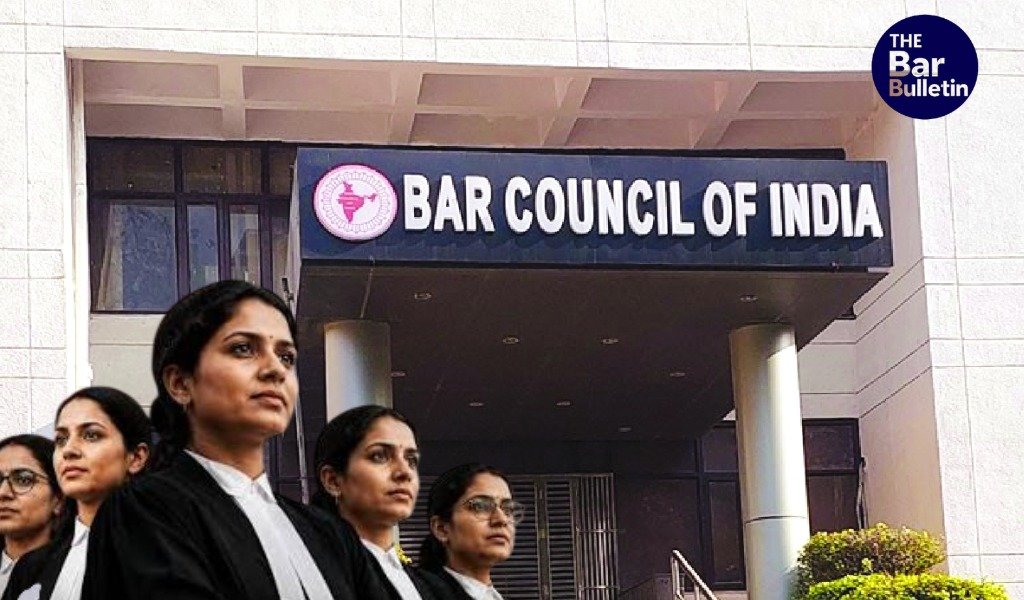

The Bar Council of India (BCI) has kept in abeyance its August 16, 2026 meeting concerning the proposed co-option of women members to State Bar Councils, citing pending election-related grievances and disputes before competent forums.
In a communication dated August 12, 2026 addressed to the Secretaries of all State Bar Councils, the BCI referred to the Supreme Court’s August 4, 2026 order in Yogamaya M.G. v. Union of India and its own communication dated August 11 concerning the proposed meeting.
The BCI noted that the Supreme Court had directed that the two women members be co-opted to each State Bar Council from the categories specified in its order, with the Chief Justice of the concerned High Court required to consider all relevant factors and consult the elected members of the respective State Bar Council before taking a decision.
The Supreme Court had also directed that the issue concerning the methodology for calculation of transferable votes among contesting candidates, particularly women candidates, be considered by the High-Powered Election Supervisory Committee headed by former Supreme Court judge Justice Sudhanshu Dhulia. Interested members of the Bar have been permitted to place their suggestions and opinions before the Committee.
The BCI stated that grievances and disputes relating to the election process including matters affecting the exclusion, elimination, ranking or electoral status of candidates, including women candidates are pending or may come up before the High-Powered Election Supervisory Committee, Election Committees, Tribunals or other competent authorities.
According to the BCI, any determination in those proceedings could affect the electoral position or status of women candidates and consequently become relevant to the factual matrix concerning their representation and co-option in the respective State Bar Councils.
The BCI therefore considered that proceeding with the separate facilitative exercise announced in its August 11 communication including the identification and recommendation of names for co-option could be premature and could result in overlapping processes or inconsistency with a subsequent determination by a competent forum.
Accordingly, the BCI has directed that its August 11 communication and the meeting proposed for August 16 shall remain in abeyance until further communication. State Bar Councils have been requested not to convene the meeting or undertake any consequential exercise pursuant to the earlier communication.