
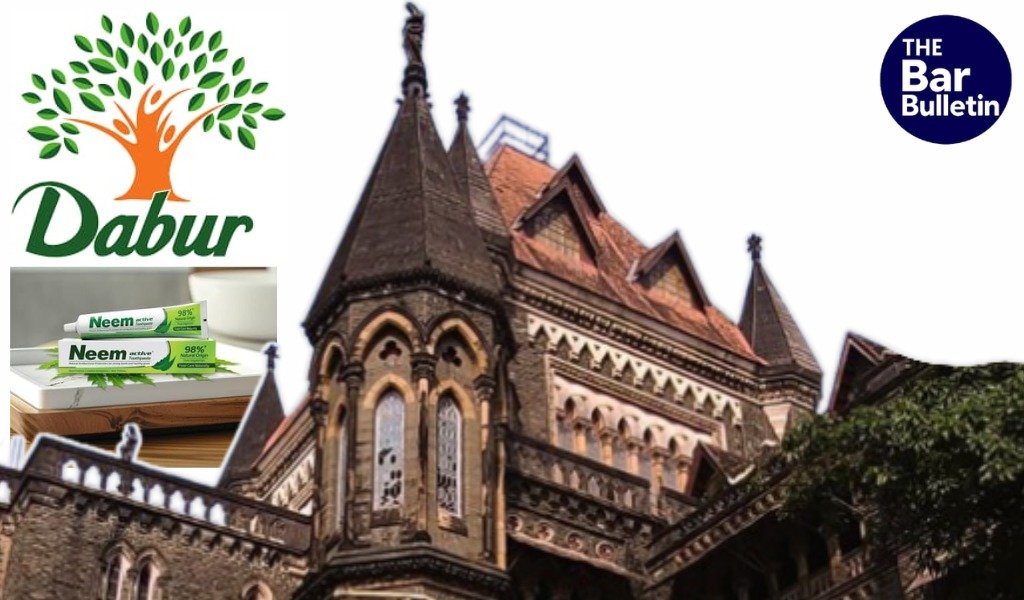

In a detailed interim order, the Bombay High Court has ruled that Jyothy Labs, which has used “NEEM” in relation to toothpaste since 1920 through its predecessor Calcutta Chemical Company, has made out a prima facie case of trade mark infringement and passing off against Dabur India. The Court held that the leading and essential feature of a composite or label mark can be protected even without standalone registration, and that a defendant who seeks registration of a mark without disclaiming a constituent element is estopped from later arguing that the same element is generic or descriptive.
The Court allowed the interim application, granting an injunction that restrains Dabur India from infringing Jyothy Labs’ registered trademarks and from passing off its goods by using the impugned label or any deceptively similar mark in relation to toothpaste. However, the Court explicitly clarified that this injunction does not place any fetter on Dabur from using the word ‘NEEM’ per se in a purely descriptive manner on its packaging.
The Court held that the proprietor of a composite or label mark may protect its leading and essential feature against unauthorised appropriation even where that feature is not independently registered. Section 17 of the Trade Marks Act does not preclude such protection, as it merely prevents the proprietor from asserting an independent monopoly over a part that is common to the trade or non-distinctive; it does not bar the proprietor from relying on the appropriation of the essential and distinctive feature to establish deceptive similarity.
The Court also explained that a party that seeks registration of a label mark without disclaiming a constituent element is estopped from arguing in infringement proceedings that the same element is generic, descriptive, or incapable of trade mark protection. The use of a word as a trade mark rather than as a descriptive term is determined by the prominence, placement, visual emphasis and overall presentation of the expression on the packaging, not by the defendant’s subjective intention.
The presence of a defendant’s house mark does not automatically dispel the likelihood of confusion where the leading and essential feature of a registered mark has been appropriated. A word that requires an imaginative leap for a consumer to connect it to the product is suggestive and not generic or descriptive, and is therefore inherently distinctive without requiring proof of secondary meaning, added the Court.
A Single Judge Bench of Justice Arif S. Doctor placed significant weight on the stark difference between Dabur’s international packaging, where “NEEM” appears inconspicuously in the bottom right corner in a clearly descriptive manner, and the impugned domestic label, where “NEEM” is displayed centrally in large, bold lettering as the leading and essential feature. Dabur’s only explanation for this change was that the domestic packaging was designed “to cater to the Indian market”, without offering any satisfactory reason for why the change was necessitated.
The Court treated this unexplained difference as a strong indicator that “NEEM” was consciously adopted and used as a source identifier on the impugned label, and not descriptively. Accordingly, the statutory defences under Section 30(2)(a) and Section 35 of the Trade Marks Act, which protect bona fide descriptive use, were held unavailable at this stage.
The Court also found Dabur’s conduct before the Trade Marks Registry to be internally inconsistent. Dabur had itself applied for registration of the impugned label in which “NEEM” appears as a leading and essential feature, without entering any disclaimer against “NEEM”. The Court held that having asserted proprietary rights in the mark as it appears on its packaging, Dabur is estopped from contending that “NEEM” is generic or descriptive. This was reinforced by the fact that Dabur has itself enforced statutory rights over similar oral hygiene terms “MESWAK” and “BABOOL” against third parties, and opposed the registration of the mark “ARYAN BABOOL” by another entity. Dabur offered no satisfactory explanation as to why “NEEM”, which like “MESWAK” and “BABOOL” is associated with oral hygiene, must be treated differently.
The Court rejected Dabur’s argument that “NEEM” is the generic name for a category of toothpaste or merely descriptive of its contents. The Court observed that the material relied upon by Dabur itself showed “NEEM” being used in relation to a wide variety of unrelated goods including hair oil, soap, body mist, face wash, pet perfume, prickly heat powder, plant fertilisers, laundry detergents and anti-ageing cream. This indicated that “NEEM” does not directly and immediately associate the word with toothpaste. A consumer would need to make an “imaginative leap” to connect the raw ingredient to the final manufactured product, placing “NEEM” in the category of a suggestive mark rather than a generic or descriptive one.
As a suggestive mark, it is inherently distinctive and the plaintiff was not required to establish secondary meaning at the interim stage. Even if “NEEM” were treated as descriptive, the proviso to Section 9(1) of the Trade Marks Act recognises that descriptive marks are registrable if they have acquired distinctiveness through use, and the plaintiff had pleaded nearly a century of continuous commercial use, added the Court.
Also read Punjab Drug Menace: SC Appoints Sr Adv Shadan Farasat, Adv Udai Khanna as Amicus Curiae
Briefly, Jyothy Labs Ltd. filed a commercial suit for infringement and passing off against Dabur India Ltd. concerning the use of the word ‘NEEM’ in relation to toothpaste products. Jyothy Labs holds valid and subsisting trademark registrations for labels in Class 3 where ‘NEEM’ is the leading and essential feature, with commercial usage tracing back to 1920 through its predecessor, Calcutta Chemical Company Ltd.
The dispute arose when Dabur introduced a domestic toothpaste product prominently featuring the word ‘NEEM’ on its packaging, despite maintaining a different international packaging where ‘NEEM’ was used inconspicuously merely as an ingredient descriptor. Dabur defended its adoption by arguing that under Section 17 of the Trade Marks Act, Jyothy Labs had no standalone registration for ‘NEEM’, and contended that the term is generic, descriptive, and common to the dental care trade. Dabur further argued that the prominent presence of its house mark ‘DABUR’ on the packaging eliminated any likelihood of consumer confusion.
