
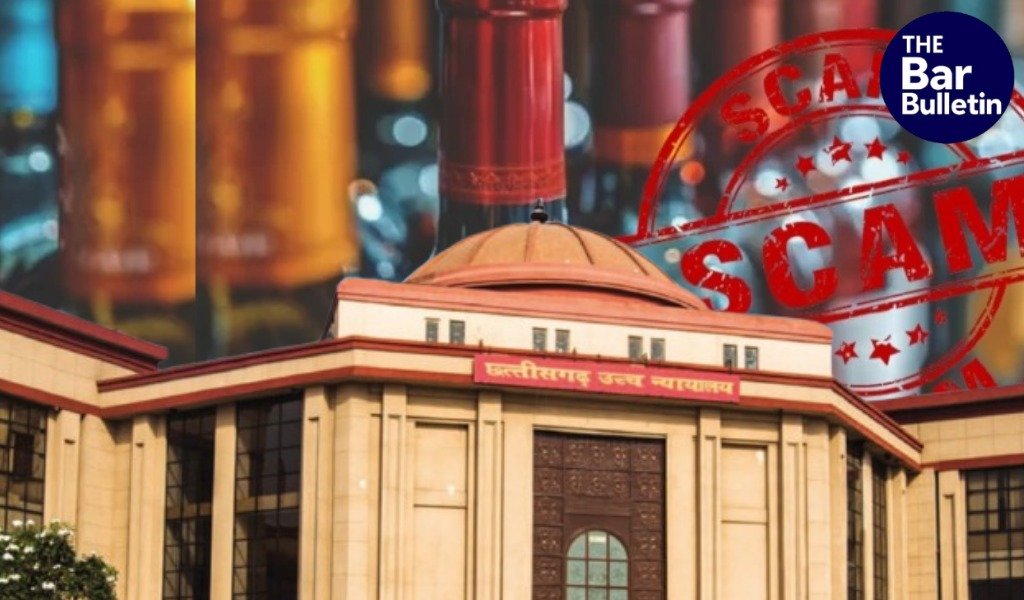

The Chhattisgarh High Court has dismissed a writ petition challenging the Enforcement Directorate’s provisional attachment of Hotel Westin Goa in connection with the alleged Chhattisgarh liquor scam.
A Division Bench comprising Chief Justice Ramesh Sinha and Justice Ravindra Kumar Agrawal held that the petition could not be entertained at this stage since the PMLA provides a complete statutory mechanism for adjudicating the provisional attachment, and the ED had already filed its complaint before the Adjudicating Authority.
The case arose from the ED’s provisional attachment order dated May 28, 2026, by which Hotel Westin Goa was attached under Section 5(1) of the PMLA, treating ₹60 crore as direct proceeds of crime and ₹50 crore as the value thereof. The petitioners, Dr. Rahul Agrawal and Pacifica Hotels India Pvt. Ltd., sought quashing of the attachment, arguing, among other things, that the ₹60 crore cash used in the hotel acquisition had already been accepted as explained money by the Income Tax authorities.
The High Court held that the issue before it was not whether the ED would ultimately succeed in establishing the alleged money-laundering link, but whether the authorised officer had relevant material to form the requisite “reason to believe” under Section 5(1) of the PMLA. The court recorded:
“
“The validity of such satisfaction is certainly amenable to judicial review. The Court can examine whether there was relevant material before the authorised officer, whether the statutory conditions were considered, and whether the reasons recorded have a rational nexus with the material relied upon. But the Court, while exercising writ jurisdiction, is not required to undertake a mini-trial for determining whether the material would ultimately establish the allegation of money-laundering.”
The Court noted that the ED had relied upon several statements, Income Tax appraisal material, etc.: Whether this material would ultimately establish the alleged nexus was a matter for the Adjudicating Authority. The Bench also rejected the petitioners’ argument that the Income Tax authorities’ acceptance of the source of the ₹60 crore prevented the ED from treating it as proceeds of crime.
“
“The Income Tax proceedings and proceedings under the PMLA operate in different statutory fields. The question before the Income Tax authorities was whether the investment/expenditure or cash component was liable to be treated as unexplained for the purposes of the Income Tax Act. The issue before the authorities under the PMLA is whether the property is derived or obtained, directly or indirectly, from criminal activity relating to a scheduled offence and whether the statutory conditions for attachment are satisfied.”
The Court pointed out that the ED’s subsequent material, including statements recorded in 2025, was not before the Income Tax authorities when they passed their orders. Therefore, the Income Tax findings could not be treated as a final adjudication of the alleged criminal provenance of the money.
The Bench further held that the absence of a banking trail did not, at this stage, disprove the ED’s case because the alleged transactions themselves were said to have taken place in cash. Whether the oral statements and other circumstances were sufficient to establish the alleged chain would have to be examined by the Adjudicating Authority.
The Court also rejected the argument that the petitioners’ absence from the FIR or prosecution complaints automatically prevented attachment of the hotel, observing that proceedings concerning the property under Sections 5 and 8 of the PMLA are distinct from criminal prosecution for the scheduled offence.
The writ petition was consequently dismissed, with no order as to costs.
