
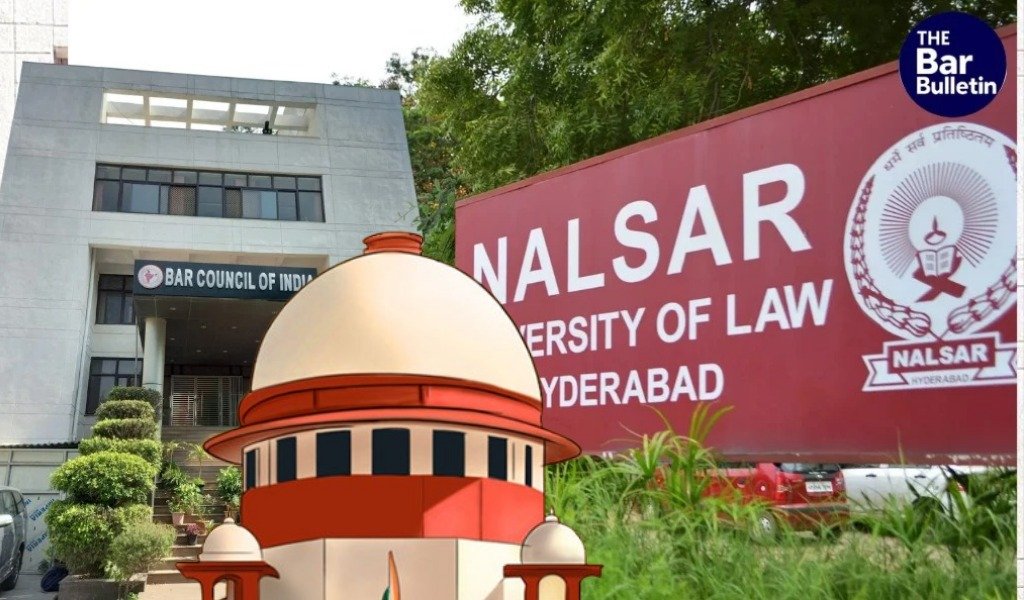

The Supreme Court on Thursday held that the Bar Council of India (BCI) has no power to take disciplinary or punitive action against law students before they are enrolled as advocates, making absolute its earlier interim protection to students of NALSAR University of Law. A Bench comprising Chief Justice Surya Kant and Justices Joymalya Bagchi and V. Mohana was hearing a PIL concerning the BCI’s action against students who had protested the proposed presence of the CJI at their convocation.
Senior Advocate K. Prameshwar, appearing for NALSAR alumni, argued that the BCI’s communications were issued without jurisdiction and that the Council had no authority even to direct the university to conduct an inquiry against the students. He submitted that the matter concerned “freedom of speech and expression within a university”, and questioned how the BCI could regulate the conduct of students who had not yet become advocates.
The BCI, represented by Senior Advocate Manan Kumar Mishra, informed the Court that the communications had already been withdrawn within hours. The Court, however, proceeded to hold that the Advocates Act does not confer any express or implied power on the BCI or State Bar Councils to take disciplinary or punitive action against law students.
“
“we are of the clear opinion that under the Advocates Act, 1961, whereunder the Bar Council of India has been statutorily created, the Act does not confer any express or implied power upon the Bar Council of India or any State Bar Council to take any disciplinary or punitive action against the students of law, such power being preceded by the registration of a law graduate as an advocate under this Act. So, as far as students are concerned, it is their parent institution or the authority prescribed under the regulations or bylaws of such institutions who alone can be permitted to take disciplinary action, if so required, against the student.”
The Court further held that disciplinary action against students, if required, falls within the domain of their parent institution or the authority prescribed under its regulations and bylaws, and accordingly declared the BCI’s communications dated August 13 and the subsequent modified communication against NALSAR students to be “without any authority of law,” while making the interim directions protecting the students absolute.
Also Read: ‘Totally Uncalled For’: CJI Surya Kant Criticises BCI Action Against NALSAR Students
The controversy arose after the BCI issued a communication dated August 13, 2026 to the NALSAR Vice-Chancellor and State Bar Councils recommending penal action against students of the 2026 graduating batch. The communication was withdrawn within hours. The Court had subsequently directed that no punitive action be taken against NALSAR students or faculty at the instance of the BCI or any State Bar Council.
Also Read: BCI Seeks Report on NALSAR Campaign; Bars Enrolment of 2026 Graduates Pending Further Orders
Making the interim protection absolute, the Court effectively clarified the limits of the BCI’s statutory authority over students, while leaving disciplinary and academic matters concerning students to the university or competent institutional authorities.