
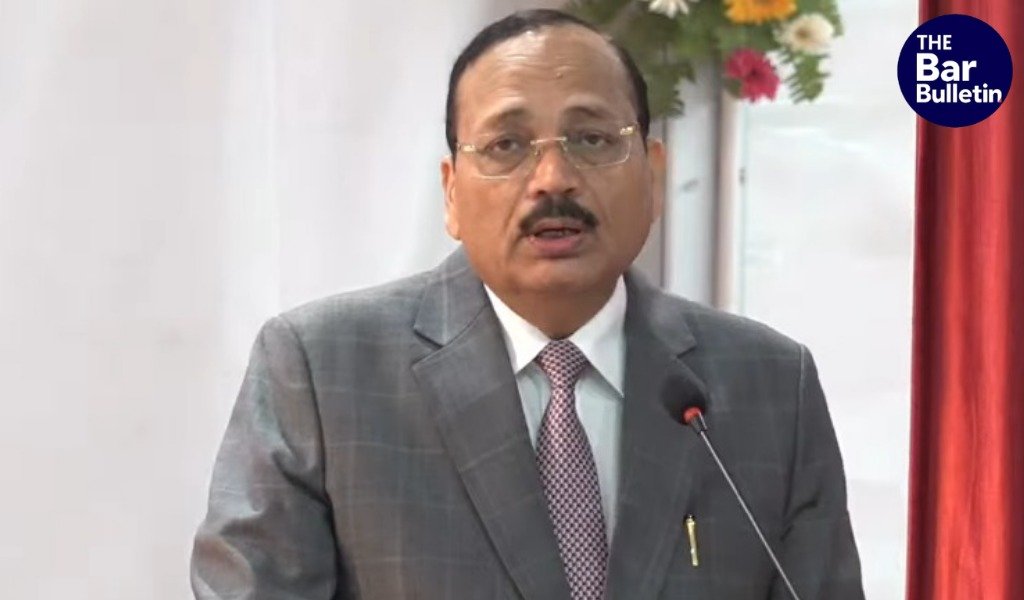

Chief Justice of India Justice Surya Kant on Saturday stressed that children must be treated as citizens with rights and entitlements in the present, and not merely as the future citizens of the country. Speaking on the need to restore childhood and protect children affected by substance abuse, the CJI called for a child-centric approach in which children affected by drug use are treated as children in need of care and protection rather than being defined by their vulnerability or substance use. He emphasised that they are entitled to safety, dignity, education, care and the opportunity to grow.
Addressing a seminar on “Restoring Childhood – Preventing Drug Abuse and Re-integration of Children in Need of Care and Protection” at Bihar Lok Bhawan, the CJI said substance abuse among children should be viewed not merely as a public health issue but also as a child protection concern.
Justice Kant noted that exposure to intoxicating substances can disrupt a child’s education, strain family relationships and affect physical and mental health, while also increasing vulnerability to exploitation, violence, trafficking and abuse. He said the larger question was how to ensure that a child exposed to substance use does not lose the opportunity to “grow, learn, recover and belong.”
Referring to an August 2026 study published in The Lancet Regional Health – Southeast Asia, the CJI said the study estimated that more than one in five teenagers in India are at moderate-to-high risk of substance use. He stressed that children can reach such vulnerability through different circumstances, including peer influence, neglect, abuse, homelessness and deprivation, requiring responses tailored to their individual situations.
He emphasised that the justice system must distinguish between a child struggling with substance use and adults who exploit children or circulate drugs. While the law must respond firmly to those exploiting children, Justice Kant said that in the case of a vulnerable child, the focus must be on safety, treatment, counselling and rehabilitation. The CJI said:
“
“Restoration does not mean turning back the clock or pretending the child has not experienced harm. It means creating conditions in which the child can once again experience what childhood ought to provide, namely, Education, relationships, play, trust and the confidence of a future beyond the present difficulty.”
Justice Kant further said intervention should begin as early as possible, with families, schools, teachers, health professionals and community workers playing a crucial role in identifying signs of vulnerability. He added that de-addiction cannot be treated purely as a clinical exercise and may require counselling, mental-health support, a safe living environment and sustained engagement with the child and family.
On reintegration, the CJI stressed that education must remain central. He said merely removing a child from a harmful environment without ensuring continuity of education could leave the child exposed to another form of vulnerability. He also cautioned that returning a child to a family is not always reintegration if that family itself was a source of neglect, violence or substance abuse. He said rehabilitation must continue beyond the immediate treatment phase:
“
“The objective of our interventions must therefore not be limited to ending substance use for a particular period. It must be to help the child regain a meaningful and secure place within family, school and community life.”
Justice Kant also highlighted the importance of confidentiality and dignity, observing that a child should not be permanently labelled because of a period of vulnerability. According to him, stigma or humiliation could discourage children from seeking assistance.
Calling for greater coordination between institutions, the CJI said the judiciary, government, police, health and education systems, child-care institutions, legal services authorities, academia and civil society each have a role in ensuring that children do not lose access to assistance while moving between institutions. He highlighted the role of legal services institutions, stating:
“
“Access to justice begins well before a matter reaches a courtroom. It may begin with a child, parent, or teacher knowing where to seek assistance, or a family understanding the protections available under law, so that an exposed child is not left without support for lack of knowledge or resources.”
In his concluding remarks, Justice Kant said children are not merely future citizens but “equally citizens of today”, entitled to safety, dignity, education, care and the opportunity to grow. He called for a system where no child is reduced to a diagnosis, case number, past mistake or period of susceptibility.
“
“Let us, therefore, work towards a system in which no child is reduced to a diagnosis, a case number, a past mistake or a period of susceptibility. Let us build a system in which protection does not end with rescue, treatment does not end with discharge, and rehabilitation does not end with return. Let us ensure that whenever childhood is threatened, there is always a pathway back to safety, dignity, belonging and hope.”