
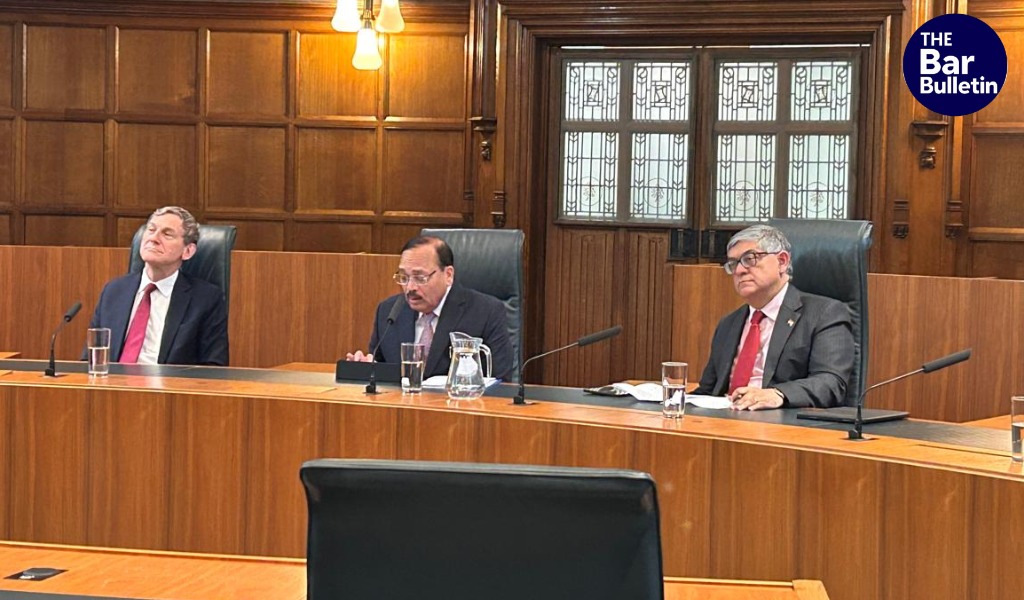

The Hon’ble Chief Justice of India, Justice Surya Kant, delivered a distinguished lecture on “Mediation, Arbitration, and the Courts: Converging Trends in the Indian and English Approaches to Commercial Dispute Resolution” at Courtroom No. 1 of the Supreme Court of the United Kingdom, Parliament Square, London, on 8 June 2026.
The event was organised by Gourab Banerji and brought together leading members of the Bench, Bar, academia, and the international dispute resolution community. The session was joined by Lord Leggatt, fostering a meaningful exchange on the evolving landscape of commercial dispute resolution in India and the United Kingdom.
In his address, the Chief Justice examined the transformation of commercial justice in an increasingly interconnected global economy, observing that litigation, arbitration, and mediation should no longer be viewed as competing mechanisms but as complementary components of a broader and more sophisticated dispute resolution ecosystem. Emphasising the need for commercial certainty, institutional confidence, and economic equilibrium, he highlighted the Judiciary’s evolving role as both facilitator and guardian within a polycentric framework of justice.
Reflecting on the development of arbitration jurisprudence in India, the Chief Justice noted the country’s steady movement towards internationally accepted principles through legislative reform and judicial interpretation. He referred to the growing convergence between Indian and English approaches to arbitration while also drawing attention to the increasing procedural complexities and litigation that often accompany arbitral proceedings across jurisdictions.
A significant focus of the lecture was the growing importance of mediation as an effective and commercially agile means of dispute resolution. Tracing mediation’s roots to India’s long-standing traditions of consensual dispute settlement, the Chief Justice observed that the enactment of the Mediation Act, 2023 represents not merely a legislative reform but a restoration of deeply embedded civilisational values that favour dialogue, reconciliation, and preservation of relationships.
The Chief Justice highlighted the institutional evolution of mediation in India, from its early recognition under Section 89 of the Code of Civil Procedure to its contemporary statutory framework under the Mediation Act, 2023. He noted that mediation has emerged from the periphery of dispute resolution to become an integral component of the administration of civil and commercial justice, supported by enforceable settlement agreements, confidentiality protections, and recognition of online mediation processes.
Drawing a comparative analysis with developments in England, the Chief Justice discussed the growing judicial encouragement of consensual dispute resolution, particularly following recent developments in English jurisprudence. He observed that both jurisdictions are increasingly embracing a culture that promotes early settlement and proportionate dispute resolution mechanisms.
Introducing the concept of “Processus Conveniens”, the Chief Justice suggested that modern commercial actors should focus not merely on selecting the most convenient forum, but on identifying the most appropriate process for resolving disputes. In this framework, courts, arbitral tribunals, and mediation each perform distinct yet complementary functions depending on the nature of the dispute and the interests involved.
Highlighting the future of mediation, the Chief Justice called for greater professionalisation of mediation practice, stronger institutional infrastructure, and wider cultural acceptance within the corporate and commercial sectors. He emphasised that mediation should be viewed not as a sign of weakness, but as an indicator of commercial sophistication, strategic maturity, and financial prudence.
Concluding his remarks, the Chief Justice reiterated that courts and alternative dispute resolution mechanisms are not rivals but partners in the administration of justice. While courts remain the ultimate guardians of legal standards and constitutional accountability, mediation provides an effective avenue for preserving commercial relationships and achieving durable, consensual outcomes. He observed that the true measure of a mature legal system lies not only in its ability to adjudicate disputes but also in its capacity to empower parties to resolve differences constructively and collaboratively.