
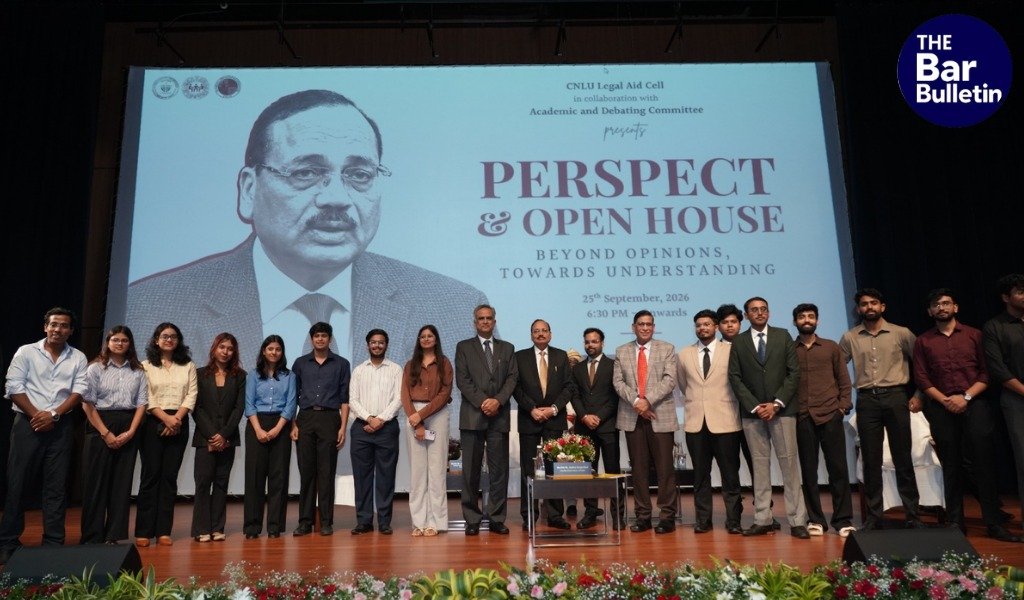

Chief Justice of India Justice Surya Kant on September 24, 2026, held an open-house interaction with law students at Chanakya National Law University (CNLU), Patna, directly taking questions on issues ranging from peaceful student protests and financial support for young lawyers to rising tuition fees, judicial clerkships, judicial appointments and the duration of legal education. The interaction was the first of its kind involving a sitting CJI at the university.
The open-house was held at CNLU’s Ashoka Auditorium and was attended by Patna High Court Chief Justice and CNLU Chancellor Justice V. Kameswar Rao. The event was jointly organised by the University’s Academic and Debating Committee and Legal Aid Committee.
Responding to a question from a student regarding the police response to peaceful student protests, CJI Surya Kant reaffirmed the judiciary’s commitment to protecting students’ fundamental right to peaceful protest.
The CJI also addressed concerns faced by first-generation lawyers. He called for a dedicated professional assistance corpus to provide financial support to young lawyers during their early years, describing it not as charity but as a structural necessity for the future of the legal profession.
There were discussion on rising tuition fees and inadequate scholarships for law students. The CJI assured students that the concerns raised would be addressed, according to the university’s press release.
A proposal by CNLU Vice-Chancellor Prof. Faizan Mustafa to compress the five-year law degree into four years, with the final year dedicated to mandatory court apprenticeship, also came up during the interaction. The proposal would remove the separate one-year practice requirement for judicial service examinations. CJI responded positively to the proposal as a new, and welcome idea.
He further observed that the proposal could generate much-needed debate on integrating court experience into legal education, while clarifying that the objective was not merely to reduce the duration of the course but to better integrate litigation with legal education.
The CJI was also asked why dissenting opinions within the Collegium are recorded but not made public. In response, he explained that disclosure, however well-intentioned, could place the individual concerned in an untenable position when personal dignity is at stake. The university’s release records the CJI as explaining that transparency has limits where individual dignity is involved.
Justice V. Kameswar Rao also supported the call for reforms in legal education and the profession, stating that judicial clerkships at High Courts should become significantly more competitive and financially attractive. He also suggested that remuneration for judicial clerkships at Patna High Court should be increased to make such positions competitive with corporate legal career opportunities.