
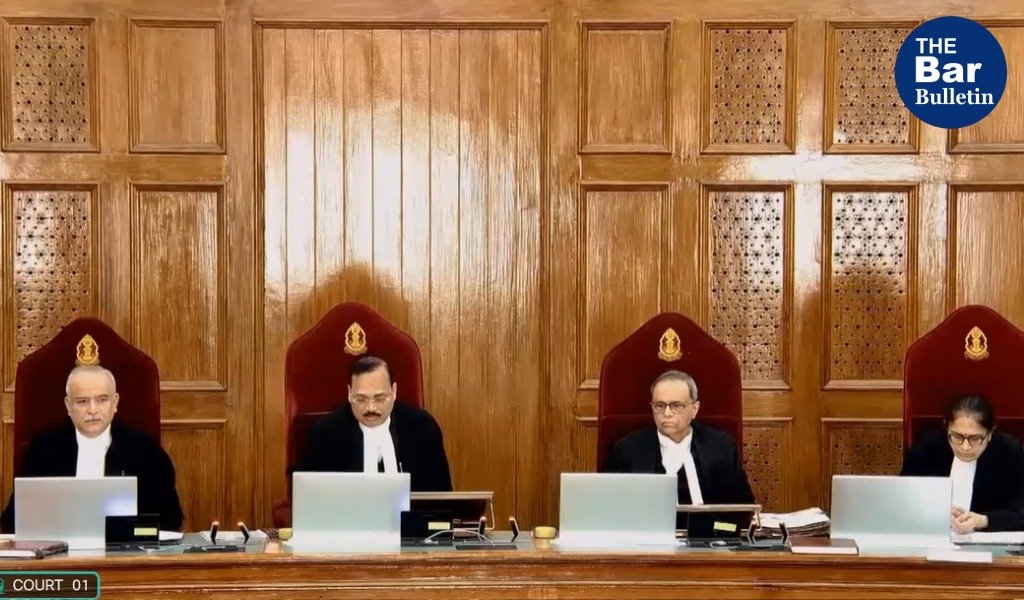

Chief Justice of India, Justice Surya Kant, on Saturday highlighted Justice Satish Chandra Sharma’s cheerful disposition and ability to maintain warm professional relationships despite the demanding nature of judicial work. Addressing a ceremonial Bench sitting held in his honour, the CJI said that Justice Sharma’s contribution to the institution extended beyond his judicial decisions and administrative responsibilities, noting that his warmth, humour and approachability had enriched the working environment of the Court.
Justice Sharma’s professional journey began in 1984. He was designated a Senior Advocate in 2003 at the age of 42 and was elevated to the Madhya Pradesh High Court in January 2008. Justice Sharma subsequently served in the Karnataka High Court, where he also discharged responsibilities as Acting Chief Justice, before becoming Chief Justice of the Telangana High Court and later the Delhi High Court. He was elevated to the Supreme Court in November 2023.
Recalling Justice Sharma’s tenure as Chief Justice of the Delhi High Court, the CJI noted that leading a court of such considerable size and institutional importance required administrative ability, sound judgment and an understanding of the needs of both the Bar and litigants.
The CJI also referred to Justice Sharma’s judicial work concerning the rights and dignity of citizens, particularly in National Association of the Deaf v. Union of India, which dealt with the implementation of statutory protections for persons with disabilities, and Ashok Agarwal v. Union of India, concerning safeguards against manual scavenging. Highlighting the significance of these decisions, the CJI stated:
“
“These decisions reflect an important aspect of his judicial approach: the recognition that the true worth of legal protections lies in their implementation.”
The CJI also recalled Justice Sharma’s participation in several Constitution Bench proceedings after his elevation to the Supreme Court. These included State of Punjab v. Davinder Singh, concerning sub-classification within Scheduled Castes; Property Owners Association v. State of Maharashtra, concerning the constitutional treatment of private property; and Aligarh Muslim University v. Naresh Agarwal, concerning the minority character of the institution.
Referring to his individual judgments, the CJI mentioned Pinky Meena v. High Court of Judicature for Rajasthan at Jodhpur (2025), in which Justice Sharma emphasised fairness and proportionality in administrative decisions affecting judicial officers, while recognising the importance of women’s representation in the judiciary.
He also referred to Sushil Kumar Tiwari v. Hare Ram Sah (2025), concerning the protective purpose of legislation enacted to safeguard children from sexual offences, and Vyakti Vikas Kendra India v. Manoj Misra (2026), which examined principles governing environmental liability and the need for a demonstrable causal connection.
Beyond his judicial contributions, the CJI spoke about Justice Sharma’s personality and the warmth he brought to institutional life, observing that judicial institutions were not sustained by discipline and protocol alone, but also by mutual regard, friendship and collegiality. Recalling his personal interactions with Justice Sharma, the CJI said:
“
“What I particularly admire about Brother Satish is his ability to remain cheerful despite the demanding nature of judicial work. The responsibilities of this office are considerable, and the pressures that accompany them are well known to all of us. Yet, he has a remarkable ability to enjoy the lighter moments, engage warmly with those around him and ensure that the seriousness of our work never takes away from the joy of working together.”
CJI Surya Kant
Concluding the address, the CJI said Justice Sharma’s retirement would mark the conclusion of his long association with the institution in a judicial capacity, but not his association with the legal fraternity. He extended his wishes for the years ahead, expressing hope that Justice Sharma would continue to retain the cheerfulness and zest for life that had characterised his time at the Court.