
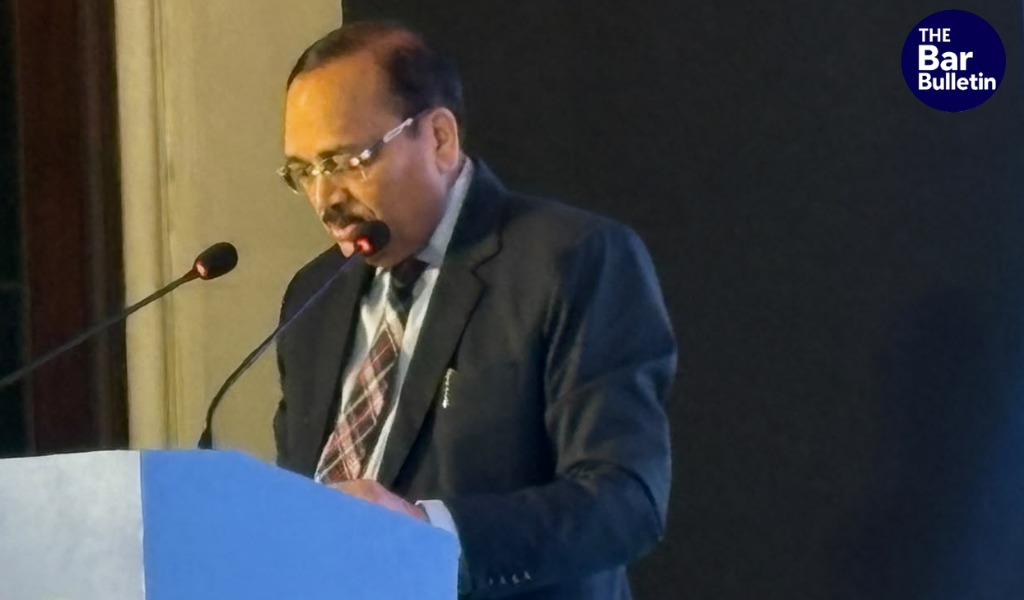

Chief Justice of India, Justice Surya Kant, asserted that implementing a system of graded transparency, including publishing redacted awards, allowing outside party submissions, and holding open hearings in investor-state matters, is not a radical reform but a necessary step to ensure public accountability in international arbitration.
Delivering the keynote address at the SIAC Annual India Conference 2026, the CJI emphasised that while private commercial disputes remain entitled to complete privacy, an absolute veil of secrecy cannot be justified when arbitrations involve state action, public procurement, or critical matters affecting public health and the environment. He called for a balanced adoption of frameworks like the UNCITRAL Rules on Transparency to prevent confidentiality from looking like a total lack of accountability in disputes that genuinely impact ordinary citizens.
Speaking on the theme “International Arbitration: Navigating New Realities and Stress-Testing the Fundamentals,” the CJI further cautioned that the dispute resolution mechanism is dangerously transforming into a mirror image of the highly complex and delayed court systems it was originally designed to replace. CJI highlighted four critical “stress tests” facing modern arbitration:
● spanning procedural bloat,
● artificial intelligence,
● public accountability, and
● conflicting arbitral awards.
Expressing deep concern over the formalisation of the process, the CJI pointed to statistical realities where premier institutions take an average of 20 to 26 months to deliver an award. Attributing these delays to aggressive counsel conduct, passive tribunals, and pervasive over-lawyering, the CJI emphasised that procedural timelines must be treated as strict obligations owed to litigants rather than concessions to arguing lawyers.
“
“Let me turn to the first stress test. I will be direct about it, because in a room like this, honesty matters more than comfort. The most common complaint I hear from parties, and I suspect many of you hear it too, is this: Arbitration is starting to look like the very court process it was meant to replace. We now see multi-day hearings. We see heavy document production modelled on common law discovery. We see competing experts on every point. And we see awards that take years, not months.”
Addressing the rapid technological revolution within legal practice, the CJI noted that generative artificial intelligence has migrated aggressively from the periphery to the very centre of international arbitration. The CJI emphasised that risks concerning deepfake evidence and undisclosed automated text generation are no longer hypothetical anomalies but active procedural hazards requiring immediate, uniform institutional protocols.
“
“Questions of accuracy, authenticity, and the ethical use of AI are no longer theoretical; they are practical challenges confronting arbitrators, counsel, and institutions alike. Deepfake evidence, AI-written witness statements and submissions drafted entirely by a generative tool, without any disclosure, are real. These are not hypothetical risks anymore, and our tribunals need real tools to deal with them.”
To mitigate these technological risks, the CJI proposed a three-pronged strategy. First, an unyielding requirement for disclosure must be enforced whenever generative AI assists in compiling witness statements or expert reports.Second, institutions like SIAC must formulate shared verification standards for digital evidence to prevent individual tribunals from improvising ad-hoc frameworks. Third, practitioners should responsibly relegate AI to administrative workflows, such as e-discovery and data management, thereby safeguarding the distinctively human domain of moral reasoning, fairness, and ultimate judicial discernment.
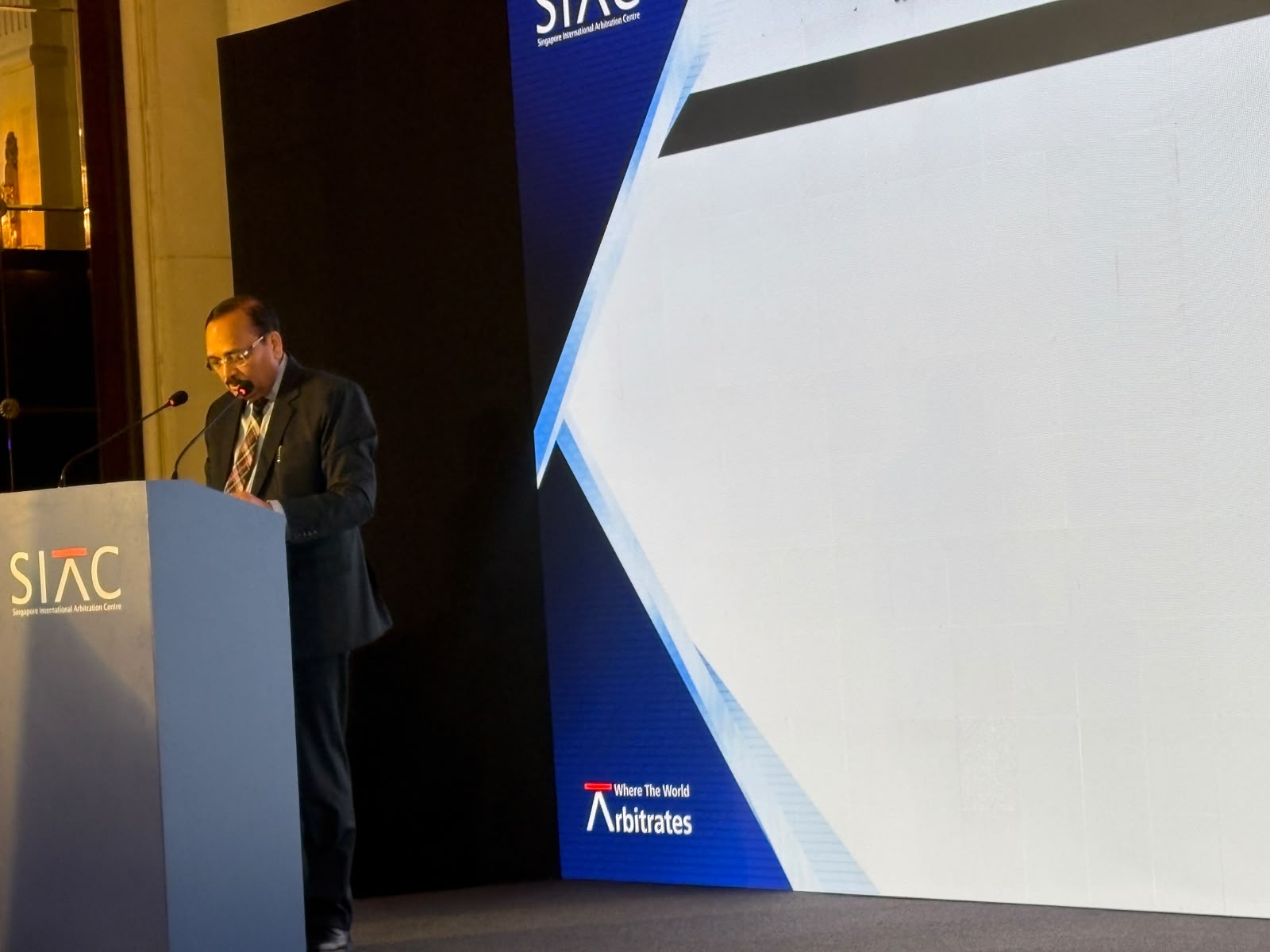
Turning to the traditional doctrine of confidentiality, the CJI addressed the industry’s reluctance to address the public accountability deficit. While acknowledging that private commercial actors remain entitled to complete privacy, the CJI asserted that an absolute veil of secrecy cannot be justified when disputes actively intersect with investor-state conflicts, infrastructure developments, public procurement, or municipal healthcare assets.
“
“For a long time, confidentiality was seen as an unquestioned virtue of arbitration. It was part of what made arbitration attractive to businesses that did not want their disputes made public. But arbitration has now grown into investor-state disputes, infrastructure contracts, and matters that genuinely affect the public. In these settings, the same confidentiality that protects a private business deal begins to look like a lack of accountability. Ask yourself honestly: would you be comfortable if a dispute over a city’s water supply, or a country’s vaccine supply, were decided entirely behind closed doors, with no public record at all? I suspect most of us would not be.”
As an actionable remedy, the CJI advocated for a balanced framework of “graded transparency” patterned after the UNCITRAL Rules on Transparency. Under this proposed paradigm, institutions would actively partition purely private disputes from those impacting the state or public health, utilising mechanism variations such as redacted award publications, open hearings, and third-party submissions where broader public interests are at stake.
The CJI further flagged the severe predictability crisis arising from fractured investment treaty arbitrations, where disparate tribunals routinely render contradictory outcomes regarding identical government measures. The CJI advised that institutions must systematically publish searchable, redacted decisions over time to build a cohesive body of persuasive precedent. Concurrently, the CJI delivered an explicit message to supervising judiciaries worldwide to exercise absolute restraint and stick strictly to narrow statutory grounds rather than second-guessing an arbitrator’s view of the merits.
Concluding the address with an analytical look at domestic developments, the CJI noted that Indian entities consistently comprise one of SIAC’s top three foreign user bases. Commenting on the upcoming International Arbitration Centre at GIFT IFSC, the CJI expressed optimism regarding its non-profit, independent institutional architecture.
“
“The proposed International Arbitration Centre at GIFT IFSC is built on an independent, not-for-profit model, much like SIAC’s own. It is a real attempt to build our own institutional strength, rather than simply borrow someone else’s. I hope it succeeds. And I hope it succeeds by following exactly the discipline I have spoken about today: strong case management, balanced transparency, sensible use of technology, and, above all, restraint from the courts that will one day be asked to support and enforce its awards.”
The CJI concluded the address by reminding practitioners that structural crises cannot be resolved simply by drafting more rules or relying blindly on technology. True institutional legitimacy, the CJI noted, demands deep behavioural discipline from practitioners and essential judicial humility from supervising courts.