
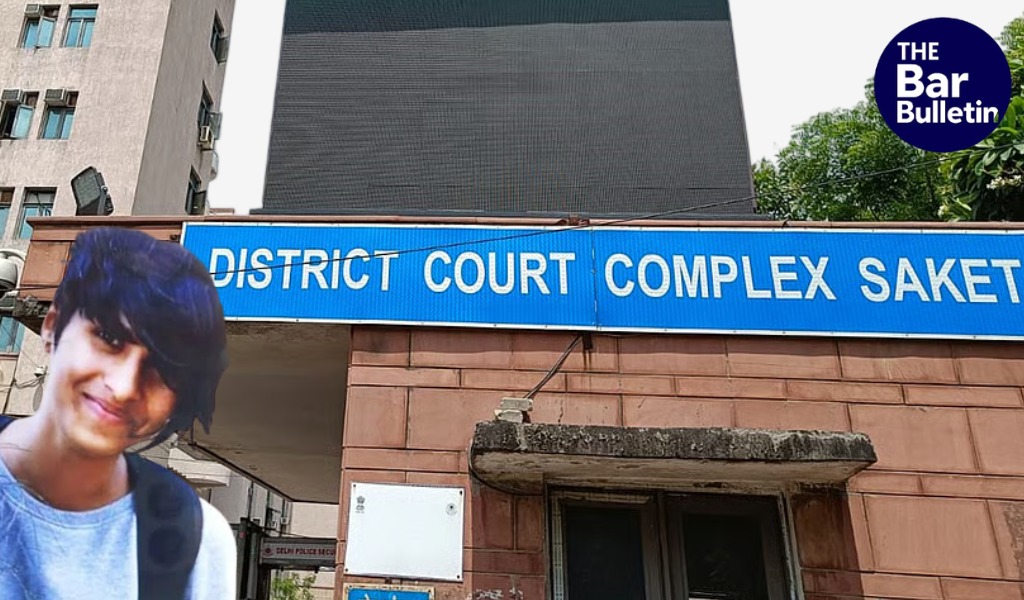

The Saket Court has rejected a request by the complainant’s counsel seeking that Aaftab Amin Poonawala, accused of murdering Shraddha Walkar, should not be permitted to sit adjacent to the defence counsel’s desk during trial proceedings, holding that even a person accused of a heinous offence is entitled to dignity, a fair trial and effective access to legal representation.
The objection was raised by the complainant’s counsel, Seema Khushwaha, during the recording of prosecution evidence. The Court noted that a similar protest had earlier been made and rejected, observing that Aaftab had consistently been permitted to sit behind or in close proximity to his counsel for ease of communication during the trial.
Rejecting the request, Additional Sessions Judge Hargurvarinder Singh Jaggi observed that requiring the accused to sit in a distant corner of the courtroom would unnecessarily impede communication between him and his lawyer, forcing defence counsel to repeatedly move across the courtroom during the examination of witnesses. The Court held that, for the smooth conduct of proceedings, Aaftab would continue to sit adjacent to and immediately behind his counsel.
The Court also relied on Rule 14 of the Delhi High Court Rules and Orders, which specifically provides that an accused in a criminal trial shall be permitted to sit during the proceedings unless required to stand for a specific purpose such as identification. In a significant observation, the Court underscored that the gravity of the allegations cannot dilute the legal rights of an accused.
“
“Be it an accused, no matter for how grievous and heinous offence, he also has rights and the Apex Court has repeatedly held that neither accused can be denied a proper seating in the courtroom, nor a treatment which may reek of disgust, vengeance.”
Emphasising the foundational principles of criminal jurisprudence, the Court observed that the presumption of innocence and the right to a fair trial remain the hallmarks of the Indian criminal justice system. It noted that the constitutional guarantee under Article 22(1) and the provisions of the Code of Criminal Procedure, 1973 and the Bharatiya Nagarik Suraksha Sanhita, 2023 protect an accused’s right to be defended by a legal practitioner of choice, which may require the accused to sit close enough to communicate with counsel during the proceedings.
Holding the complainant’s request to be“unwarranted and unreasonable,” the Court dismissed the objection.
Separately, the Court took on record an application filed by the prosecution seeking permission to record, through video conferencing, the evidence of officials from WhatsApp LLC and Meta Platforms Inc., Google LLC, Gmail, and Bumble under the Delhi High Court’s Electronic Evidence and Video Conferencing Rules, 2025. Time was granted to the accused to file a reply, and the application has been listed for arguments on July 24, 2026.
