
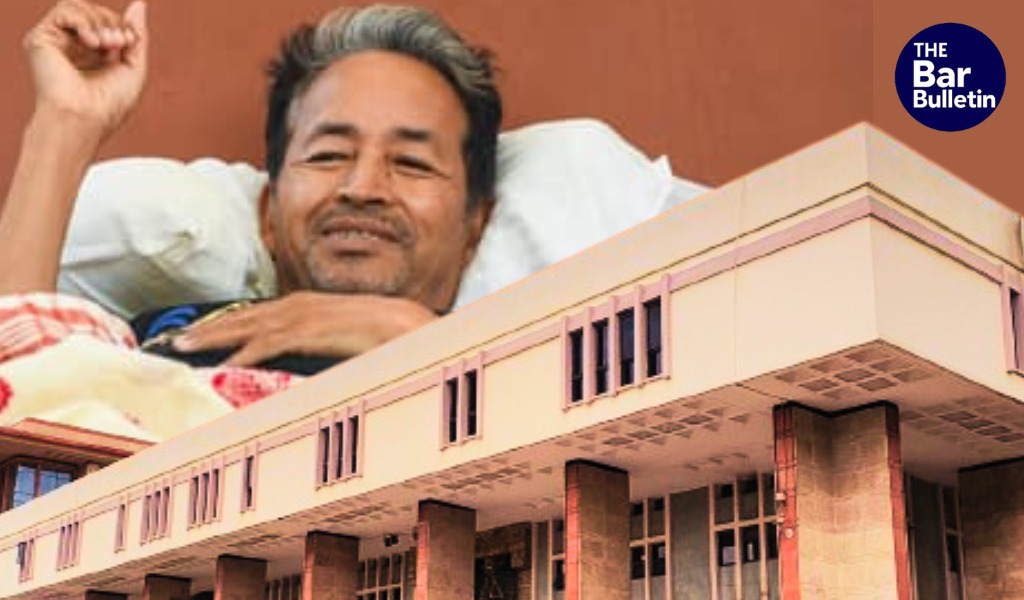
The Delhi High Court on Monday directed the personal appearance of the Director (In-charge), All India Institute of Medical Sciences (AIIMS), and Dr. Akshay, the emergency medicine specialist associated with the treating team, while hearing Gitanjali Agmo’s appeal seeking transfer from Safdarjung Hospital to a hospital of his choice. The Court also directed the authorities to place on record all pathological reports generated by Safdarjung Hospital, AIIMS and a private laboratory, along with all medical health bulletins issued regarding Wangchuk’s condition.
A Division Bench of Chief Justice Devendra Kumar Upadhyaya and Justice Tejas Karia heard the appeal challenging the Single Judge’s refusal to grant interim relief after Wangchuk alleged that he had been forcibly shifted from his protest site to Safdarjung Hospital and was being prevented from choosing his preferred hospital for treatment.
Senior Advocate Akhil Sibal appeared for the appellant. Solicitor General Tushar Mehta and Additional Solicitor General Chetan Sharma represented the respondents.
Senior Advocate Akhil Sibal argued that the earlier order of the High Court only required the authorities to monitor Wangchuk’s health and provide necessary medical intervention, and did not authorise officials to forcibly remove him from the protest site. Contending that Wangchuk is neither under arrest nor detention, Sibal submitted that he has a constitutional right to bodily autonomy, including the freedom to choose his doctors and hospital. Placing reliance on the Supreme Court’s Constitution Bench decision in Common Cause, he argued that a competent adult is entitled to refuse medical treatment or seek treatment from a medical facility of his choice.
Opposing the plea, Solicitor General Tushar Mehta submitted that the State’s intervention was prompted solely by concern for Wangchuk’s deteriorating health and the need to preserve life. He argued that while bodily autonomy is a recognised constitutional right, it is not absolute, particularly where a prolonged public protest may have implications for public order. The Solicitor General further informed the Court that an AIIMS expert had been associated with the treating team, that blood samples had been tested independently by Safdarjung Hospital, AIIMS and a private laboratory, and that the reports were substantially consistent.
Taking note of the rival submissions, the Division Bench directed that all pathological reports based on blood samples analysed by Safdarjung Hospital, AIIMS and the private laboratory be placed on affidavit. The appellant was also directed to file the laboratory reports relied upon by him. Significantly, the Court requested the personal presence of the Director (In-charge), AIIMS, and Dr. Akshay, the emergency medicine specialist associated with the treating team, to assist the Court at the next hearing. It also permitted the doctor consulted by the appellant to remain present and directed the respondents to produce all medical health bulletins issued regarding Wangchuk’s medical condition.
The Court held
“Having regard to the circumstances and facts of the case, as also the submissions made on behalf of the respective parties, we direct that all the pathological reports of the husband of the appellant based on the samples analysed at the laboratory of Safdarjung Hospital, All India Institute of Medical Sciences and the private laboratory shall be filed on affidavit… We request the Director (In-charge), AIIMS, along with Dr. Akshay, in-charge of Emergency Medicine, to be present tomorrow for our assistance. The respondents shall also bring on record all the medical public health bulletins issued from time to time in respect of the health condition of the husband of the appellant.”
The matter has been listed for further hearing on July 21 at 12.30pm.