
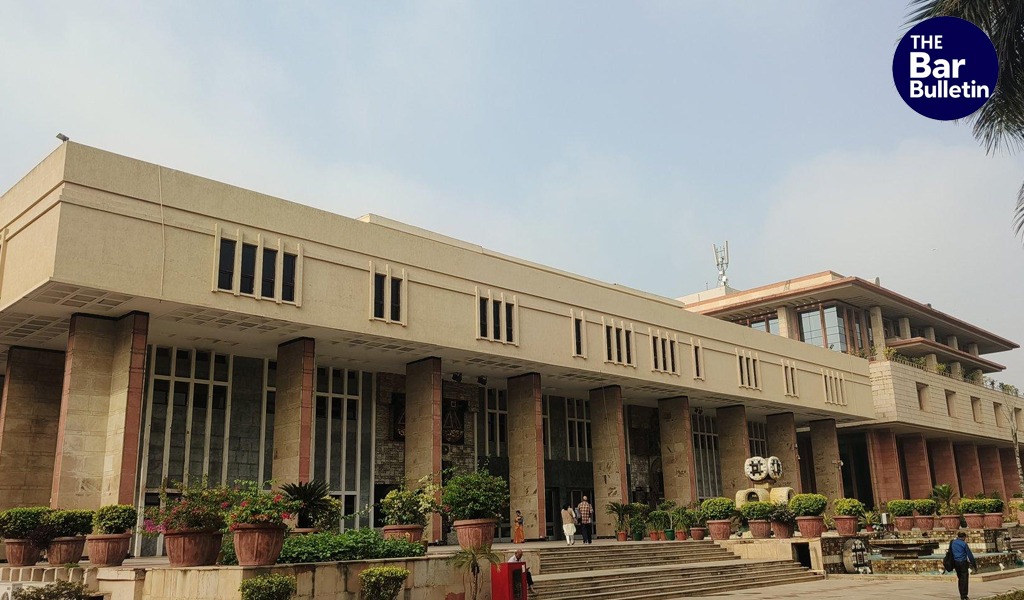

The Delhi High Court has held that contractors cannot be blacklisted for an indefinite period, quashing the Delhi Jal Board’s decision debarring Kaveri Infrastructure Pvt. Ltd. from participating in its tenders for nearly 18 years. The Court observed that even a conviction in a criminal case cannot justify continuous or permanent blacklisting and directed that the company be allowed to participate in future tenders, subject to fulfilling the prescribed eligibility criteria.
Justice Amit Bansal was hearing a petition challenging a speaking order dated July 22, 2022, by which the Delhi Jal Board continued the petitioner’s debarment from participating in its tendering process until the conclusion of criminal proceedings arising out of a CBI case relating to the award of a ₹35.84 crore contract in 2004.
The petitioner contended that the impugned order was arbitrary as it prescribed no definite period of debarment and merely reiterated an earlier blacklisting order passed in 2008. It argued that indefinite blacklisting was contrary to the Delhi Jal Board’s own enlistment rules, the CPWD Enlistment Rules, and the settled law laid down by the Supreme Court in Kulja Industries Ltd. v. Chief General Manager, BSNL, (2014) 14 SCC 731.
The Delhi Jal Board opposed the petition, submitting that the issue had already been decided in earlier proceedings and that the petitioner and its Managing Director had been convicted by the CBI Court in 2013 for offences under the Indian Penal Code and the Prevention of Corruption Act. It argued that the State was entitled to determine with whom it would conduct business and that the Court ought not to interfere with such policy decisions.
Rejecting the respondent’s stand, the High Court found that the impugned order was a mechanical reproduction of the 2008 blacklisting order and failed even to take note of the petitioner’s subsequent conviction or the pendency of appeals. The Court observed that the order did not specify any period of debarment and instead linked the petitioner’s exclusion to open-ended contingencies such as the conclusion of criminal proceedings and appeals, rendering the debarment indefinite.
Also Read Allahabad HC Refuses to Stall ATS Probe Into Madrassas; Says Inquiry Is Not a Coercive Action
The Court noted that the Delhi Jal Board’s own Enlistment Rules, 2023 prescribe a maximum debarment period of two years, while the CPWD Rules similarly cap the period of blacklisting. It held that the impugned order was ex facie inconsistent with these rules and with the law governing blacklisting.
Relying on the Supreme Court’s decision in Kulja Industries and the Delhi High Court’s earlier rulings in Coastal Marine Construction. v. v. Indian Oil Corporation Limited, 2019 SCC OnLine Del 6542 and Sabharwal Medicos v. Union of India, 2013 SCC OnLine Del 3839, Justice Bansal reiterated that debarment is never intended to be permanent and that the duration of blacklisting must be proportionate to the nature and gravity of the misconduct. Even in cases involving allegations of fraud, corruption or forgery, the Court observed, the law does not permit blacklisting for an indefinite period.
The Court further rejected the respondent’s plea that the petition was barred by limitation, holding that continued blacklisting constituted a recurring cause of action. It also observed that the legal position had significantly evolved after the earlier proceedings, particularly following the Supreme Court’s ruling in Kulja Industries Ltd. , which categorically held that permanent blacklisting is impermissible.
While observing that the matter could ordinarily have been remanded to the Delhi Jal Board to determine an appropriate period of debarment, the Court declined to do so since the petitioner had already remained blacklisted for nearly 18 years. Holding that such prolonged exclusion could not continue, the Court quashed the impugned order and directed that Kaveri Infrastructure be permitted to participate in future tenders floated by the Delhi Jal Board, subject to satisfying the applicable eligibility conditions.
