
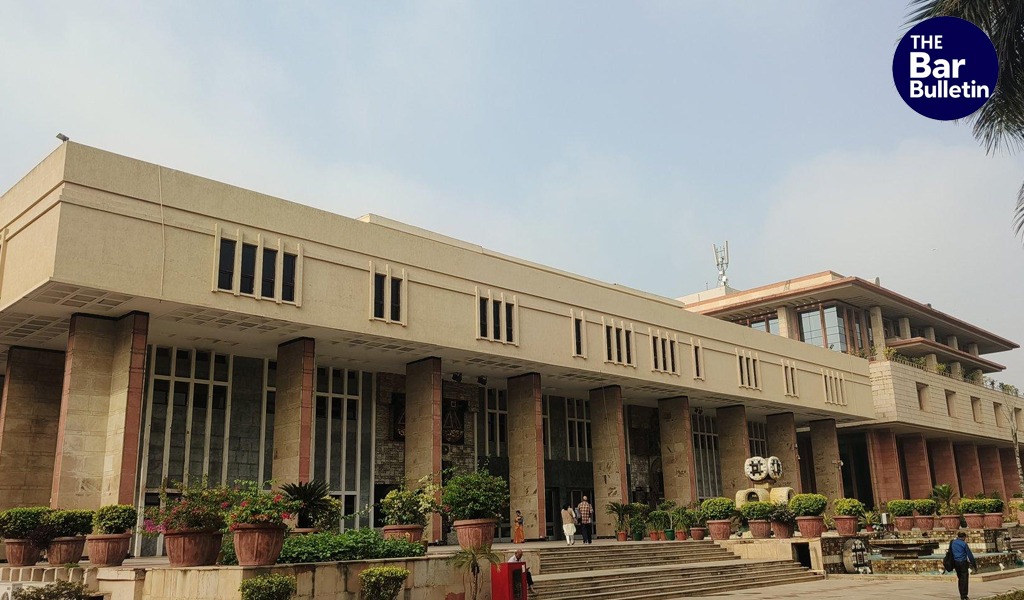
The Delhi High Court has refused to grant interim relief to the Delhi High Court Bar Association (DHCBA), the Asian Patent Attorneys Association (APAA), and the International Trademark Association (INTA), declining their plea to restrain a committee constituted by the Full Court from placing its report on enhancement of the pecuniary jurisdiction of Delhi’s District Courts before the Full Court.
A Division Bench of Justice Anil Kshetarpal and Justice Tejas Karia held that the petitioners had failed to establish a prima facie case, observing that the committee was merely undertaking a consultative exercise and that any eventual amendment to the pecuniary jurisdiction could only be made by Parliament through an amendment to the Delhi High Court Act, 1966.
Also Read ‘Ghostbusters’ Trademark | Delhi HC Orders Fresh Hearing on Columbia Pictures’ Opposition
The dispute arose from a representation submitted by the Coordination Committee of All District Courts Bar Associations of Delhi to the Union Law Minister seeking enhancement of the pecuniary jurisdiction of District Courts. A copy of the representation was also forwarded to the Chief Justice of the Delhi High Court. Acting on the representation, the Full Court resolved to constitute a seven-judge committee to examine the issue after consulting stakeholders and to submit its recommendations.
The petitioners sought an interim stay on the presentation of the committee’s report before the Full Court and also sought a direction that the report be supplied to them beforehand.
Rejecting the contentions, the Bench held that although Parliament alone possesses legislative competence to amend the Delhi High Court Act, there is nothing preventing the High Court, on its administrative side, from examining issues affecting the administration of justice and forwarding its views or recommendations to the competent authority.
The Court observed that institutional dialogue between constitutional authorities is a recognised feature of constitutional democracy, and that recommendations made by the High Court have no legislative force by themselves. Even if the Full Court ultimately forwards its recommendations, such recommendations neither amend the statute nor alter the jurisdiction of any court.
The Bench also noted that the DHCBA and other stakeholders had been invited to participate in the consultative process through communications issued by the committee, and their views and written submissions had been considered. Therefore, the plea that principles of natural justice had been violated was found to be without merit.
Also Read Bengaluru Court Grants Conditional Bail to Actor Prakash Raj in Multiple Voter ID Case
The Court further observed that Delhi’s existing pecuniary jurisdiction of ₹2 crore, fixed under the 2015 amendment to the Delhi High Court Act, was introduced over a decade ago. It remarked that rising property values and increased commercial activity in the National Capital Territory have resulted in even comparatively modest property disputes crossing the ₹2 crore threshold, requiring litigants from across Delhi to approach the High Court rather than nearby District Courts. At the same time, Delhi now has eleven judicial districts with adequate judicial infrastructure, making reconsideration of the existing pecuniary limits a legitimate subject for examination.
Holding that the petitioners had failed to demonstrate a prima facie case, balance of convenience, or irreparable injury, the Division Bench refused to stay the submission of the committee’s report or direct its disclosure before consideration by the Full Court. The interim applications were accordingly dismissed, while the writ petitions have been listed for further hearing on July 24, 2026.
