
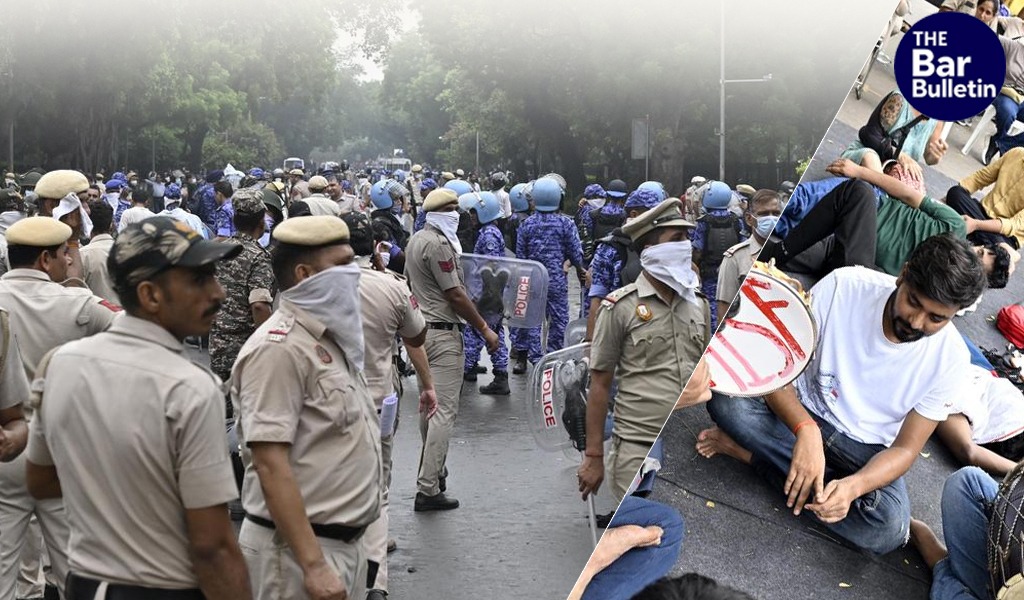
The Delhi High Court on Friday heard a petition challenging the alleged surveillance of protesters at Jantar Mantar, with the petitioner contending that continuous videography and the reported use of facial recognition technology violate the fundamental right to privacy and have a chilling effect on the exercise of democratic dissent.
The petitioner raised a preliminary objection against tagging the matter with other petitions concerning alleged police action during protests. It was argued that while those petitions dealt with allegations of police excesses, the present case raises a distinct constitutional challenge concerning surveillance of protesters and the absence of any legal framework governing it.
Relying on the Supreme Court’s decision in K.S. Puttaswamy v. Union of India, (2017) 10 SCC 1, counsel submitted that the right to privacy extends even to persons participating in peaceful demonstrations in public places and that any State surveillance must satisfy the constitutional tests of legality, legitimate State purpose and proportionality. Arguing that the issue concerns the constitutional limits on State surveillance, counsel submitted:
“
“The law is very clear. In a democratic process, in a democratic polity, there is a right to privacy in a public place, even at a demonstration, even while I’m walking on the pavement. My right to privacy can be restrained, but there is a triple test. There has to be a law. Secondly, that law has to be based on a State need. And thirdly, it has to be proportionate… For any kind of surveillance, there has to be a law in place, it has to be proportionate, and this Court has been charged with a duty to scrutinise the State purpose very minutely.”
The petitioner further contended that reports suggesting deployment of facial recognition technology at protest sites raised serious constitutional concerns, particularly in the absence of statutory safeguards governing collection, storage, retention and destruction of personal data. It was argued that facial recognition technology is susceptible to errors and may expose innocent individuals to criminal investigation.
Referring to photographs placed on record, counsel alleged that police personnel, including officers in plain clothes, were recording protesters and their conversations without disclosing the purpose for which the recordings were being made or the manner in which the data would be handled.
Urging the Court to direct the authorities to disclose the legal framework governing such surveillance, counsel argued:
“
“Today maybe these students are in protest. Tomorrow it may be somebody else. This privacy violation of protesters is criminalising a very fundamental democratic right. Our democratic right is not just to go and vote, but from time to time we have a right to peacefully ventilate our grievances without being treated as criminals… Make a procedure, make a protocol. Say what the data will be used for, how it will be kept and how it will be destroyed. Have a structure of law. Protect us from misuse.”
Opposing the petition, Solicitor General Tushar Mehta submitted that videography at designated protest sites is carried out as a law-and-order measure pursuant to a standing order issued in compliance with Supreme Court directions. He argued that the right to privacy is not absolute and cannot be invoked to prohibit videography in public spaces where large gatherings take place. The Solicitor General submitted:
“
“Videography is an accepted mode for the purpose of enforcement of law and order… The organisers have given an undertaking to abide by these conditions. Whatever protest happens there will be videographed throughout the year for the purpose of ensuring law and order. When you are doing something in an open public place, this claim of privacy is ironical. Privacy is a fundamental right, but where there is a legitimate State interest, proportionate action can certainly be taken.”
Referring to the principles laid down in Puttaswamy, the Solicitor General argued that restrictions on the right to privacy are constitutionally permissible where they are backed by a legitimate State interest and are proportionate to the objective sought to be achieved. He further submitted that protesters themselves routinely record demonstrations and disseminate the footage on social media, making the claim of privacy in such circumstances untenable.
In rejoinder, the petitioner distinguished State surveillance from recording by private citizens or journalists, contending that governmental collection and retention of personal data stands on an entirely different constitutional footing because of the coercive powers available to the State. Responding to the Solicitor General’s argument, counsel submitted:
“
“There is a difference between a journalist and a private individual… But when the State is doing videography, the State stands on a different footing from an individual. This is a false equivalence… There is no data protection in this SOP. Once they have determined the number of people, what do they do with all this footage? Where do they secure it?”
Towards the end of the hearing, the Bench of Chief Justice Devendra Kumar Upadhyaya and Justice Tejas Karia indicated that it would first consider the issues raised before passing any further directions, observing: “We need to make up our mind first.”
The matter is listed for Monday.