
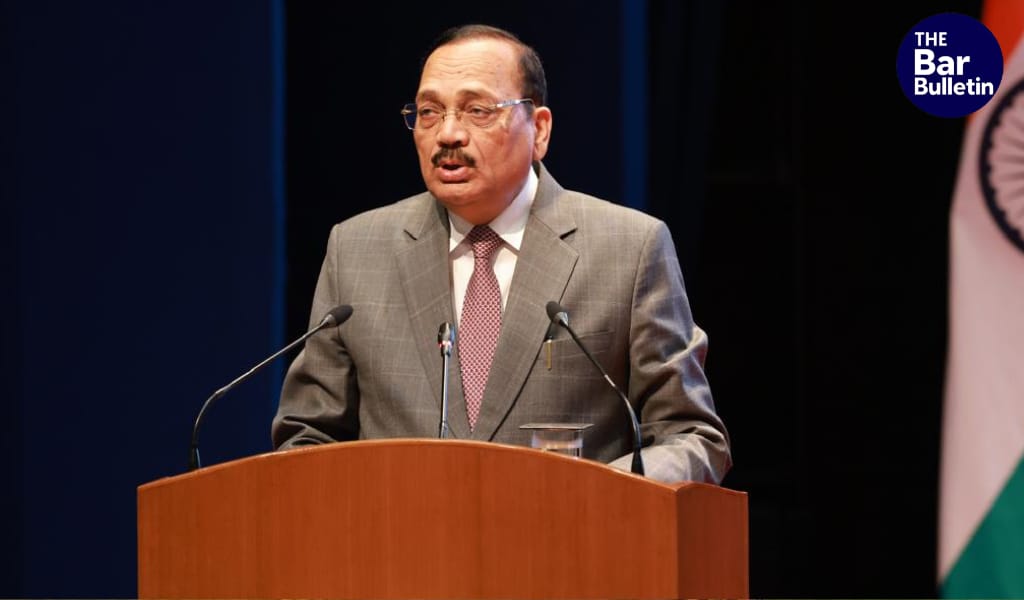

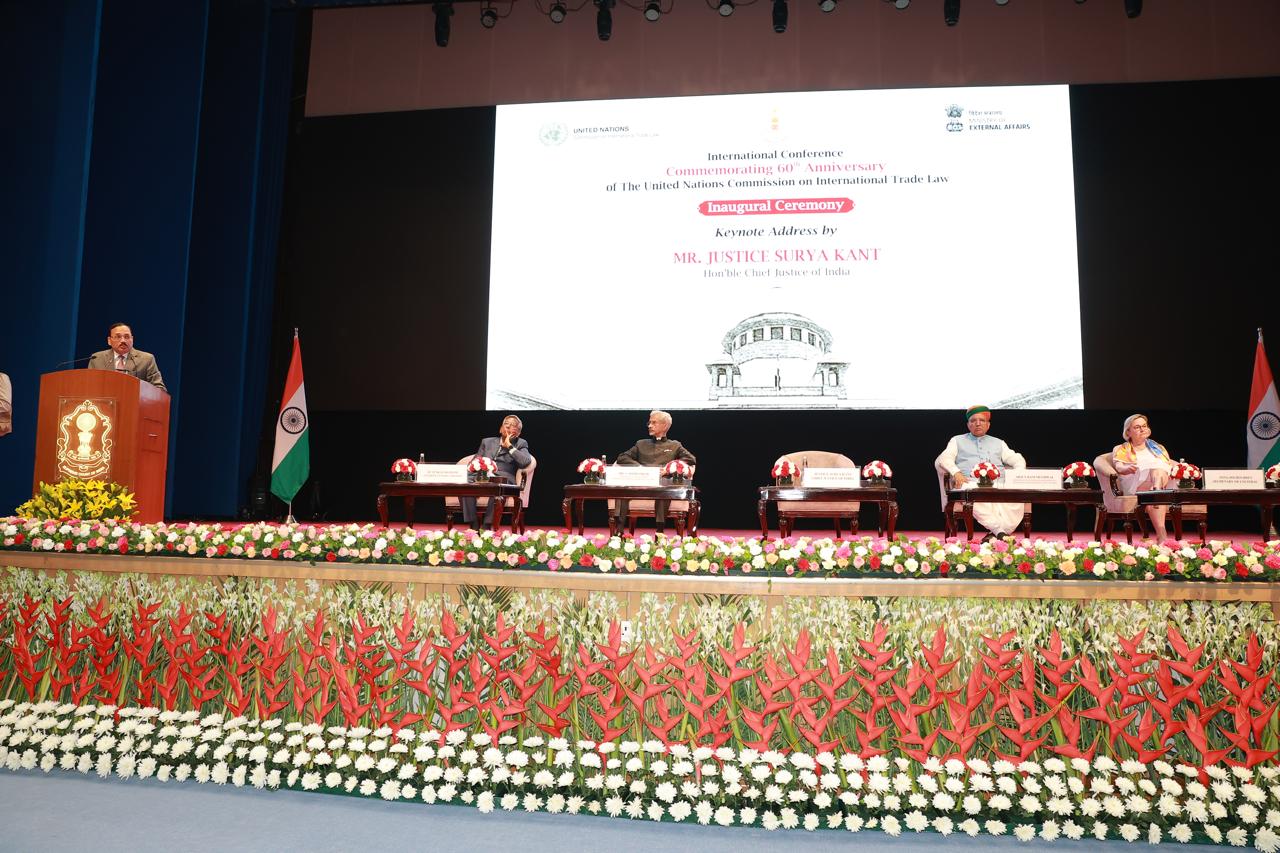
Chief Justice of India Surya Kant highlighted the importance of a rules-based international trading system, stating that global commerce can flourish only where trust, legal certainty and the rule of law prevail. Delivering the keynote address at the international conference commemorating the 60th anniversary of the United Nations Commission on International Trade Law (UNCITRAL), the CJI highlighted India’s growing stature as a credible destination for international commercial dispute resolution.
Tracing the history of commerce from the ancient dockyard of Lothal in the Indus Valley Civilisation, the CJI observed that trade has always been sustained by confidence that promises will be honoured and agreements faithfully enforced. He said UNCITRAL has, over six decades, built legal bridges between diverse jurisdictions, enabling businesses to focus on enterprise rather than legal uncertainty.
Also Read CJI Surya Kant to Inaugurate Commonwealth Peace Mediation Conference 2026 in Jaipur
Highlighting India’s recent judicial reforms, the CJI referred to the National Judicial Data Grid (NJDG), live-streaming and real-time transcription of Constitution Bench proceedings, the draft AI Regulations, the Mediation Act, 2023, and the Special Lok Adalat initiative, describing them as significant steps towards enhancing transparency and promoting consensual dispute resolution.
Speaking on alternative dispute resolution, the CJI said arbitration and mediation have become indispensable pillars of the modern international trading system, offering parties neutral, flexible and internationally enforceable mechanisms for resolving cross-border commercial disputes. While arbitration provides finality and enforceability, mediation enables parties to preserve long-term commercial relationships, he noted.
The CJI also stressed that courts are not competitors to arbitration or mediation but their institutional foundation. By respecting party autonomy, enforcing arbitral awards and mediated settlements, and intervening only where judicial oversight is necessary, courts inspire confidence in the entire dispute resolution ecosystem, he said.
Also Read Maadhyam to Host International ADR Conference 2026 in New Delhi from August 7–9
Referring to India’s arbitration landscape, the CJI observed that the country’s legal framework has matured through legislative reforms and judicial interpretation, adding that India is increasingly being viewed as a fair jurisdiction where international commercial disputes can be resolved efficiently, fairly and with global credibility.
Concluding his address, the CJI called upon the international legal community to deepen cooperation in the face of challenges posed by technology, geopolitical instability and sustainable commerce, expressing hope that the conference would generate practical ideas to strengthen international trade law. He emphasised that a rules-based international trading system is worth preserving and enriching.