
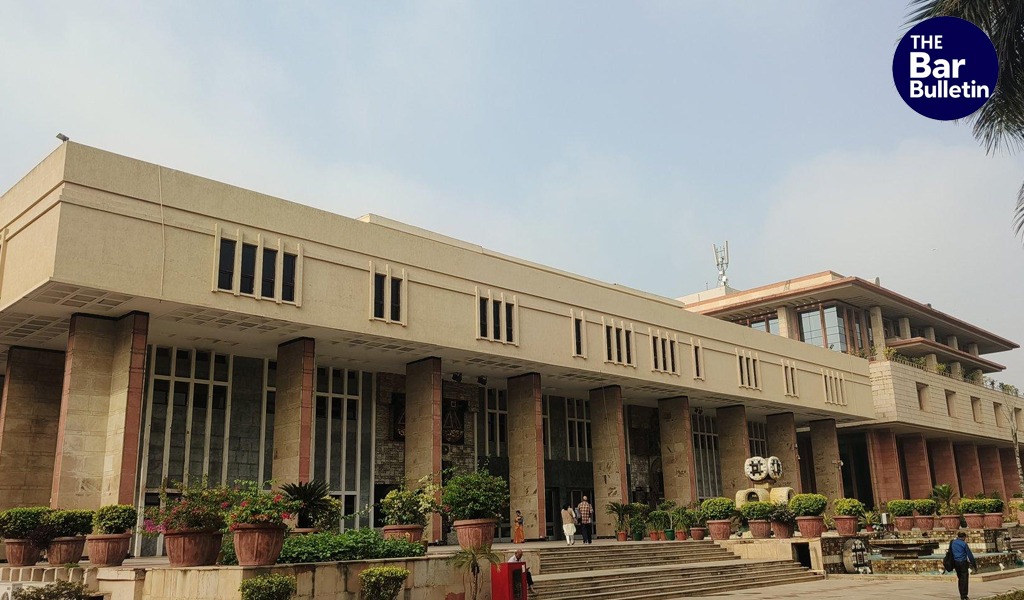

In a significant ruling on the interplay between Section 43D of the UAPA and Section 187 of the Bharatiya Nyaya Sanhita, 2023 (BNSS), the Delhi High Court has clarified that the reference to Section 167 CrPC in Section 43D(2) UAPA must be read as a reference to Section 187 BNSS by virtue of Section 8(1) of the General Clauses Act, 1897, thereby continuing the 180-day outer limit for detention in UAPA cases. Accordingly, the Court dismissed the appeal, holding that the Appellant was not entitled to default bail and that the ship to claim such relief had sailed, as the charge-sheet had already been filed on 14th May 2026.
The Court held that the reference to Section 167 of the CrPC in Section 43D(2) of the UAPA is ‘legislation by reference’ and not ‘legislation by incorporation’, and therefore, by virtue of Section 8(1) of the General Clauses Act, 1897, it must be construed as a reference to Section 187 of the BNSS. The first proviso to Section 43D(2) UAPA extending the period of detention up to 180 days continues to apply, and the Appellant was not entitled to default bail after 90 days. The Court further held that the Appellant lost his right to challenge the first extension order by acquiescence, as he did not challenge it promptly but only after the second extension was granted and the default bail application was dismissed.
The Division Bench comprising Justice Prathiba M. Singh and Justice Vikas Mahajan noted that the central legal issue raised in the appeal was whether, after the enactment of the BNSS, the first proviso to Section 43D(2) of the UAPA extending the period of investigation to 180 days would continue to apply, and consequently, whether an accused in a UAPA case would be entitled to default bail after 90 days or after 180 days.
The Court observed that Section 167 of the CrPC permits extension of custody of an accused for a maximum period of 90 days in cases of offences punishable with death, imprisonment for life, or imprisonment for a term of not less than 10 years, and 60 days for other offences. When this provision was adapted to the UAPA, Section 43D(2) modified the periods of 15 days, 60 days, and 90 days to 30 days, 90 days, and 90 days respectively, and added a first proviso extending the maximum period of 90 days to 180 days upon satisfaction of the Court based on the Public Prosecutor’s report.
The Court further observed that the BNSS came into force on 1st July 2024, and the Ministry of Law and Justice issued a notification dated 16th July 2024 under Section 8 of the General Clauses Act, 1897, providing that references to the CrPC in any enactment would be construed as references to the BNSS. The Court noted that the fundamental distinction between Section 167 of the CrPC and Section 187 of the BNSS lies in the manner in which police custody of 15 days can be sought — under the BNSS, it can be in whole or in parts during the initial 40 or 60 days of the detention period.
The Court observed that Section 167 of the CrPC has not been bodily lifted into Section 43D(2) of the UAPA; rather, Section 43D(2) merely modifies the time periods mentioned in Section 167 of the CrPC for the purpose of UAPA. The Court held that this constitutes ‘legislation by reference’ and not ‘legislation by incorporation’, and therefore, by virtue of Section 8(1) of the General Clauses Act, 1897, the reference to Section 167 of the CrPC in Section 43D(2) of the UAPA must be construed as a reference to Section 187 of the BNSS.
The Court further observed that the intention of the Legislature in increasing the detention period to 180 days in UAPA cases was to provide a longer period of detention for heinous offences such as terrorism, and this intention cannot be defeated by the mere enactment of the BNSS. The Court also noted that Section 4 of both the CrPC and the BNSS makes it clear that offences under other laws shall be inquired into, investigated, tried, and otherwise dealt with according to the special laws.
Also read Supreme Court Quashes Politically Influenced Backdoor Appointments of Four Haryana Engineers
Briefly, on 10th November 2025, a vehicle-borne Improvised Explosive Device explosion took place at Gate No. 4, Lal Qila Metro Station, Netaji Subhash Chandra Marg, Delhi, carried out by Accused No. 1, Dr. Umer Un Nabi, who is since deceased. Initially, FIR was registered at PS Kotwali, which was later re-registered at PS National Investigation Agency, New Delhi dated 11th November 2025 for offences under Sections 103(1)/109(1)/61(2) of the Bharatiya Nyaya Sanhita, 2023, Sections 16/18 of the UAPA, and Sections 3/4 of the Explosive Substance Act, 1908.
The Appellant, Jasir Bilal Wani @ Danish, was arrested on 17th November 2025 from the NIA Camp Office, Srinagar, and was granted police custody for a total of 24 days. Subsequently, he was sent to judicial custody via orders dated 10th December 2025, 24th December 2025, and 8th January 2026. During the judicial custody period, the NIA moved an application under Section 43D(2) of the UAPA read with Section 187 of the BNSS seeking further police custody, which was allowed on 13th January 2026 till 16th January 2026, after which the Appellant was again sent to judicial custody for 28 days.
On 10th February 2026, the NIA filed an application seeking extension of the investigation and custody remand period beyond the statutory 90 days, up to 180 days, in terms of Section 43D(2)(b) of the UAPA read with Section 187 of the BNSS. By order dated 13th February 2026, the Trial Court extended the remand of the Appellant for a further 45 days, i.e., up to 135 days from the date of arrest. On 15th February 2026, the Appellant moved an application seeking default bail under Section 187(3) of the BNSS. The NIA thereafter moved a second application seeking a further extension of 45 days (totalling 180 days), which was allowed by the Trial Court vide order dated 27th March 2026. The default bail application was dismissed by the Trial Court on the ground that the Appellant had not challenged the first extension order dated 13th February 2026, and the present application amounted to a review of that order.
