
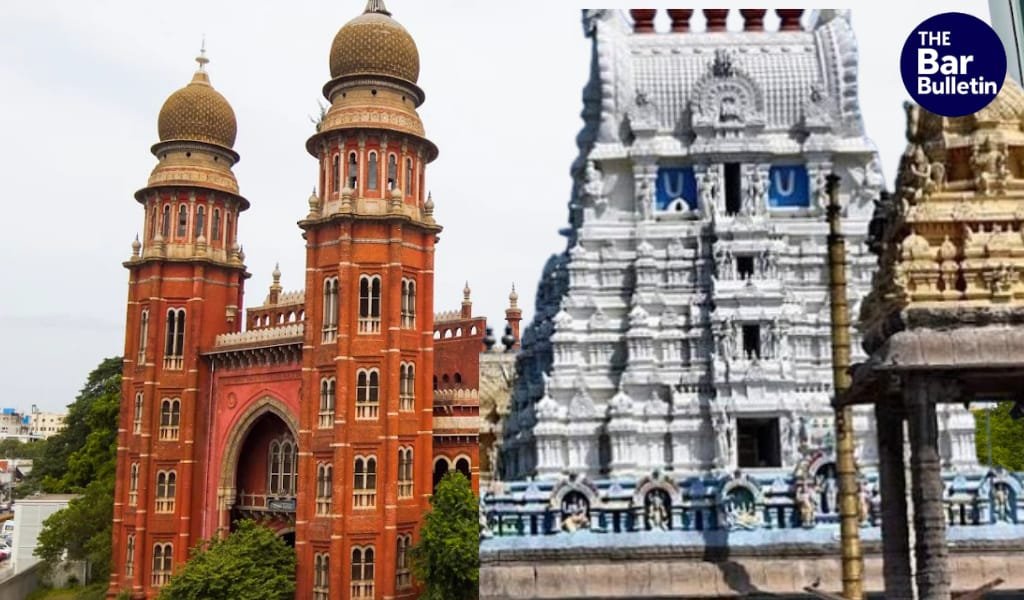

In a Public Interest Litigation alleging caste-based segregation against Non-Brahmin Thenkalai devotees at the Sri Manavala Mamunigal Shrine, the Madras High Court has recorded the temple administration’s categorical undertaking that there shall be no discrimination in the distribution of Theertham, Satari and Prasadham, and that no devotee shall be prevented from reciting Prabandhams in the shrines for the purpose of worship, subject to the statutorily protected Adhyabaga Misari right of the Thenkalai Sect.
The Court invoked the teaching from Chapter 9, Verse 29 of the Bhagavad Gita to emphasise that in the eyes of God, all living beings are equal and that there is no room for discrimination in a place of public worship. On the question of recitation of Prabandhams, the Court accepted that the Adhyabaga Misari right is a statutorily protected service mirasi right of the Thenkalai Sect and does not amount to discrimination, since the petitioner and other devotees would not be prevented from reciting Prabandhams in the shrines for their own worship.
The Division Bench comprising Dr Justice G. Jayachandran and Justice E. Manoharan began its analysis by invoking the timeless teaching from Chapter 9, Verse 29 of the Bhagavad Gita, where Lord Krishna declares that He is equally disposed to all living beings, neither partial to anyone nor hating anyone, and that those who worship Him with devotion abide in Him and He in them. The Court observed that in the eyes of God, all living beings are equal and that God does not discriminate. Building on this foundational principle, the Court noted that the Hon’ble Courts have consistently held that there is no room for discrimination in a place of public worship.
The Court took on record the statement made by the Special Government Pleader appearing for the fourth respondent i.e., the Executive Trustee of the Arulmigu Devaraja Swamy Devasthanam, that the temple administration will not discriminate against any section of the public in the matter of distribution of Theertham, Satari and Prasadham. The Court treated this statement as an undertaking given on behalf of the temple administration that it would ensure non-discrimination in such distribution, observing that this would resolve one of the principal grievances raised by the petitioner.
On the issue of recitation of hymns and Prabandhams, the Court took on record the statement contained in Paragraph 9 of the counter affidavit filed by the fourth respondent. The Court noted that apart from the Adhyabaga Misari, which is a statutorily secured right conferred upon the Thenkalai Sect and constitutes an important service offered during certain rituals, neither the petitioner nor any other person or group would be prevented from reciting Prabandhams in any shrine of the temple for the purpose of their worship. The Court further observed that the petitioner himself had stated that he worships Lord Devarajaswamy and that it was not his intention to disrupt any of the traditional rituals performed in praise of the deity.
Briefly, a Public Interest Litigation (PIL) was filed by Madhavan Ramanuja Dasan, a resident of Kancheepuram and Secretary of the Thirukatchi Nambi Thirumaladiar Seva Sangam, who is a devotee of Lord Devarajaswamy and a Thenkalai Vaishnavite. The petition was filed against the alleged discrimination faced by Non-Brahmin devotees of the Thenkalai cult at the Arulmigu Devaraja Swamigal Temple in Kanchipuram, particularly at the Sri Manavala Mamunigal Shrine. The petitioner raised grievances regarding the distribution of Prasadam and Theethams, the recitation of Tamil Prabandams, and the manner in which devotees were allowed entry into the shrine.
The petitioner alleged that the temple had two entrances to the Sannathi of Manavala Munigal, a main entrance and a side entrance, and that Non-Brahmin devotees were being restricted to using only the side entrance while Brahmins were permitted to use the main entrance. It was further alleged that Non-Brahmins were not being given permission to recite hymns in the shrines of the Devarajaswamy Temple, and that during the ten-day birthday celebrations of Manavala Munigal, Non-Brahmin devotees were made to stand outside the Sannathi where they would receive Prasadham and Theertham but no Satari would be placed on them.
The petitioner brought to the Court’s attention two earlier communications issued by the third respondent i.e., the Assistant Commissioner of the HR and CE Department, Kanchepuram dated Oct 14, 2003 and Dec 23, 2003, both of which had expressly stated that there should be no discrimination between Brahmins and Non-Brahmins in the distribution of Theertham, Satari and Prasadham.
