
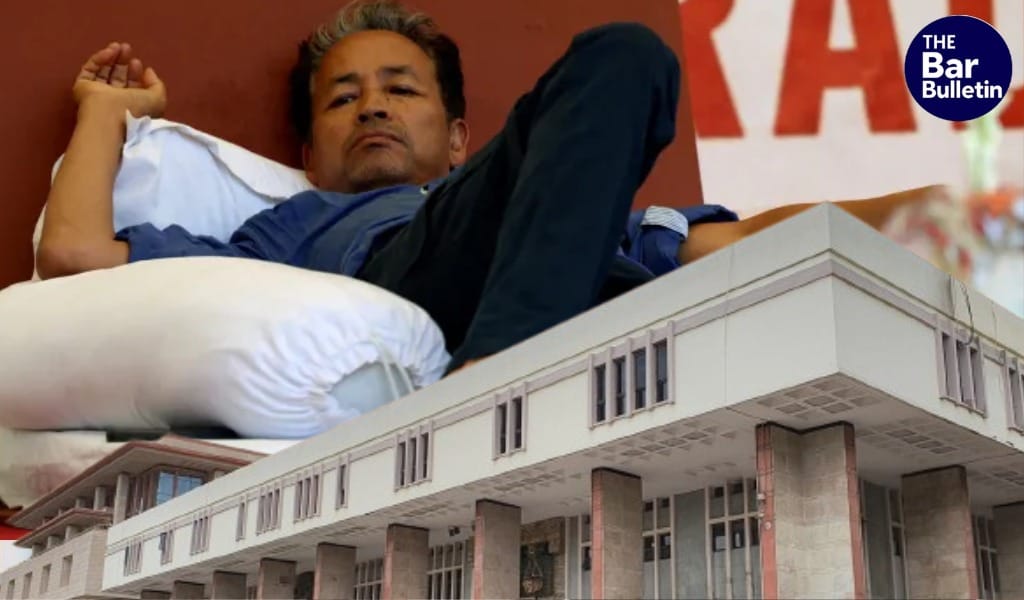

The Delhi High Court on Sunday refused to grant interim relief to Geetanjali Agmo, wife of activist Sonam Wangchuk, who sought directions to shift him from Safdarjung Hospital to Medanta Hospital, where arrangements had already been made for his treatment.
Justice Mini Pushkarna held that Sonam Wangchuk, who has been on a hunger strike for nearly 17-18 days, was under continuous medical supervision and that no material was placed before the Court to show that any force was being used upon him or that his bodily autonomy was being violated. The Court directed the respondents to file a status report within three days and listed the matter for hearing on July 24.
Read Also: Acting On Delhi HC Order, Police Shift Sonam Wangchuk To Hospital As Health Deteriorates
Senior Advocate Kapil Sibal appeared for the petitioner, while Additional Solicitor General Chetan Sharma represented the Union Government.
Petitioner Cites Trust Deficit, Seeks Right to Hospital of Choice
Opening the case, Senior Advocate Kapil Sibal submitted that Wangchuk was neither under detention nor accused of any offence and was therefore entitled to receive treatment at a hospital of his choice. He argued that the family did not wish to contest the medical opinions of government doctors but merely sought his discharge from Safdarjung Hospital so that he could be shifted to Medanta Hospital, which had already agreed to admit him. Mr Sibal also submitted that the family had no objection if doctors from AIIMS or Safdarjung Hospital continued to monitor Wangchuk’s condition even after the transfer.
“
“He is neither under detention nor is there any offence alleged to have been committed by him. We are entitled to a doctor and a hospital of our choice. We have already spoken to Medanta. They are ready to send an ambulance and we will go there for treatment. We don’t want to enter into any controversy. That is the limited prayer before this Court. If doctors from AIIMS want to be associated with his treatment, we have absolutely no objection. How can the Government say that it has taken control of his body and will not allow him to go anywhere else?”
Supporting the plea, Geetanjali Agmo alleged that the hospital informed the family that Wangchuk’s potassium had fallen to a life-threatening level of 2.9, but refused an immediate independent test. According to him, the blood sample was handed over only after nearly twelve hours, and an independent NABL-accredited laboratory subsequently reported the potassium level at 3.6, leading the family to question the hospital’s findings.
“
“At 8 in the morning they said his potassium levels were 2.9. The previous day it was 4.3. We only asked for a second opinion because 2.9 is life-threatening and it’s not a joke to put somebody on an IV when he does not need it. I asked that an outside NABL-accredited laboratory be allowed to take a sample, but that was denied. They made me wait for almost twelve hours before giving me the sample. When we finally got it tested, it came back as 3.6. He is not in detention. There is no case against him. He is a citizen of India and is entitled to treatment at a hospital of his choice.”
She further told the Court that the family’s confidence in the treatment had been shaken not only because of the disputed medical reports but also due to the environment in which Sonam Wangchuk was being kept. She alleged that policemen remained around his room and that family members were constantly watched while meeting him.
“
“When I go to meet him, they (policemen) are eavesdropping all the time. Are they treating the patient? Is the family not more concerned about his health than the doctor?”
As Geetanjali Agmo informed the Court that Medanta Hospital was ready to immediately admit Wangchuk, she asserted that he could not be compelled to remain at a government hospital against his wishes. The submission prompted an immediate response from ASG Chetan Sharma, who remarked:
“
“This is the activist speaking… The activist has taken over. This is not an activist platform. This is a court of law… If they are indeed so concerned about his health, then please cooperate. Please cooperate. Don’t be obdurate. They know their responsibility more than anybody else. It can’t be a situation where doctors are told that ‘we have no confidence in you’.
Government Defends Medical Intervention
Opposing the petition, ASG Chetan Sharma submitted that Wangchuk had been shifted to Safdarjung Hospital only because of his deteriorating medical condition and in compliance with an earlier Division Bench order directing authorities to ensure that every medical effort was made to preserve his life. He submitted that, considering Sonam Wangchuk’s prolonged fast and public profile, the Government had to exercise greater caution.
The ASG further submitted that doctors could not effectively treat a patient if their professional judgment was rejected at every stage and requested the Medical Superintendent to explain the difficulty faced by the treating team.
‘We Wanted To Do More, But He Did Not Consent’: Doctors
Responding to the Court, the Medical Superintendent of Safdarjung Hospital said the treating doctors had encountered a complete lack of trust from the patient and his family, preventing them from administering interventions they considered medically necessary.
“
“Our single role when a patient comes to us is that of a doctor treating a patient. From the word go, they did not have confidence in us and they expressed it very freely and very openly. That tied our hands. We would have liked to take more interventional action for his treatment in our considered medical opinion, but he did not consent to it. At every point he said, ‘I do not trust you.’ So the question of faith is definitely there.”
Dr. Akshay, Additional Professor in the Department of Emergency Medicine at AIIMS, informed the Court that Sonam Wangchuk remained under close observation but had consistently declined intravenous treatment despite medical advice.
“
“We have been monitoring him closely. He has started taking oral potassium and sugar-free ORS, but we have been continuously trying to persuade him to accept IV fluids because they are required right now. He has refused IV access. His potassium has remained between 3.4 and 2.8 over the last two days, his sodium and sugar levels are also on the lower side, and his recent blood gas report shows ketosis, which means he is dehydrated and requires carbohydrates with potassium correction. If he does not receive that treatment, his condition can deteriorate.”
No Interim Relief: Court
Declining to grant interim relief, the Court held that the decision to shift Wangchuk from the site of his hunger strike to Safdarjung Hospital had been taken in view of his deteriorating medical condition and in compliance with the directions issued earlier by a Division Bench of the High Court directing that every possible medical effort be made to preserve his life. The Court noted the submissions of the treating doctors that Wangchuk had been administered only oral fluids, oral potassium chloride and sugar-free ORS with his consent, while intravenous fluids had not been given because he had refused them. It further observed that his medical condition continued to be closely monitored by specialists from Safdarjung Hospital and AIIMS and found no prima facie material to conclude that force had been used against him or that his bodily autonomy had been violated. Recording these findings, Justice Mini Pushkarna observed:
“
“Considering the overall conspectus of the facts and circumstances before this Court, this Court is of the view that since the Government has taken the decision to shift Mr. Sonam Wangchuk to the hospital on account of his medical condition, this Court does not find the same to be an arbitrary action. Further, since the doctors at Safdarjung Hospital are closely monitoring the health of Mr. Sonam Wangchuk and have only administered oral fluids, oral potassium chloride and oral ORS without sugar as per his consent, it cannot be said that any force is being used against Mr. Sonam Wangchuk or that his bodily autonomy is being violated in any manner whatsoever.”
The Court also took note of the Government’s submission that Wangchuk’s wife, brother and brother-in-law had been granted 24×7 access to him and had been provided a separate room at the hospital, observing that such access was unprecedented compared to the visiting arrangements ordinarily available to other patients. It issued notice on the petition, directed the respondents to file a status report within three days, permitted the petitioner to file a rejoinder before the next date of hearing, and listed the matter for further consideration on July 24.
