
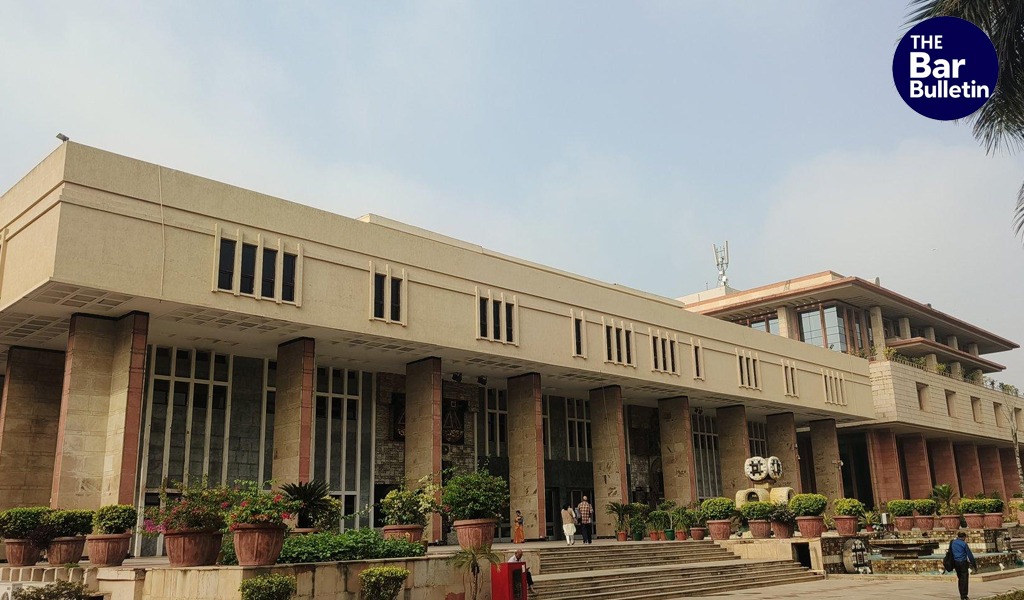

The Delhi High Court has held that an earning husband cannot be denied compensation under the head of loss of dependency merely because he was financially independent or because of the assumption that, in a patriarchal society, husbands are not dependent on their wives. Setting aside such stereotypes, the Court ruled that the contribution of an earning wife to the family’s financial corpus must be recognised while computing compensation under the Motor Vehicles Act.
Justice Anish Dayal dismissed an appeal filed by Oriental Insurance Company challenging a Motor Accident Claims Tribunal (MACT) award of ₹57.64 lakh granted to appellant for the death of his wife in a road accident on National Highway-58 in January 2022. The wife, aged 33, was a postgraduate (M.Phil.) working as a Salaried Director with Grepix Infotech Pvt. Ltd. and was earning approximately ₹65,000 per month. She died when a rashly driven truck collided with the family’s car, killing her along with their daughter, mother-in-law and niece.
The insurer argued that since the husband was himself an earning member, he could not be treated as financially dependent on his deceased wife and was therefore ineligible for compensation under the head of loss of dependency. Relying on earlier Delhi High Court judgments, the insurer contended that the husband was entitled only to compensation for “loss of estate” and not “loss of dependency.”
Rejecting the contention, the Court observed that compensation in motor accident claims cannot be determined on assumptions regarding the financial roles of husbands and wives. It emphasised that whether the deceased is a husband or a wife, the income earned by that person forms part of the family corpus and contributes to the household. Denying compensation merely because another spouse also earns would amount to an arbitrary and subjective assessment inconsistent with the settled principles laid down by the Supreme Court in Sarla Verma (Smt.) & Others v. Delhi Transport Corporation & Another, (2009) 6 SCC 121 and National Insurance Company Limited v. Pranay Sethi & Others, (2017) 16 SCC 680.
The Court made it clear that motor accident compensation cannot be viewed through the prism of a patriarchal social structure. It observed that courts should not attempt to scrutinise private financial arrangements within families to determine whether one spouse was “dependent” on the other. Instead, if the deceased was an earning member, that income should ordinarily be treated as a contribution to the family, irrespective of the surviving spouse’s independent earnings.
Justice Dayal also noted that societal realities have evolved and courts must recognise changing family structures. Referring extensively to the Supreme Court’s decisions in Arun Kumar Agrawal v. National Insurance Co. Ltd. and Malakappa v. IFFCO Tokio General Insurance Co. Ltd., the Court reiterated that even the unpaid domestic services rendered by a spouse carry substantial pecuniary value. It observed:
“
“It is perhaps time that the Courts take note of evolving societal structures and changing realities, which are no longer anchored in the traditional past.”
The Court further found that the claimant had specifically pleaded and proved that his wife’s income substantially contributed towards repayment of the family’s home loan, office rent and other liabilities. Significantly, the insurance company neither challenged these assertions in its written statement nor led any evidence to disprove the husband’s dependency. The Court held that raising the issue for the first time in appeal could not be sustained.
Clarifying the law on motor accident compensation, the Court distinguished between loss of dependency and loss of estate. It held that spouses, parents and children ordinarily fall within the category of dependants and are entitled to compensation under the head of loss of dependency in accordance with the principles laid down in Sarla Verma and Pranay Sethi. The concept of “loss of estate”, the Court said, is primarily applicable in exceptional cases involving claimants beyond the realm of dependency, such as siblings or other relatives.
Finding no infirmity in the Tribunal’s computation, the Delhi High Court upheld the compensation awarded to the husband and dismissed the insurer’s appeal.
