
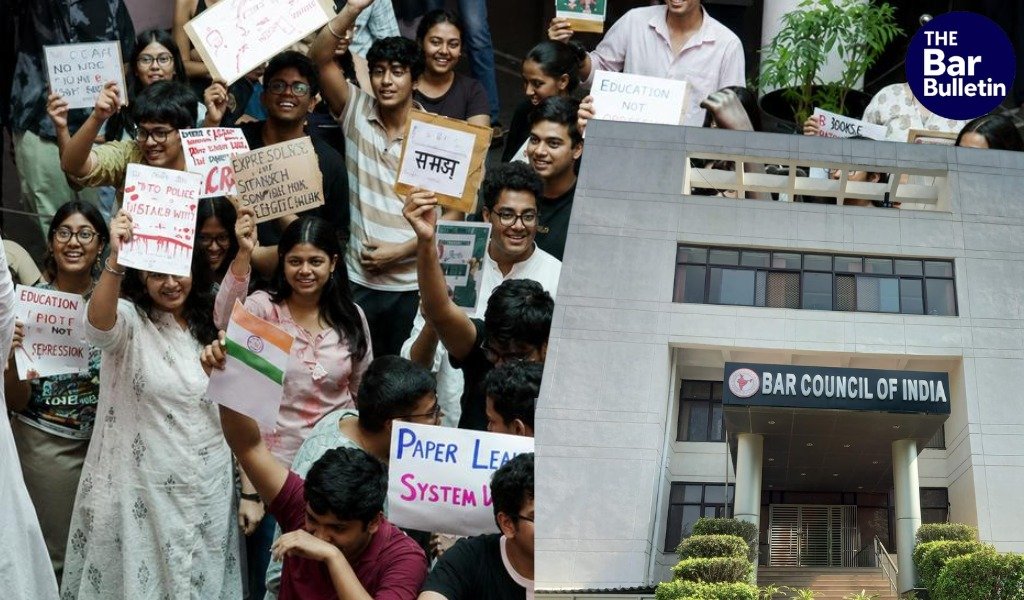
The Student Bar Council of NALSAR University of Law has issued a statement condemning the Bar Council of India’s now-withdrawn directions concerning the 2026 graduating batch, after the BCI initially directed State Bar Councils to restrict their enrolment and subsequently sought an inquiry into persons allegedly involved in expressing dissent over the participation of the Chief Justice of India at the university’s convocation. The Student Bar Council noted that the BCI later cancelled the proceedings against NALSAR through an unofficial communication on X and acknowledged that the withdrawal extinguished the immediate cause of action.
The Council has nevertheless criticised the episode on statutory, constitutional, first-principles and broader institutional grounds. On the statutory issue, it argues that the BCI’s powers under the Advocates Act, 1961 do not extend to restricting enrolment of an entire graduating batch on account of peaceful student dissent, and contends that Section 24A confines disqualifications from enrolment to specified statutory grounds, including convictions for criminal offences.
The statement further challenges the BCI’s reliance on Ex-Capt. Harish Uppal v. Union of India, arguing that the decision concerned the BCI’s regulatory and disciplinary authority over advocates in the context of strikes and boycotts affecting the administration of justice, and did not confer a general power to intervene in university affairs or restrict enrolment of an entire graduating batch.
The Student Bar Council has also objected to the proposed inquiry into the identities of students, faculty, alumni, research scholars, student-body office-bearers and others allegedly involved in the campaign, terming the demand intrusive and raising concerns over privacy and potential long-term consequences for students. It has demanded an apology from BCI Chairperson Manan Kumar Mishra for what it describes as objectionable comments in the communications.
On the constitutional front, the statement invokes Article 19(1)(a) and Supreme Court decisions recognising dissent and peaceful protest as integral to democratic life. It cites Javed Ahmad Hajam v. State of Maharashtra on the right to legitimate dissent and Anita Thakur v. Government of J&K on the constitutional significance of peaceful protest.
The Council further argues that constitutional fidelity does not require silence and that universities must remain spaces for independent thought, critical inquiry and questioning of authority. It states that no institution, including the Supreme Court or the CJI, is beyond legitimate scrutiny in a constitutional democracy, while emphasising that judicial accountability and judicial independence are not inherently opposed.
Concluding its statement, the Student Bar Council says the controversy raises a broader question about whether universities and legal regulators will preserve democratic space and constitutional freedoms when dissent is inconvenient. It thanked NALSAR’s alumni, administration, Vice Chancellor and the wider legal and social fraternity for their solidarity and ended with an Independence Day message invoking the Constitution and the ideals of the freedom struggle.