
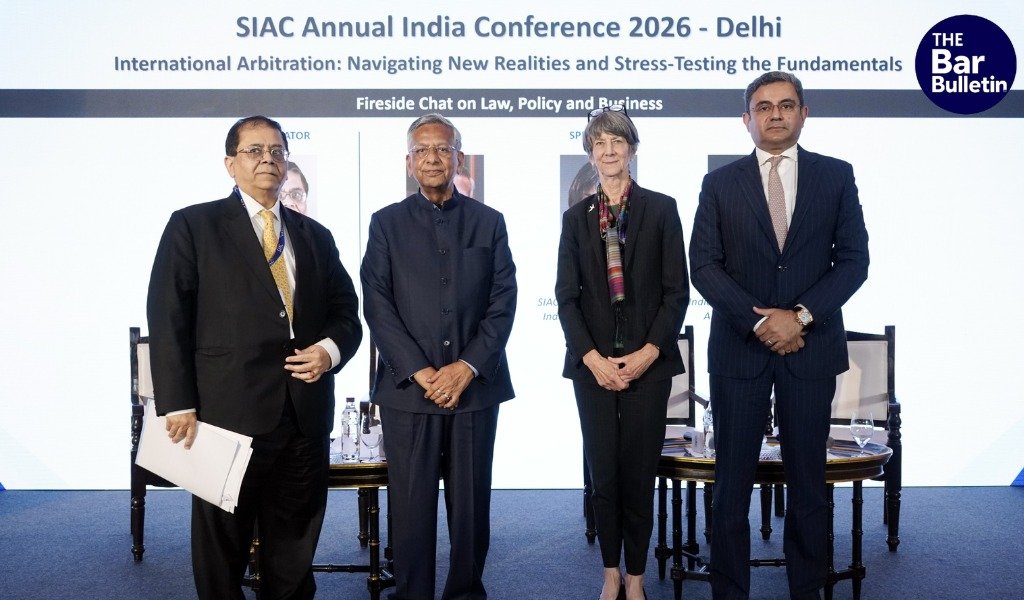

As India positions itself to become the world’s third-largest economy, strengthening dispute resolution, improving contract enforcement and fostering greater confidence in arbitration will be critical to sustaining investment-led growth, speakers observed during a fireside chat on “Law, Policy and Business” at the SIAC Conference.
Moderated by Mr. Cyril Shroff, Member of the SIAC Board of Directors and Managing Partner, Cyril Amarchand Mangaldas, the discussion brought together Attorney General for India R. Venkataramani, SIAC Court of Arbitration President Lucy Reed, and IMFA Managing Director and Former FICCI President Subhrakant Panda.
Setting the context, Shroff described India as being at an ‘inflection point’, noting that sustained economic reforms over the past decade had placed the country on a strong growth trajectory. However, he cautioned that India’s economic ambitions would ultimately depend upon the strength of its dispute resolution framework.
‘The world sees India’s opportunities, but it also asks why dispute resolution remains slow. Where there is business, there will be disputes’, he observed, adding that improving contract enforcement and judicial efficiency remains one of India’s most important reform priorities.
Responding to the opening question, Attorney General R. Venkataramani argued that dispute resolution can no longer be viewed in isolation from economic policy.
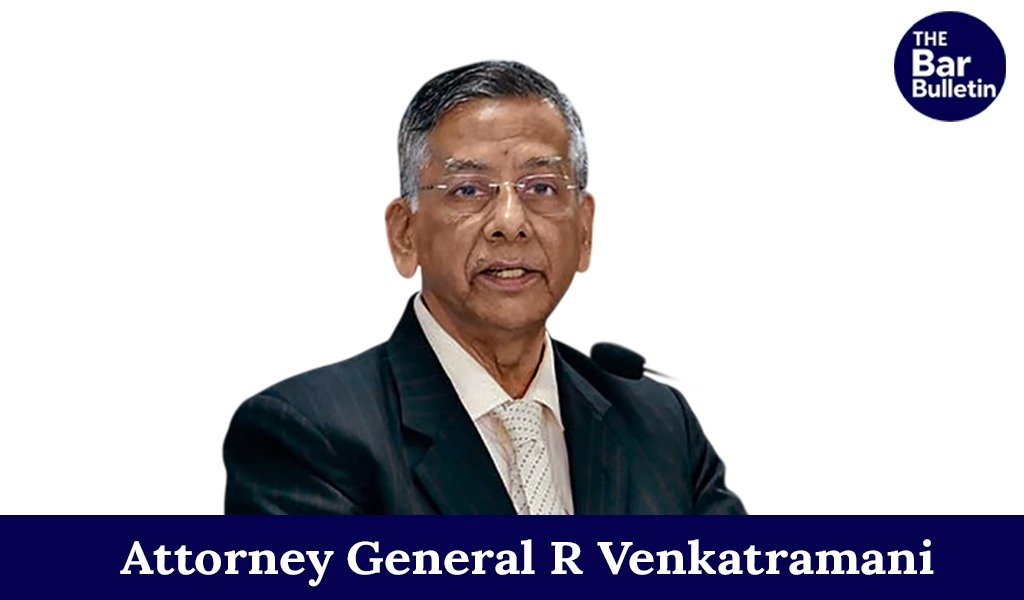
He said modern commercial transactions are no longer merely wealth-generating exercises but also involve broader social, technological and policy considerations. In such an environment, governments must continuously adapt legal frameworks to changing global realities.
Calling for fresh thinking, the Attorney General suggested that incremental procedural reforms may no longer be sufficient and advocated a fundamental re-examination of India’s dispute resolution architecture to better address contemporary commercial challenges.
On the relationship between economic development and the rule of law, AG emphasised that legal systems should increasingly be viewed as instruments of economic policy. He observed that commercial dispute resolution forms an integral part of national economic strategy and must evolve accordingly to support India’s long-term growth ambitions.
Speaking from the perspective of international arbitration, Lucy Reed, President of the SIAC Court of Arbitration, said arbitration institutions must continue to innovate while remaining firmly rooted in their foundational principles.
She stressed that neutrality, fairness, international outlook and service to users remain the defining characteristics of successful arbitration institutions, even as artificial intelligence and technological advances reshape legal practice.
Reed also highlighted the importance of diversity in arbitration, calling for broader representation across gender, nationality, age and professional backgrounds. She added that future arbitrators would require not only technological competence but also strong critical thinking and sound judgment, qualities that cannot be replaced by artificial intelligence.
Offering the industry’s perspective, Subhrakant Panda, Managing Director of Indian Metals and Ferro Alloys Ltd. and former President of FICCI, said India’s current growth story presents unprecedented opportunities for business, but investors ultimately seek certainty rather than protection.
According to Panda, commercial decisions are driven by risk-adjusted returns, making policy certainty, enforceability of contractual rights and predictable dispute resolution essential factors in investment decisions.
He observed that India has gradually evolved from a relationship-driven economy to an increasingly rules-based system, where businesses expect transparent governance and legal certainty.
When disputes arise, Panda said businesses value certainty of process, transparency, enforceability and speed above all else.
“Even if an award goes against you, it is easier to accept when the process has been fair, transparent and the reasoning is clear,” he remarked.
The discussion also examined the government’s growing reluctance to resort to arbitration in certain public sector disputes.
Addressing the issue, Attorney General Venkataramani said public accountability considerations often influence decision-making within government because public officials remain answerable to audit and oversight institutions. Rather than abandoning arbitration, he suggested that India’s arbitration framework may require structural reforms capable of balancing commercial efficiency with public accountability.
Artificial intelligence also featured prominently during the discussion. While acknowledging AI’s potential to improve efficiency and accessibility, Venkataramani cautioned against allowing technology to replace human judgment, compassion and discretion in legal decision-making.
Concluding the session, Lucy Reed reflected on what distinguishes globally successful arbitration centres.
She said longevity, judicial support for the enforcement of arbitral awards and a genuinely international outlook remain the hallmarks of respected arbitral institutions. Noting that many arbitration centres are established but few achieve global relevance, she observed that credibility is earned over decades through consistent institutional performance rather than mere establishment.