
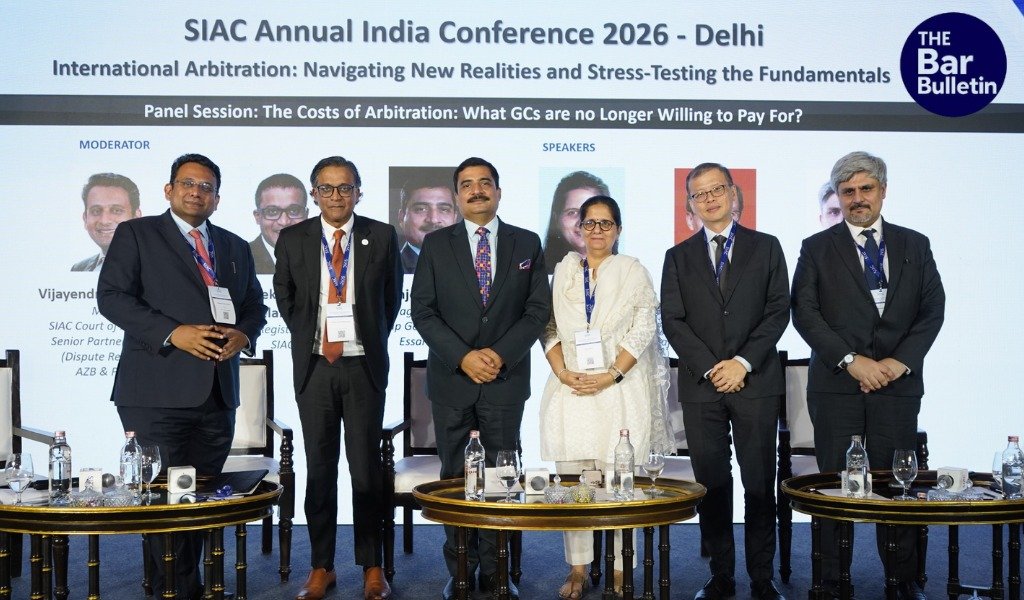

General Counsel are no longer looking at arbitration merely as a legal process, they expect it to deliver commercial value, predictable costs and efficient outcomes, panellists observed during a session on “The Costs of Arbitration: What GCs are No Longer Willing to Pay For” at the SIAC Annual India Conference 2026 in New Delhi.
Moderated by Vijayendra Pratap Singh, Member of the SIAC Court of Arbitration and Senior Partner at AZB & Partners, the panel featured Dr. Sanjeev Gemawat, Managing Director and Group General Counsel, Essar Group; Priya Mehra, Chief of Governance & Strategic Acquisitions, Akasa Air; Vivekananda Neelakantan, Registrar, SIAC; Kelvin Poon SC, Deputy Managing Partner, Rajah & Tann Singapore LLP; and Abhishek Tewari, Partner, S&R Associates.
Opening the discussion, the moderator observed that corporate legal departments have evolved from traditional compliance functions into strategic business partners, prompting a corresponding shift in what they expect from external counsel and arbitration.
Dr. Sanjeev Gemawat said the role of in-house legal teams has fundamentally changed, with General Counsel now actively participating in business strategy, governance and commercial decision-making rather than merely providing legal advice.
He noted that large Indian legal departments today possess significant in-house expertise, allowing them to scrutinise external legal spend far more closely than before.
‘General Counsel know exactly where costs are being incurred and how billing patterns work’, he said, adding that law firms have increasingly moved away from traditional billing practices in response to client expectations.
Gemawat also observed that technological advancements, particularly artificial intelligence, have significantly enhanced the capabilities of in-house legal teams, enabling them to perform work that was previously outsourced to external firms.
According to him, clients are increasingly unwilling to pay for inefficiencies or work that technology can perform more effectively.
Speaking from the aviation sector, Priya Mehra said one of the biggest frustrations for in-house counsel is having to educate external lawyers on specialised industries before receiving legal advice.
She explained that aviation contracts often involve highly technical and confidential commercial arrangements, making it difficult to rely extensively on outside counsel.
“
“We often end up teaching the law firms before they advise us. Clients shouldn’t have to pay for lawyers to learn the industry on the job,” she remarked.
Mehra said Akasa Air handles a substantial portion of its commercial contracting internally because of the specialised nature of aviation transactions and the confidentiality surrounding agreements with aircraft manufacturers.
However, she acknowledged that dispute resolution remains an area where specialist external counsel continue to play an indispensable role.
Offering the external counsel’s perspective, Kelvin Poon SC said modern clients expect lawyers to function as strategic business partners rather than technical legal advisers.
He observed that today’s arbitration counsel are increasingly required to assist boards and senior management in evaluating commercial risks, explaining legal strategies and helping businesses navigate complex disputes from a broader commercial perspective.
“
“Clients are no longer paying only for legal execution. They expect value, strategic thinking and partnership throughout the dispute,” he said.
Poon added that discussions around legal fees now begin much earlier, with clients seeking transparency on different procedural options, likely costs and potential outcomes before disputes progress.
Abhishek Tewari argued that the biggest drivers of arbitration costs arise much earlier than the arbitration itself.
According to him, parties should carefully negotiate dispute resolution clauses while drafting contracts, including decisions on the number of arbitrators, choice of institution, procedural mechanisms and seat of arbitration.
He also stressed the importance of involving arbitration counsel at an early stage rather than after disputes have escalated.
“
‘Giving counsel more time at the beginning often saves significant costs later in the proceedings’, he observed.
Tewari further cautioned that while artificial intelligence can improve efficiency in document review, its output must always be carefully reviewed by lawyers before being relied upon in arbitral proceedings.
The discussion also examined the innovations introduced under the SIAC Rules 2025, including the Streamlined Procedure, Preliminary Determination, Early Dismissal, Emergency Arbitration and the newly introduced Protective Preliminary Order mechanism.
Vijayendra Pratap Singh noted that the reforms were intended to reduce unnecessary cost and delay while preserving the quality and enforceability of arbitral awards.
Highlighting practical examples, Vivekananda Neelakantan explained that SIAC’s administrative fees constitute only a small fraction of the overall costs of arbitration, while providing certainty, procedural efficiency and institutional oversight throughout the proceedings.
He observed that in many large commercial disputes, institutional costs account for less than one per cent of the amount in dispute, making institutional arbitration highly cost-effective relative to overall legal expenditure.
Vivekananda also shared examples demonstrating the efficiency of SIAC’s procedures. He stated examples of streamlined procedure cases that had concluded within three months from the appointment of the sole arbitrator. He also highlighted an emergency arbitration in which the emergency arbitrator was appointed within a few hours of the request being made, a Protective Preliminary Order (ad interim ex parte relief) was granted in less than 12 hours, and the emergency arbitration was later concluded within the prescribed 14-day timeframe.
The panel also discussed legal professional privilege for in-house counsel in India.
Dr Gemawat argued that the current legal position creates practical difficulties for multinational corporations because communications with in-house legal teams do not enjoy the same degree of protection as communications with external advocates.
He suggested that the existing statutory framework requires reconsideration to better reflect the realities of modern corporate legal practice, where in-house counsel play a central role in managing legal risk and business strategy.
Returning to the business perspective, Priya Mehra observed that litigation budgets remain among the most difficult items for companies to forecast because disputes often arise unexpectedly.
However, she said the growing involvement of General Counsel in business decision-making enables organisations to identify legal risks much earlier, reducing both litigation exposure and legal costs.
The panellists agreed that arbitration must increasingly focus on delivering commercial value rather than procedural complexity.
Across sectors, General Counsel are seeking faster resolution, predictable pricing, greater industry expertise, technology-enabled efficiency and legal advisers who understand business objectives as well as legal principles.