
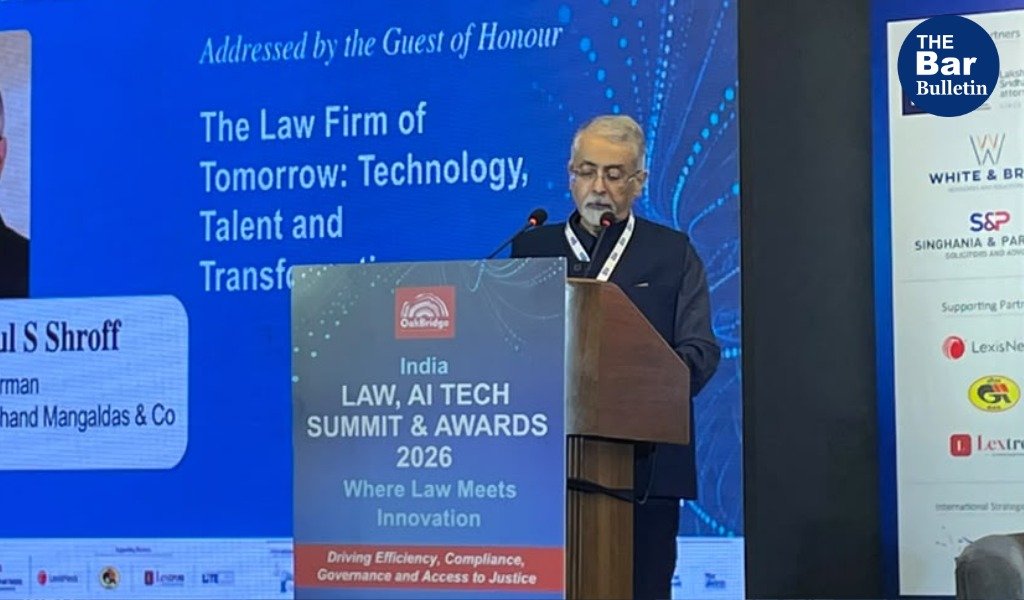

The law firm of tomorrow will not simply be today’s law firm equipped with better technology, but a fundamentally different institution, Dr. Shardul Shroff, Executive Chairman of Shardul Amarchand Mangaldas & Co., said while addressing the OakBridge India Law, AI & Tech Summit 2026 in New Delhi on Saturday.
Speaking on the theme of “The Law Firm of Tomorrow: Technology, Talent and Transformation,” Shroff said the legal profession was at an inflection point, with technology reshaping how law firms operate, attract talent, serve clients and create value.
He identified three interconnected pillars of this transformation: technology, talent and transformation. Tracing the profession’s evolution through the introduction of computers, the internet and electronic filing, Shroff said the next phase would require law firms to rethink their institutional structures and the way they deliver legal services.
On the role of technology, Shroff emphasised that while AI could assist lawyers with analysis and improve efficiency, it could not displace professional accountability or compromise confidentiality, independence and ethical standards. He said:
“
“The objective is not to create a law firm without lawyers. It is to create a law firm where lawyers can perform at a much higher level.”
Turning to the second pillar, talent, Shroff said people would remain the most important asset of a law firm, even as technology became increasingly integrated into legal practice. He cautioned that the intellectual discipline developed through legal research, reading judgments, preparing drafts and understanding the law from first principles could not be replaced by technological tools. Law firms would therefore need to reconsider how they train and develop young lawyers. He said:
“
“We would use AI to accelerate learning, but not eliminate learning. We should encourage young lawyers to embrace technology while ensuring that they will develop independently. The law of tomorrow must be technologically empowered, but intellectually independent.”
He added that talent management would necessarily change as law firms adapted to the evolving demands of legal practice.
Senior Advocate and Society of Indian Law Firms President Lalit Bhasin on Saturday said India needed stronger arbitration institutions, observing that corporate parties continued to prefer Singapore over India for resolving commercial disputes. He called for a more effective alternative dispute resolution framework, including online dispute resolution and greater emphasis on negotiated settlements, to reduce the burden on courts.

Speaking at the OakBridge India Law, AI & Tech Summit 2026 in New Delhi, Lalit Bhasin said that while alternative dispute resolution mechanisms could help reduce the burden on courts, India’s arbitration framework had failed to inspire sufficient confidence among corporate parties. He said:
“
“Arbitration has failed in this country. We do not even have good arbitration institutions. Two corporates having a dispute would rather go to Singapore and not decide on having the arbitration done in India. Therefore, ADR again is not the answer. The answer, and I appeal to the general counsel in particular, lies in two quotations. One is by Justice Krishna Iyer. That does not deal with technology, actually. But he said, way back in 1978, he told the lawyers, if you win a case, that is very satisfying. You are very satisfied, you have won a case. But if you settle a case, it is divine.”
Questions AI’s Role In Reducing Judicial Pendency
Lalit Bhasin questioned whether artificial intelligence had offered any meaningful solution to India’s mounting case pendency, arguing that technological advancements in filing and virtual appearances had not necessarily translated into faster disposal of cases. He said AI had no role in determining what the law was, since law was a product of legislation or judicial interpretation. Its potential role, he argued, lay in improving the justice delivery system and facilitating quicker and less expensive disposal of cases. He said:
“AI has no role to play for what the law is concerned. Law is a product of legislation or interpretation by the courts. Where the role of AI comes in, how to improve the justice delivery system, so that justice which is an integral part of our Constitution, you see, is given to our citizens.”
Referring to the Constitution’s commitment to securing social, economic and political justice, he questioned whether citizens were actually receiving timely justice. He contrasted the pace of disposal he had witnessed in the early years of his legal career with the present situation, in which cases continued to remain pending for years.
He referred to the growing pendency across courts and questioned whether AI could provide practical tools for expediting the disposal of cases and making justice delivery less expensive.
Lalit Bhasin observed that technology had made it easier to file cases and appear before courts virtually, allowing lawyers and litigants to participate in proceedings from distant locations. However, he questioned whether these facilities had addressed the more fundamental problem of delays in deciding cases.
Referring to a previous interaction with former Chief Justice of India DY Chandrachud at a law school convocation, he said he had raised the issue of case disposal despite technological improvements in court access.
“The question which I posed was, what about the disposal of the cases? This ease of filing cases has resulted in piling of cases in all the courts, including the Supreme Court. So where does the AI fit in so far as the justice delivery system is concerned? I have not found any answer,” he said.
He added that despite attending law school events and several conferences, he had not received a convincing answer on how AI could help expedite the disposal of pending cases. He urged technology experts and legal professionals to focus on innovation in justice delivery rather than merely digitising existing processes.
Calls For Greater Focus On Settlement And Negotiation
Lalit Bhasin said online dispute resolution could help reduce the time taken to resolve disputes, but stressed that effective alternative dispute resolution required more than arbitration. He said the answer lay in encouraging parties to settle disputes rather than allowing them to proceed through prolonged adversarial proceedings. Appealing particularly to general counsel, he referred to two observations on the value of settlement. He recalled a quote made by former Supreme Court judge Justice VR Krishna Iyer in 1978:
“If you win a case, that is very satisfying. You are very satisfied, you have won a case. But if you settle a case, it is divine.”
He said that differences between parties should not be allowed to escalate into disputes, repeating: “Let your differences not become disputes.”
Bhasin said technology could play a role in facilitating this approach and urged law schools to introduce practical training in negotiation so that young lawyers could help parties resolve disagreements amicably without resorting to arbitration or litigation.
“In the law schools, to introduce something like skill development in negotiations so that matters can be resolved amicably without any recourse to arbitration or much less litigation. That is what is required,” he said.
He concluded by urging experts to identify practical ways to improve the justice delivery system and reduce the delays that continue to affect litigants.
Senior Advocate and Society of Indian Law Firms President Lalit Bhasin questioned whether artificial intelligence had yet demonstrated a meaningful role in improving the pace of justice delivery in India. He distinguished between changes in substantive law and the need to reform the justice delivery system. While acknowledging the introduction of new criminal laws and the consolidation of labour laws into four Labour Codes, he said the fundamental challenge lay in the growing delay in disposal of cases.
Referring to the Constitution’s commitment to securing social, economic and political justice, Bhasin questioned whether citizens were actually receiving timely justice. He said AI had no role in determining what the law was, since law was a product of legislation and judicial interpretation. Its potential role, he argued, lay in improving the system through which justice was delivered. He said:
“AI has no role to play for what the law is concerned. Law is a product of legislation or interpretation by the courts. Where the role of AI comes in, how to improve the justice delivery system, so that justice which is an integral part of our Constitution, is given to our citizens….The question which I posed was, what about the disposal of the cases? This ease of filing cases has resulted in piling of cases in all the courts, including the Supreme Court. So where does the AI fit in so far as the justice delivery system is concerned? I have not found any answer.”
He challenged technology experts and legal professionals to identify practical ways in which AI could facilitate quicker and less expensive disposal of cases, rather than merely digitising existing processes.
Mr Bhasin also questioned the effectiveness of India’s arbitration ecosystem, observing that corporate parties often preferred Singapore over India as the seat of arbitration because of concerns about the available institutional framework.
“Arbitration has failed in this country. We do not even have good arbitration institutions. Two corporates having a dispute would rather go to Singapore and not decide on having the arbitration done in India,” he said.
He called for greater emphasis on online dispute resolution and effective alternative dispute resolution mechanisms, including negotiation and settlement, rather than treating arbitration as the only alternative to litigation.
Referring to a statement attributed to former Supreme Court judge Justice VR Krishna Iyer, he said that while winning a case could be satisfying for a lawyer, settling a dispute was a more meaningful outcome.
“If you win a case, that is very satisfying. You are very satisfied, you have won a case. But if you settle a case, it is divine,” he said.
He also recalled the principle that differences between parties should not be allowed to escalate into disputes, and said technology could play a role in facilitating amicable resolution.
Mr Bhasin urged law schools to introduce skill development in negotiation so that future lawyers could help parties resolve disputes without necessarily resorting to arbitration or litigation.
“Let your differences not become disputes. That is where you see the role of technology can come in. In the law schools, to introduce something like skill development in negotiations so that matters can be resolved amicably without any recourse to arbitration or much less litigation. That is what is required,” he said.
He concluded by calling on experts to identify ways to reduce delays in the justice delivery system and ensure that technological innovation translated into timely and affordable justice for citizens.