
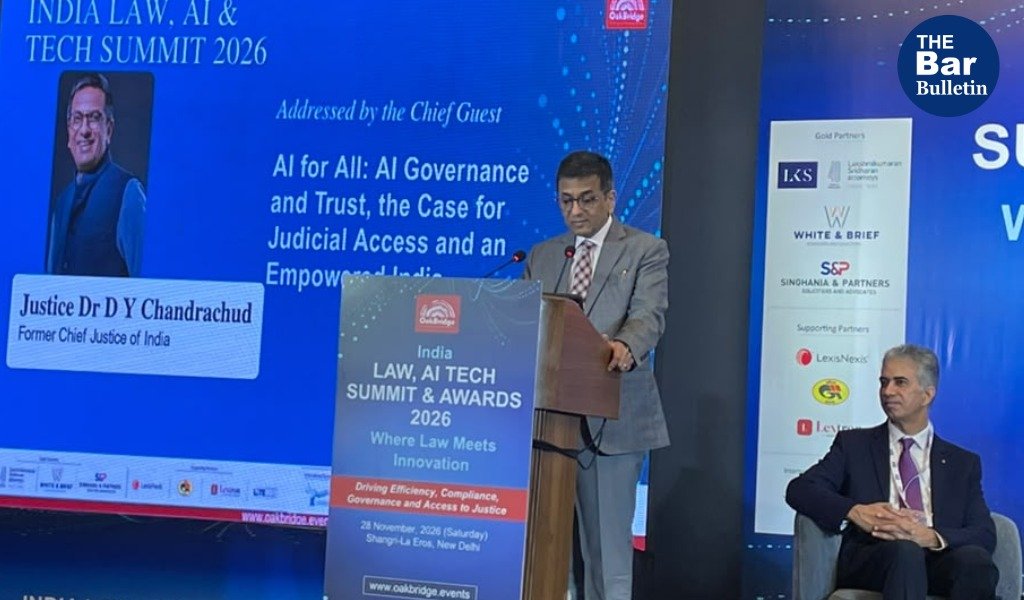

Former Chief Justice of India DY Chandrachud on Saturday referred to Sunny Deol’s iconic “Tarikh pe tarikh” dialogue from the 1993 film Damini to question whether artificial intelligence (AI) can help address judicial delays or merely provide courts with a faster way of assigning hearing dates.
Speaking at the OakBridge India Law, AI & Tech Summit 2026 in New Delhi, Justice Chandrachud said the dialogue, which has become synonymous with the problem of prolonged litigation, had not lost its relevance even after more than three decades. He recalled that, three years ago, while serving as Chief Justice of India, he had said that he did not want the Supreme Court to become a “tarikh pe tarik court”.
“Three years ago, I said from the Bench as Chief Justice of India that I did not want the Supreme Court to become a tarikh pe tarik court. I have come here this morning to ask whether the technology we have gathered to discuss can help us retire that line or whether it will only give us a quicker way of handing out dates,” he said.
Speaking on the theme of AI for All, Trust and Access to Justice, Justice Chandrachud cautioned that the benefits of artificial intelligence must not remain confined to those who already have access to legal resources. Technology, he said, should bring the law closer to ordinary people without compromising the principles that make courts worthy of public trust. He said:
“If AI ends up serving only those whom the law already serves, namely the resourced, we will have built a faster system for a few, and called it progress. So the central question I want to place before you this morning is a simple one. Can we use this technology to bring the law closer to the people it is meant for? And can we do so without giving up the things that make a court worth trusting? I believe we can. I also believe it will not happen by itself.”
AI Must Address The Structural Challenges Facing The Justice System
Highlighting the scale of pendency, Justice Chandrachud referred to figures presented by the Union Law Minister in Parliament in July 2026, stating that approximately 5.64 crore cases were pending across Indian courts, including more than 96,000 cases in the Supreme Court. He also pointed out that over 80,000 cases in the High Courts had remained pending for more than 30 years.
He noted that India had approximately 21,000 judges, translating to around 50 judges for every 10 lakh people, while a district court judge handled an average caseload of approximately 2,200 cases.
Justice Chandrachud also highlighted the limited public expenditure on legal aid, referring to the India Justice Report’s finding that the amount spent on legal aid worked out to just Rs. 6.46 per person annually.
He said access to justice could not be measured merely by whether a person was able to approach a court. It must extend to the person’s ability to understand the proceedings, obtain legal assistance, follow the progress of the case and understand the decision ultimately delivered.
Referring to the language barrier, he observed that proceedings in the Supreme Court and High Courts are conducted in English under Article 348 of the Constitution, leaving many litigants unable to read the judgments that determine their rights.
Fake AI-Generated Citations A Serious Threat To Judicial Credibility
Justice Chandrachud cautioned against the use of AI-generated legal research without verification, referring to instances in which courts had relied on non-existent judgments and fabricated extracts from genuine decisions.
He referred to an August 2025 incident before a trial court in Andhra Pradesh, where an order relied on four Supreme Court judgments that did not exist. The High Court subsequently found that the citations had been generated using an AI tool. When the matter reached the Supreme Court in February 2026, the Court held that a decision founded on non-existent judgments could not be treated as a mere error in decision-making and that consequences must follow.
He also referred to the July 2026 decision in Pooja Ramesh Singh v. Jammu and Kashmir Bank, in which the Supreme Court dealt with an insolvency order containing citations to non-existent judgments as well as fabricated paragraphs attributed to genuine decisions.
Justice Chandrachud said the latter form of error was particularly concerning because fabricated passages from genuine judgments could escape casual scrutiny and would be detected only by someone who actually examined the reported decision. He said:
“A citation of a law report that does not exist can be caught in 30 seconds. A real judgment with an invented paragraph will pass every casual check. It will be found out only by someone who opens the report and reads it.”
AI Already Being Used For Translation, Transcription And Court Administration
Justice Chandrachud also outlined several ways in which technology was already being deployed within the Indian judicial system. He referred to the Supreme Court’s SUVAS (Supreme Court Vidhik Anuvaad Software), which translates judgments into 18 Indian languages. By December 2024, more than 36,000 judgments had been translated into Hindi and over 42,000 into 17 other languages. He emphasised that these translations were vetted by retired judicial officers, translators and advocates.
He also referred to the National Judicial Data Grid, which makes pendency figures across the district courts, High Courts and Supreme Court publicly accessible.
Another tool, LEGRA, assists judges in reviewing documents and organising legal research without recommending outcomes or drafting judgments. The Supreme Court Registry, in collaboration with IIT Madras, was also testing a tool to identify defects in fresh filings.
Referring to the use of speech-to-text technology in trial courts, Justice Chandrachud said that since November 1, 2025, every trial court in Kerala had been recording witness depositions through such a tool, following an earlier pilot in four courts in Karnataka.
He observed that transcription, translation, listing and scrutiny of filing defects were routine tasks that consumed considerable judicial time, even though judges should be able to concentrate on decision-making.
“I have come to think that the best use of AI in a court is the boring one. The trouble begins when the technology is asked to do something more interesting,” he said.
Justice Chandrachud Lays Down Five Tests For AI In Courtrooms
Justice Chandrachud then set out five tests that, according to him, any AI tool must satisfy before it can be used in a courtroom. He said a tool that passed all five tests deserved a place in the courtroom, while one that failed even one should not be used.
The first test was that a human being must decide and sign the judgment. AI could assist with locating documents, translation and summarisation, but the decision and the reasons supporting it must remain with the judge.
“The decision and the reasons for it must belong to the judge,” he said, adding that a language model had taken no oath, could not be called upon to explain itself before a higher court and did not bear responsibility for the consequences of a decision.
The second test was that a person’s liberty must never be determined by a probability score. While risk-assessment tools could provide information based on patterns in other cases, they could not replace an individual judicial assessment in bail matters.
The third test was transparency. A litigant must know when AI has been used in their case and must have the ability to identify and challenge an error. Drawing a parallel with the principle of open courts, Justice Chandrachud said litigants should be able to ascertain whether AI had been used to translate evidence or summarise an appeal.
The fourth test was that technology must reach those at the back of the queue, rather than exclude people who lack access to smartphones, reliable internet connections or the ability to navigate online portals.
“Digital by default is a sound policy. Digital or nothing would be a denial of justice,” he said, stressing that physical counters, paper forms and human assistance must continue to remain available.
The fifth test concerned data security. Justice Chandrachud said courts held deeply private information about people’s lives, including details relating to children in conflict with law and survivors of sexual assault. Such information required secure systems, rather than being exposed to public chatbots.
He endorsed the need for a sovereign database and an AI model built in India, emphasising that the right to privacy did not end at the courtroom door.
Asks Law Firms Who Benefits From AI-Driven Efficiency
Turning to the legal profession, Justice Chandrachud referred to the address delivered by Dr Shardul Shroff on the future of law firms and raised questions about how the time saved through AI would be distributed between clients and law firms.
He questioned whether junior lawyers would lose essential opportunities to develop their drafting and legal reasoning skills if AI increasingly took over first drafts and routine assignments. He said:
“If a tool now produces in an hour the first draft that used to take an associate a day, who benefits from the time saved? The client or the firm? And if juniors no longer write first drafts, how will they learn to write the final one? Every senior in this hall learned the law by doing their tedious work badly and being corrected.”
Justice Chandrachud further cautioned that AI was not merely an organisational tool but a cognitive technology capable of influencing thought, institutional structures and decision-making. He said the pressure to prioritise cost and efficiency could increasingly push courts and law firms towards technology-driven solutions at the expense of human discretion and judgment.
He called for a balance between efficiency and the need to preserve individualised assessment, particularly in areas of legal practice requiring judgment, discretion and ethical evaluation.
‘If AI Has Only Made The Powerful Faster, We Will Have Failed’
Concluding his address, Justice Chandrachud said the success of AI in the justice system should ultimately be measured by the experience of an ordinary litigant, rather than by the sophistication of the technology deployed.
He asked whether, ten years from now, a woman litigating a land dispute in a taluka court would receive the order in her own language on the day it was passed, know her next hearing date without having to pay someone for the information, and be assured that a human being had considered her case. He also asked whether a woman facing domestic violence would be able to understand the remedies available under law and access them, instead of having those remedies remain confined to the pages of legislation. He said:
“If the answers to those questions are yes, we will have earned the title of this session. And a young lawyer watching Damini will have to ask the senior what that famous line was all about. If AI has only made the powerful faster, we will have failed, however impressive our tools.”
Justice Chandrachud said he remained optimistic about the ability of judges, court registries and members of the Bar to work together to ensure that technology strengthens access to justice while preserving public confidence in the judicial system.