
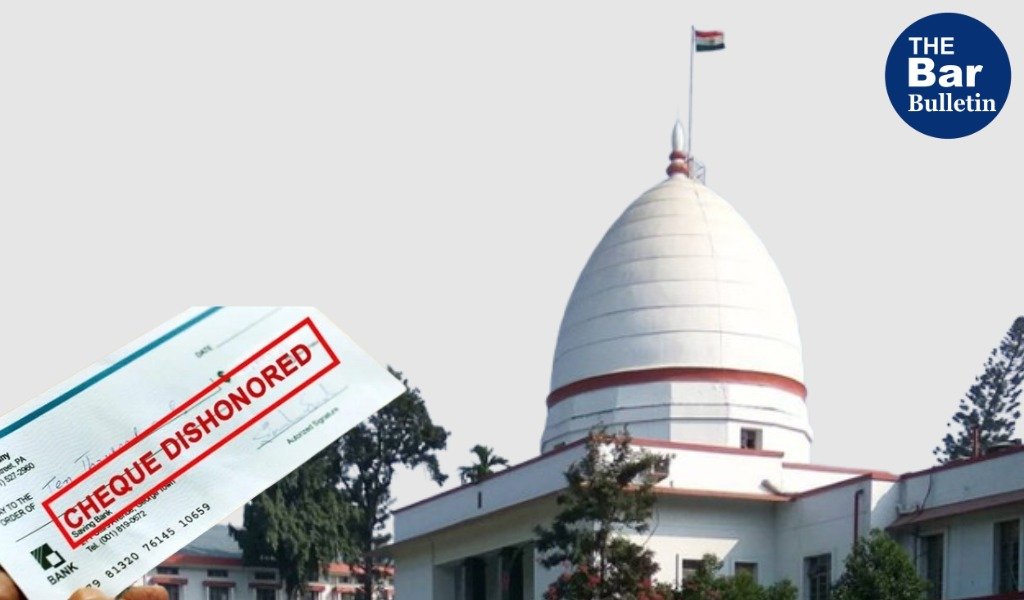

The Gauhati High Court has held that dishonour of a cheque with the remark ‘Bank Merged’ does not automatically defeat a prosecution under Section 138 NI Act, and issues relating to bank merger, validity of cheque, security cheque defence and existence of debt must be tested during trial. The Court ruled that merely because a cheque was returned unpaid after the merger of Allahabad Bank with Indian Bank, proceedings under Section 138 NI Act cannot be thrown out at the initial stage.
Whether the cheque was issued towards a legally enforceable liability or was merely a security cheque involves disputed factual questions that must be decided by the trial court. The Court reiterated that dishonour for reasons other than insufficiency of funds may also attract Section 138, depending on the circumstances. At the Section 528 BNSS stage, the Court cannot examine contested documents, ledger accounts or rival factual claims requiring appreciation of evidence.
Briefly, the petitioner challenged a cheque dishonour complaint and sought quashing of the proceedings under Section 138 of the Negotiable Instruments Act. The complainant, M/s Gopi Mohan Drug Distributor, alleged that medicines and surgical goods were supplied to the petitioner on credit and that an amount of Rs. 75,650 remained unpaid. To discharge this liability, the petitioner allegedly issued a cheque drawn on Allahabad Bank, which was subsequently dishonoured with the remark ‘Bank merged’. Despite a statutory demand notice, payment was not made, leading to the filing of the complaint.
The petitioner contended that the cheque was not issued towards any existing liability but was an old security cheque handed over years earlier during business dealings. It was also argued that, following the merger of Allahabad Bank with Indian Bank, any cheque of the erstwhile Allahabad Bank had become invalid and, therefore, dishonour of such a cheque could not attract prosecution under Section 138 of the NI Act.
A Single Judge Bench of Justice Shamima Jahan observed that the power to quash criminal proceedings under Section 528 BNSS can be exercised only in exceptional cases where no prima facie offence is disclosed or where continuation of proceedings would amount to abuse of process of law. Disputed questions of fact ordinarily cannot be examined at the quashing stage.
The Court noted that the complainant had specifically alleged the existence of an unpaid debt and issuance of a cheque towards discharge of that liability. The petitioner’s claim that the cheque was merely a security cheque and that there was no outstanding liability involved disputed facts requiring evidence, which could only be examined during trial.
Referring to the Supreme Court decision in Laxmi Dyechem v. State of Gujarat [(2012) 13 SCC 375], the Court observed that Section 138 is not confined only to cases where cheques are dishonoured for insufficiency of funds. Various other reasons for dishonour may also fall within the scope of the provision depending upon the facts of the case.
The Court further observed that the mere fact that the cheque was returned because of the merger of Allahabad Bank with Indian Bank does not automatically render the complaint non-maintainable. It relied upon decisions of the Bombay High Court and Punjab & Haryana High Court holding that bank merger-related issues often involve factual inquiries and cannot be used as a straightjacket ground for quashing proceedings at the threshold.
According to the Court, a complainant cannot reasonably be presumed to have knowledge of the legal consequences of a bank merger or whether a particular cheque had become invalid due to such restructuring. These are matters within the special knowledge of banking institutions and cannot by themselves defeat a complaint under Section 138 at the preliminary stage.
The Court also noted that the petitioner’s reliance on ledger accounts to show absence of liability was contested by the complainant. Whether a legally recoverable debt existed, whether the cheque was issued towards such debt, and whether it was only a security cheque are all matters requiring evidence and adjudication by the trial court.
