
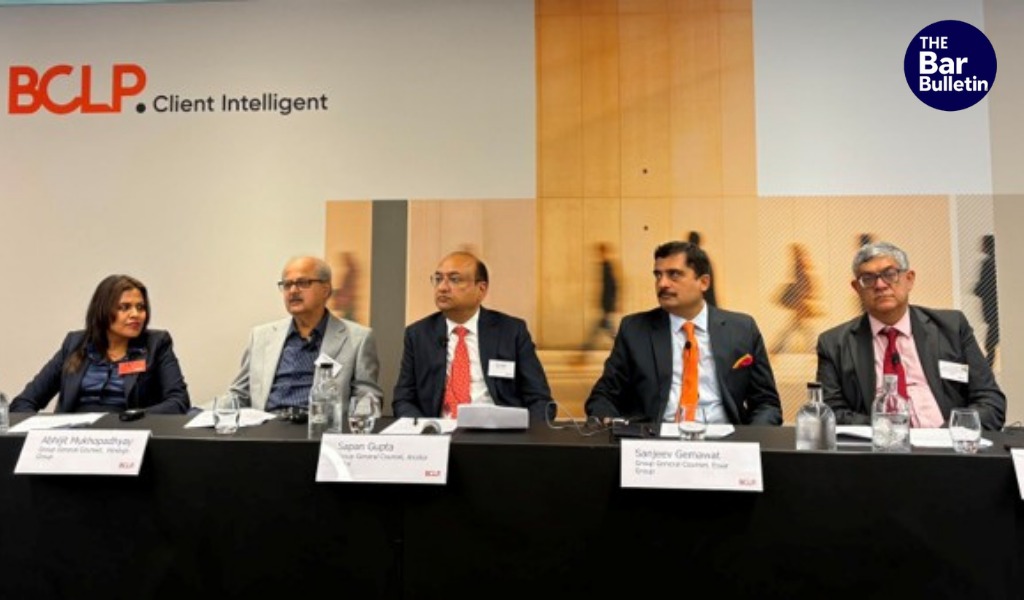

The challenges of multi-party disputes, enforcement of arbitral awards and the importance of dispute prevention were the focus of a panel discussion at London International Disputes Week 2026 (LIDW26) moderated by Shivani Sanghi, Partner & Head of India Practice, BCLP, & Steering Committee Member, Indian Women in International Arbitration (IWIA). The Panel featured:
- Sapan Gupta – Group General Counsel, ArcelorMittal
- Abhijit Mukhopadhyay – Group General Counsel, Hinduja Group
- Dr Sanjeev Gemawat – Group General Counsel, Essar Group
- Gourab Banerji – Senior Advocate, Essex Court Chambers; President, Arbitration Bar of India (ABI)
Opening the discussion, Ms Sanghi highlighted the growing complexity of modern disputes involving multiple parties, multiple contracts and cross-border business relationships, noting that questions surrounding joinder, consolidation and enforceability increasingly sit at the heart of commercial arbitration.
Addressing India’s adoption of the Group of Companies Doctrine, Senior Advocate Gourab Banerjee examined how Indian courts have sought to address complex commercial arrangements by allowing, in certain circumstances, non-signatories to be joined to arbitration proceedings. While recognising the doctrine’s practical benefits, Mr Banerjee noted that it continues to generate uncertainty, particularly where enforcement is sought in jurisdictions that do not recognise the concept.
“The idea is that you want a one-stop shop where all connected disputes can be resolved,” Mr Banerjee observed, while cautioning that enforceability remains a significant consideration in cross-border matters.
Providing an in-house perspective, Mr Sapan Gupta discussed the practical challenges associated with disputes involving multiple stakeholders. He noted that in highly complex commercial relationships, negotiated settlements often provide the most effective route to resolution, particularly where procedural complexity threatens to undermine efficiency. Mr Gupta also highlighted the importance of tracing responsibility and understanding the commercial realities behind corporate structures when pursuing enforcement strategies.
Mr Abhijit Mukhopadhyay focused on the role of contract drafting in avoiding disputes altogether. He emphasised that businesses should devote as much attention to structuring agreements as they do to resolving disputes after they arise.
“I have got a dispute resolution policy—only one line: don’t have any dispute at all,” Mr Mukhopadhyay remarked, stressing that careful identification of contracting parties, jurisdictional analysis and enforceability assessments should form part of every major commercial negotiation.
Mr Mukhopadhyay further stated that legal teams should challenge assumptions made during commercial discussions and ensure that contractual protections are established while relationships remain positive, rather than after disputes emerge.
Mr Sanjeev Gemawat highlighted the importance of considering enforcement from the very beginning of a transaction. He explained that when businesses operate through chains of related contracts, parties often seek to adopt consistent institutional mechanisms and dispute resolution frameworks across agreements to reduce fragmentation and procedural risk.
Mr Gemawat noted, however, that even well-drafted arbitration clauses can encounter difficulties where local courts take a different view of dispute resolution arrangements, making enforcement planning a critical component of risk management.
The discussion concluded with a broader examination of enforcement, which all panellists identified as the ultimate test of any dispute resolution process.
Reflecting on India’s progress, Mr Banerjee acknowledged that while enforcement remains one of the system’s greatest challenges, significant improvements have been made through legislative reform and a more arbitration-friendly judicial approach.
The panellists agreed that successful dispute resolution begins long before a dispute arises. Whether through careful drafting, thoughtful structuring of dispute resolution clauses, early assessment of enforcement risks or greater use of mediation, businesses increasingly recognise that prevention and preparedness are as important as the arbitral process itself.
While challenges remain, particularly in relation to enforcement timelines and cross-border complexities, the discussion reflected growing confidence in the continued evolution of India’s arbitration framework and its ability to support increasingly sophisticated commercial disputes.