
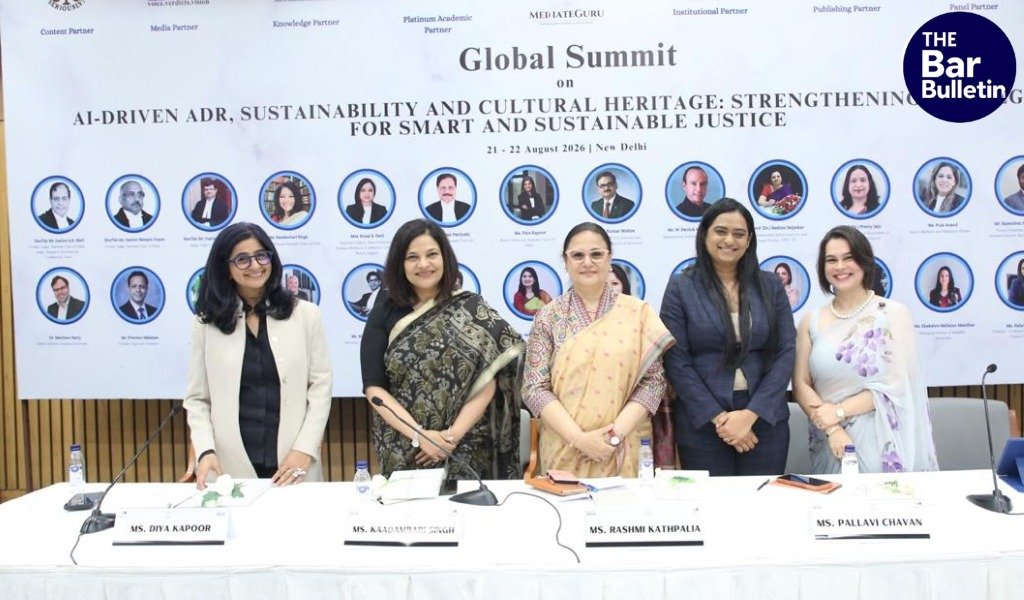

ConstructHER Legal Network participated as Panel Partner at MediateGuru’s Global Summit on “AI-Driven ADR, Sustainability and Cultural Heritage: Strengthening ADR Regimes for Smart and Sustainable Justice”, held in New Delhi on 21–22 August 2026.
ConstructHER curated and led a focused panel, “Green Clauses and Grey Areas”, with practitioners from construction law, arbitration, public infrastructure, general counsel practice, delay analysis and quantum.
Moderated by Ms. Mehak Oberoi, Founder of ConstructHER Legal Network, the panel featured Ms. Rashmi Kathpalia, Advocate, former General Counsel, Arbitrator and Mediator; Ms. Kadambari Singh, Senior Advocate; Ms. Diya Kapur, Senior Advocate; and Ms. Pallavi Chauhan, Director – Contracts and Claims, Masin Projects Pvt. Ltd.
Ms. Oberoi opened with a striking contrast. India has approximately 15 billion square feet of registered green building space, making it the second largest in the world, yet construction contracts have not kept pace with the legal precision needed to allocate sustainability obligations.
Once green commitments become contractual obligations, familiar construction disputes acquire another dimension: who bears the risk, who pays for compliance, and how should losses be proved when those commitments are not met?
Panelist Insights
Ms. Rashmi Kathpalia brought the perspective of a former general counsel and construction disputes practitioner. Drawing on her experience in infrastructure, commercial and regulatory disputes, she explained that environmental, health and safety requirements have existed in construction contracts for decades, often through technical specifications rather than provisions setting out clear contractual consequences. The vocabulary may have shifted towards ESG, sustainability goals and carbon management, but contractors are not new to environmental and safety obligations.
Her central point was commercial: sustainability comes at a price. Owners cannot expect “five-star” sustainability outcomes at “one-star” tender pricing. If a project requires green-certified materials, carbon-reduction measures or specified environmental compliance, the resulting cost and risk cannot simply be passed to the contractor without corresponding contractual and commercial adjustment.
Those obligations also need to be measurable, priced and allocated from the outset. An obligation that cannot be measured objectively is difficult to connect to liquidated damages or other contractual consequences. Where a sustainability goal cannot be measured through an appropriate engineering tool, or liquidated damages are proposed against an unmeasurable target, the contractor needs to resist accepting that risk.
This becomes particularly difficult in public-sector and infrastructure contracts, where standard forms may leave little room for amendment. Sustainability requirements may appear in technical specifications without corresponding provisions in the main contract, leaving the contractor expected to deliver a green outcome without necessarily receiving the price, time or contractual protection needed to do so fairly.
Ms. Kadambari Singh considered the position in public infrastructure and government contracting. She discussed standardised infrastructure templates, the influence of FIDIC-based frameworks and lender-linked environmental requirements in World Bank-funded and similar projects. Green clauses can now be tied directly to financing conditions, making compliance both a project and funding issue.
That makes scrutiny before tender especially important. Authorities and employers should establish whether a concessionaire or contractor has the expertise and capacity to meet green specifications before execution begins. Ms. Singh also questioned continued reliance on the L1 approach where contractors bid at levels at which they may ultimately be unable to perform.
Fitness-for-purpose obligations and project-lifespan warranties can place the ultimate risk on the contractor, but that allocation is not absolute. Specifications, technological issues, variations and additional costs may alter responsibility and entitlement to compensation. Ms. Singh referred to differing jurisprudence on these questions, making clear why contracts need to anticipate them rather than leave them to be resolved after a dispute arises.
She also distinguished between employer delay, contractor delay and concurrent delay. Those causes need to be separated carefully in arbitration, particularly in infrastructure matters involving substantial public funds. Contemporaneous evidence and expert analysis become especially important because party-appointed delay evidence can become one-sided unless the underlying facts, concurrency and methodology are rigorously tested.
Ms. Pallavi Chauhan added the forensic delay and quantum perspective. Existing delay-analysis methodologies, including those recognised under construction law protocols, are capable of dealing with sustainability-related procurement delays, provided the analysis remains sensitive to the facts.
The critical path, in her words, is “colour-blind”. Whether a delay concerns green-certified material or conventional procurement, the questions are familiar: when was the obligation introduced? Was it part of the tender? Was it priced and programmed? Was float available? How did each party respond as events developed?
Consider a green material specified from the outset whose approved vendor later becomes unavailable. The contractor may notify late; the employer may respond late; a replacement vendor may affect cost and time. Whether the resulting delay affects the critical path cannot be assumed. Responsibility has to be established through the factual chronology and programme analysis.
On quantum, Ms. Chauhan identified several possible heads of loss following a failure to obtain green certification: remedial costs, retesting expenses, professional fees, loss of tax incentives, reduced FAR or saleable area, financing consequences, and possible loss of rental or market premium. Invoices, purchase orders, joint measurements and payment records may establish some of these losses. Reputation, market premium and longer-term rental effects are harder to prove because India does not yet have mature benchmark data for sustainable buildings.
The evidentiary gap has a direct contractual consequence. A party may establish that it suffered a loss without being able to prove its extent. If green outcomes are to carry contractual consequences, better data will be needed on cost, premium valuation, financing benefits and performance.
Ms. Diya Kapur focused on the legal treatment of liquidated damages and sustainability-related losses. Indian law can require a claimant to establish loss and reasonableness even where the parties have agreed a pre-estimated amount for breach. That exercise becomes harder where a failed green outcome produces indirect or difficult-to-quantify consequences such as reputational loss, future rental premium, market positioning or financing disadvantage.
Liquidated damages clauses are intended to avoid a full proof-of-loss exercise, yet parties may still find themselves relying on expert evidence and detailed damages analysis. In sustainability disputes, much therefore turns on drafting. Unless the contract defines the obligation, measurement standard and consequence of non-compliance with sufficient precision, disputes over green certification can become difficult to resolve efficiently.
Ms. Kapur also considered AI in arbitration. Responding to the concern that technology might deepen the imbalance between parties with different financial resources, she took the opposite view. AI, she suggested, could make arbitration more symmetrical by allowing parties with fewer resources to interrogate expert evidence more effectively and prepare for cross-examination without necessarily having access to the same scale of expert support as a better-resourced opponent.
What Needs to Change in the Contract
The discussion pointed to changes that need to happen before disputes arise. Sustainability obligations should be built into contracts during the pre-tender and negotiation stages rather than added later as fragmented clauses without a coherent allocation of risk. The speakers discussed separate budgets for green compliance, carbon-emissions management systems, clearer tender specifications, substantive pre-bid discussions, better baseline programming, stronger data collection and alternatives to a purely lowest-bidder approach where sustainability, quality and technical capability materially affect project delivery.
Sustainable construction cannot sensibly be assigned to one party alone. Responsibility extends across the owner, contractor and subcontractor. The contract needs to identify those responsibilities, price them realistically, provide objective methods for measuring performance and state what happens when an obligation is missed.
For ConstructHER Legal Network, the panel also reflected its commitment to bringing more women and interdisciplinary voices into construction law and dispute resolution. The different perspectives—from general counsel and senior advocates to construction claims and arbitration practice—kept the discussion focused on the questions contracts and tribunals will have to answer: who carries the risk, who pays for compliance, how is loss proved, and how should sustainable obligations be drafted in the first place?
The discussion in New Delhi left one point difficult to avoid: as green requirements become measurable contractual obligations, construction disputes will have to deal with their consequences in the same exacting terms as time, cost, procurement and performance.
The Wider Summit
MediateGuru hosted the summit with Your Honour, Seriously! as Content Partner; The Bar Bulletin as Media Partner; AIAC and the Centre for Alternative Dispute Resolution as Knowledge Partners; the University of Kent as Platinum Academic Partner; Presolv360 as Institutional Partner; Atlantis Press | Springer Nature as Publishing Partner; and ConstructHER Legal Network as Panel Partner.
The wider summit brought together an eminent group of attendees and speakers, including Hon’ble Mr. Justice A.K. Sikri, former Judge, Supreme Court of India and Judge, Singapore International Commercial Court; Hon’ble Mr. Justice Hemant Gupta, former Judge, Supreme Court of India; Hon’ble Mr. Justice Tejas Karia, Judge, High Court of Delhi; Mrs. Sonal S. Patil, Registrar (Legal), State Consumer Disputes Redressal Commission, Circuit Bench, Nagpur; Mr. Sukumar Pattjoshi, Senior Advocate, Supreme Court of India; Ms. Kadambari Singh, Senior Advocate; Mr. Ajit Kumar Mishra, Director (Works), IRCON International Ltd.; Mr. W. Patrick McPhilamy, III, international arbitrator and mediator; Prof. (Dr.) Rashmi Salpekar, Dean, Vivekananda School of Law and Legal Studies, VIPS-TC; and Prof. (Dr.) Preety Jain, Dean and Chairperson, Department of Law, Kurukshetra University.