
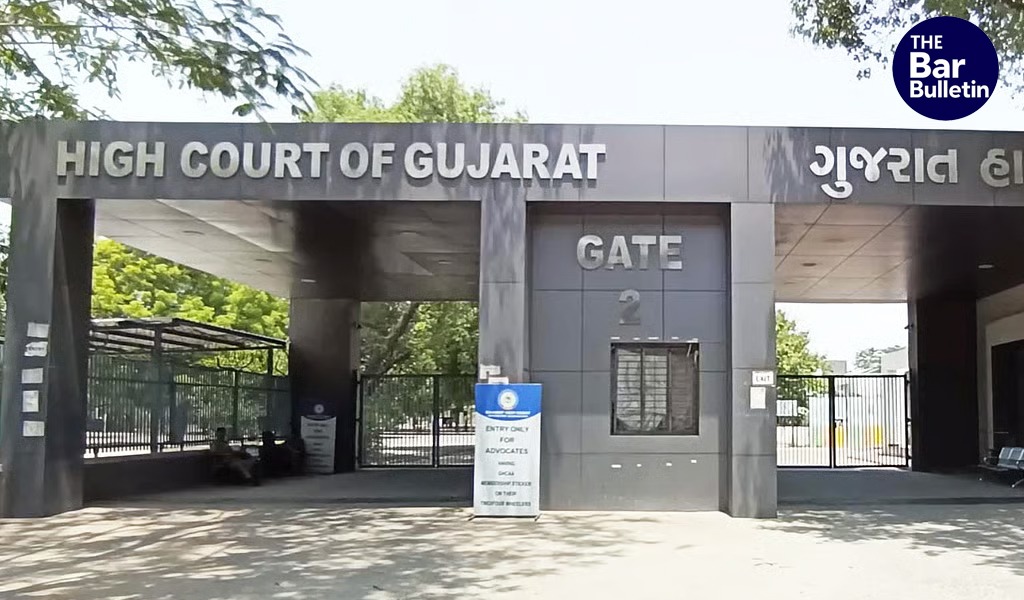

In a significant ruling on the statutory architecture of the ESI Act, the Gujarat High Court (Ahmedabad Bench) has held that recovery proceedings under Section 45B of ESI Act cannot be initiated without a prior determination order under Section 45A or adjudication under Section 75, and that the five-year limitation under Section 77(1A)(b) does not apply to Section 45A proceedings.
Emphasising that Section 45A is a residuary best-judgment power and not an optional route, the High Court held that the statutory scheme of the ESI Act mandates a determination order under Section 45A or adjudication under Section 75 as a precondition for recovery under Section 45B. Since ESIC could not produce any Section 45A order on record despite being given an opportunity to do so, the recovery proceedings initiated by ESIC were exercised in a ‘totalitarian and dictatorial’ manner and could not be sustained.
A Single Judge Bench of Justice J. C. Doshi undertook a detailed examination of the statutory scheme under Sections 45A and 45B of the ESI Act, and noted that before invoking the summary power to determine contribution under Section 45A, two conditions must be satisfied: first, where the employer fails to submit returns, particulars, or maintain registers under Section 44; or second, where a Social Security Officer is obstructed or prevented from exercising functions under Section 45(2). The proviso to Section 45A also mandates a reasonable opportunity of being heard and prescribes a five-year limitation from the date the contribution became payable.
The Court observed that Section 45A is a best-judgment assessment akin to taxing statutes, applicable only when records are not produced or there is no cooperation from the employer. Where records are produced and cooperation is forthcoming, assessment must be carried out under Section 75(2)(a) and not under Section 45A. The Court emphasised that the two parts of Section 45A(1) operate in distinct spheres, the first deals with non-submission of records, while the second requires actual physical obstruction, use of force, or threatened use of force, and not mere failure to comply with directions. Further, Section 45A does not prescribe any period of limitation, and the five-year bar under the proviso to Section 77(1A)(b) applies only to claims made by the Corporation before the ESI Court, not to proceedings under Section 45A.
Briefly, the Employees’ State Insurance Corporation (ESIC) filed a first appeal under Section 82(2) of the Employees’ State Insurance Act, 1948, challenging the judgment and order passed by the ESI Court, which had allowed the petition filed by M/s. Rubi Coach Builders Pvt Ltd. under Section 75 of the ESI Act and declared that ESIC was not entitled to recover a contribution amount of Rs. 46,472/-, along with interest and surcharge, totalling Rs. 63,107/-.
The petitioner company had been allotted ESI Code, and an Insurance Inspector had visited the establishment and checked its records. The dispute essentially revolved around whether certain payments made by the company, including travelling allowance, transport charges, overtime wages, special allowance, conveyance allowance, washing allowance, and a payment of Rs. 2.10 lakhs made to R.K. Contractor for building construction, fell within the definition of ‘wages’ under Section 2(22) of the ESI Act.
On April 07, 1983, the petitioner had addressed a representation to ESIC clarifying that payments towards travelling allowance and overtime did not fall within the definition of ‘wages’. However, without adjudicating the core dispute, ESIC issued a recovery warrant under Section 45B of the ESI Act on April 05, 1989, demanding Rs. 63,107/-. The petitioner wrote back on April 14, 1989, disputing the liability, but the Mamlatdar issued a notice on April 24, 1989 to recover the amount as arrears of land revenue.
