
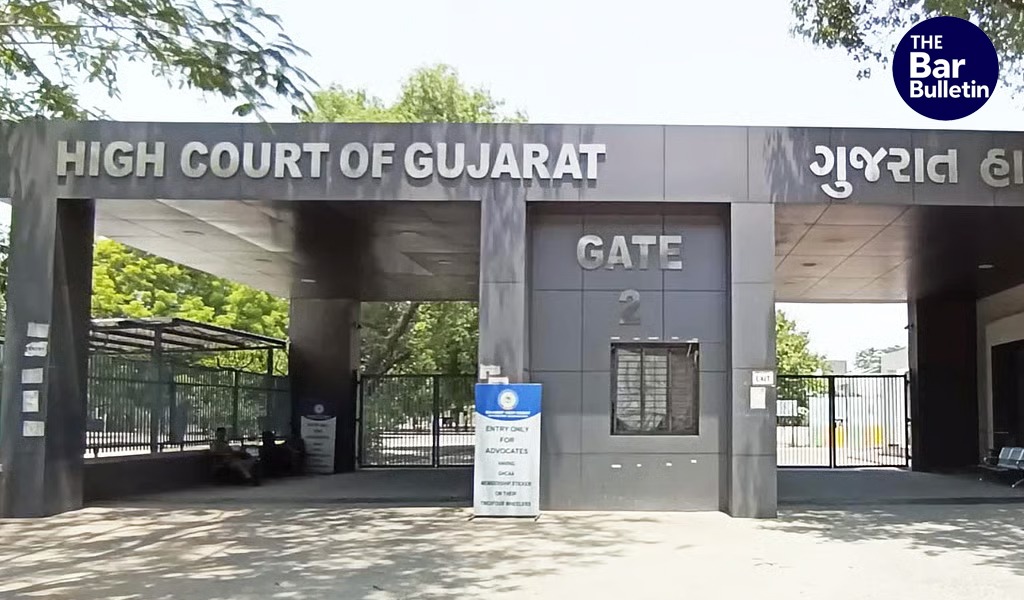

The Gujarat High Court has upheld the acquittal of four persons accused of assaulting and abusing a school teacher belonging to a Scheduled Caste, holding that the prosecution failed to establish the essential ingredients of the offence under the Scheduled Castes and Scheduled Tribes (Prevention of Atrocities) Act, 1989 or prove the case beyond reasonable doubt.
Dismissing the State’s appeal against the 2009 acquittal, Justice Hemant M. Prachchhak found no perversity or legal infirmity in the trial court’s findings. The Court reiterated that an appellate court should not interfere with an acquittal unless the conclusions reached by the trial court are manifestly illegal or perverse.
According to the prosecution, the complainant, a Scheduled Caste school teacher, alleged that the accused assaulted him and his family with sticks, threatened them, and hurled caste-based abuses outside his residence a day before a court hearing in an earlier dispute between the parties. An FIR was registered under Sections 323, 504, 506(2) and 114 of the IPC, along with Section 3(1)(10) of the SC/ST Act.
After re-appreciating the evidence, the High Court observed that there was long-standing enmity between the two families, with earlier criminal cases pending between them. It noted that the medical evidence did not fully support the version of the complainant and the other injured witnesses. The Court further found that no independent witness corroborated the prosecution’s case.
On the allegation under the SC/ST Act, the Court held that the prosecution failed to prove that the alleged caste-based insults were made in any place within public view, an essential ingredient of the offence. Relying on recent Supreme Court decisions interpreting Section 3(1)(10) of the Act, the Court observed that abusive words attract the penal provision only when they are uttered in a public place within public view with the intention of humiliating a member of a Scheduled Caste or Scheduled Tribe on the basis of caste. Since the alleged incident occurred at the complainant’s doorstep and the evidence did not establish the requirement of public view, the offence under the Act was not made out.
The High Court also noted the trial court’s finding that the complainant had admitted to filing several complaints under the SC/ST Act in the past and receiving compensation from the Social Welfare Department. Referring to this aspect, the Court observed that the trial court had concluded the complainant had misused the provisions of the Act, and found no reason to interfere with that assessment.
Reaffirming the settled principles governing appeals against acquittal, the Court observed that an accused enjoys a double presumption of innocence after acquittal and that appellate courts should not substitute a different view merely because another conclusion is possible. Finding no credible evidence connecting the accused with the alleged offences beyond reasonable doubt, the High Court dismissed the State’s appeal and confirmed the acquittal recorded by the trial court.
