

Justice Sanjay Karol, Former Judge, Supreme Court, has described the seven-year-long litigation in the Delhi Metro Rail Corporation (DMRC) arbitration dispute as “just an aberration”, while defending India’s arbitration and award-enforcement framework. He said India has a robust system in terms of adjudication, the approach of courts and enforceability. He thus called upon international arbitration practitioners and businesses to continue viewing India as a favourable destination for arbitration, emphasising that the country takes the enforcement of arbitral awards seriously.
Justice Karol made the remarks while responding to an audience question on how far the enforceability of an arbitral award should influence the choice of arbitral seat, particularly where the seat, governing law and location of assets are in different jurisdictions.
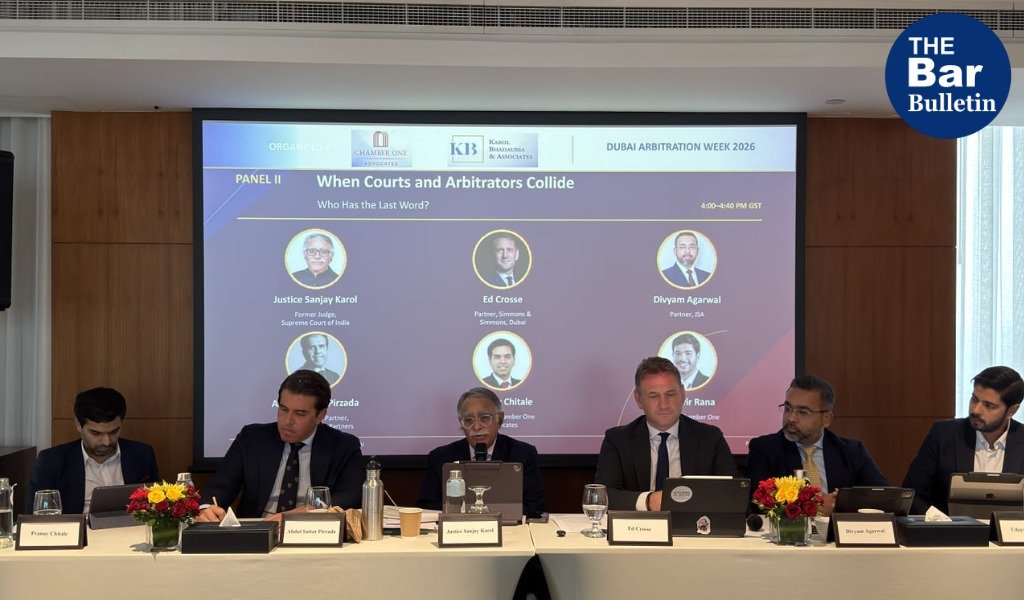
The session was organised by Chamber One Advocates and Karol, Bhadauria & Associates on November 12, 2026, as part of Dubai Arbitration Week 2026 at Anantara Downtown Dubai. The panel discussion, titled “Beyond the Arbitration Clause: Consent, Courts & The Battle for Jurisdiction,” was moderated by Pranay Chitale, Partner at Chamber One Advocates. It featured:
● Justice Sanjay Karol, former Judge of the Supreme Court of India;
● Divyam Agarwal, Partner at JSA;
● Ed Crosse, Partner and Head of Middle East Disputes and Investigations at Simmons & Simmons, Dubai;
● Abdul Sattar Pirzada, Co-Founder and Partner at Khaled Almarri & Partners; and
● Udayvir Rana, Partner at Chamber One Advocates.
The welcome address was delivered by Udayvir Rana, Partner, Chamber One Advocates, who introduced the session and its panellists.
Interim relief and the role of courts
Opening the discussion, Pranay Chitale asked where courts should draw the line between supporting arbitration and interfering with the arbitral process, particularly when parties seek interim relief.
Justice Karol responded that Indian courts give primacy to the arbitration agreement and have a statutory mechanism to grant interim injunctions, protect assets and preserve property. Parties can approach courts for interim protection even before invoking arbitration. However, once the arbitral tribunal is constituted, courts generally leave the question of interim relief to the tribunal’s discretion, particularly in matters concerning the protection and preservation of assets and property.
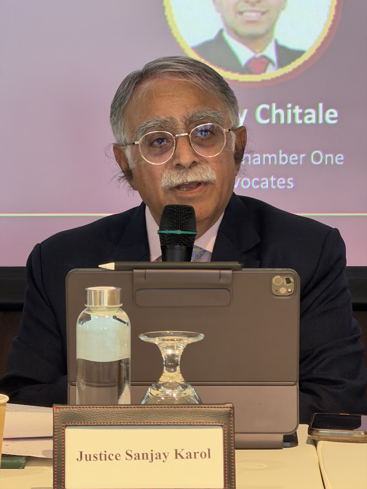
He added that courts may grant an injunction while also directing the parties to initiate arbitration, making it clear that a party cannot obtain interim protection and then simply sit on it without pursuing the arbitral proceedings.
Divyam Agarwal explained the position through an analogy of two siblings fighting over a piece of chocolate. If the parent who is supposed to decide the dispute is away and one sibling fears that the other is about to eat the chocolate, the sibling may approach the second parent for immediate protection. Similarly, courts can intervene where an asset is at risk of being dissipated or a bank guarantee is about to be invoked.
He explained Section 9 allows courts to grant interim measures before, during and after arbitral proceedings, while Section 17 empowers the tribunal to grant interim measures during the proceedings. He emphasised that a hands-off approach by courts does not mean that urgent protection will be denied.
Comparing the Indian position with England, Ed Crosse referred to Section 44 of the English Arbitration Act, under which courts assist the arbitral process only to the extent that the tribunal cannot act effectively. Courts may grant urgent freezing orders, including ex parte relief where notifying the tribunal or the other party could create a risk of assets being moved. Where the matter is not urgent, permission from the tribunal or emergency arbitrator, or the written agreement of the other party, is generally required.
Abdul Sattar Pirzada outlined the UAE’s three regimes, onshore courts, the Dubai International Financial Centre (DIFC) and the Abu Dhabi Global Market (ADGM). He said the DIFC and ADGM courts are generally quicker in dealing with freezing orders, asset preservation and status quo relief, while onshore courts have also become increasingly willing to grant interim measures.
Giving an example, he said his team had secured a freezing order within 48 hours in a matter involving the risk of asset dissipation. Available relief in the UAE includes freezing bank accounts and shares, preserving project documents, restraining the invocation of performance bonds or termination of contracts, and granting anti-suit injunctions in appropriate cases.
Challenges to arbitral awards and judicial intervention
On the extent of judicial scrutiny after an arbitral award is delivered, Pranay Chitale asked Justice Karol how courts balance the need to ensure that awards comply with the law against the principle of finality.

Justice Karol explained that Indian law provides limited grounds to challenge an award under Section 34 of the Act. Referring to the Supreme Court’s ruling in Gayatri Balasamy v. ISG Novasoft Technologies Ltd., 2025 INSC 605, he said the Court had recognised a limited power to modify arbitral awards, while reiterating that interpretation of the contract primarily remains within the tribunal’s domain.
He added that a mere application of substantive Indian law is not, by itself, a ground to set aside an award. Public policy challenges are confined to narrow grounds, including fraud, corruption and patent illegality. Courts, he said, examine whether material was placed before the tribunal, whether adequate reasons were given and whether settled legal principles were followed.
The moderator then asked Divyam Agarwal whether Section 34 proceedings in practice often become attempts to reopen the merits of a dispute, despite the limited grounds available under the law.

He responded that the practical experience was different from the position reflected in the statute. Citing an Oxford Arbitration International report analysing cases before the Delhi High Court between 2021 and 2024, he said patent illegality was pleaded in 38% of petitions and succeeded in 11%, while public policy was raised in 31% of petitions and succeeded in 9%. He further said the reported success rate of challenges was 19% in Delhi, compared with 44% in Mumbai, 46.6% in Karnataka and 37.73% in Madras.
He cited the seven-year DMRC arbitration litigation, which saw three different judicial outcomes, as an example of uncertainty affecting parties’ confidence in India as an arbitral destination. He also noted that India ranked 20th in the 2025 Queen Mary arbitration hub rankings, with only Delhi featuring among the top 20. He said:
“
“I just want to clarify that I am not going to sugarcoat it and say that everything is fine. Courts seldom interfere, but the statistics are very different. The Oxford Arbitration International report analysed Section 34 cases before various Indian courts. In the Delhi High Court, between 2021 and 2024, patent illegality was pleaded in 38% of petitions, but succeeded in only 11%. Public policy was pleaded in 31% of petitions and succeeded only 9% of the time.
Look at the DMRC case. From the date the award was passed until the curative petition was decided, it took seven years. During those seven years, the case went through three different judicial outcomes. Imagine the situation from a user’s perspective: even seven years down the line, you are not sure whether you are going to get a decision in your favour. If we want to claim ourselves to be an arbitration hub, we should have finality attached to awards and ensure the least possible judicial interference.”
Responding to the same issue from the English perspective, Ed Crosse said excessive judicial intervention could discourage parties from choosing a jurisdiction as the seat of arbitration. In England, public policy is a difficult ground on which to set aside an award and is generally reserved for exceptional circumstances.
He referred to the case involving the Federal Republic of Nigeria and Process & Industrial Developments, involving allegations of bribery, false evidence and fraud, as an example of circumstances warranting judicial intervention. He said courts must step in where an award has been obtained through fraud or where the arbitral process itself has been compromised.
Abdul Sattar Pirzada said public policy under UAE law is also intended to be a narrowly defined ground and cannot be used to reargue the merits of a dispute. He noted that awards generally enjoy a higher degree of finality before the DIFC and ADGM courts, while the approach of onshore courts may be comparatively more open.

However, he also shared an instance in which an onshore court upheld an award despite a challenge to the constitution of the arbitral tribunal, describing it as an encouraging development in the UAE’s evolving approach. He said:
“
“Public policy is really intended to operate as a very carefully limited ground for setting aside an arbitral award. It is supposed to be reserved for cases that genuinely conflict with the fundamental principles of the legal system. It is not designed as a general route to reargue the merits of the dispute or to correct ordinary errors of fact and law.
The UAE Federal Arbitration Law has clarified and narrowed down the scope of this ground quite well. However, in practice, the way public policy is applied before the onshore courts and the way it is applied before the DIFC and ADGM courts can still differ. Parties sometimes raise public policy arguments where the real concern relates to the tribunal’s findings of fact or its application of law, rather than any fundamental principle.
Before the DIFC and ADGM courts, awards tend to enjoy a higher degree of finality and the courts are generally more reluctant to set them aside. Before the onshore courts, the position can sometimes be more open, which may lead to greater uncertainty for parties and a higher possibility that the arbitration process may be extended by court proceedings.”
Enforcement of arbitral awards across jurisdictions
Moving to the final segment, Pranay Chitale observed that obtaining a favourable award is only part of the process, with the real challenge often lying in enforcing it, particularly when assets are spread across multiple jurisdictions.
Asked how Indian courts approach the enforcement of domestic and foreign awards, Justice Karol said the effectiveness of an arbitration regime depends not merely on the quality of awards but also on whether they can be enforced.
Referring to Section 48 of the Arbitration Act, he said the grounds for refusing enforcement of foreign awards are limited and Indian courts provide assistance where the award debtor’s assets are located within their territorial jurisdiction. He cited the Supreme Court’s decision in Vijay Karia v. Prysmian Cavi E Sistemi SRL as reiterating India’s commitment to enforcement of foreign arbitral awards.
However, he identified tracing and locating assets as a significant practical difficulty. Once the assets are located, he said, the mechanism for enforcement is available.
The moderator then asked Divyam Agarwal about the practical difficulties in enforcing awards passed in Dubai in India, particularly given the significant commercial ties between the two countries.
Mr Agarwal pointed to a specific legal obstacle under Section 44 of the Arbitration Act. He explained that, for an award to qualify as a foreign award under the provision, it must originate from a Convention country and the territory must also be notified by the Indian government as a reciprocating territory.
While both India and the UAE are parties to the New York Convention, he said the UAE has not been notified as a reciprocating territory for arbitral awards, although reciprocity exists for court judgments. Consequently, UAE arbitral awards cannot be directly enforced in India under Part II of the Act.
One suggested route is to have the award converted into a court decree in the UAE, including through the DIFC or ADGM courts, and then seek enforcement in India on the basis of reciprocity for court judgments. However, Agarwal cautioned that this route is not straightforward, as Indian courts may examine whether the foreign judgment was passed on the merits of the dispute.
He urged the governments of India and the UAE to address what he described as an apparent oversight, particularly in view of the commercial relationship between the two countries.
Divyam Agarwal also said enforcement practices in India had improved, with courts increasingly requiring parties challenging execution to provide security or make a deposit before their objections are heard. He advised award holders to obtain asset reports before initiating enforcement proceedings and said execution could be pursued simultaneously in multiple jurisdictions where assets are located.
He further referred to a recent Supreme Court decision concerning a domestic arbitral award that had remained pending execution for 26 years. The Court had referred the issue to the Law Commission to examine measures needed to address delays in enforcement, he said.
Ed Crosse said English courts provide a summary procedure to enforce an arbitral award as a judgment, after which parties can use remedies such as freezing orders and asset disclosure orders. Courts can also compel an award debtor to disclose information about assets, with failure to make truthful disclosures potentially attracting contempt of court consequences.
He also referred to a multilateral memorandum on enforcement of commercial court money judgments prepared by the Standing International Forum of Commercial Courts, describing it as a guide for practitioners dealing with cross-border enforcement. On public policy he said:

“
“It is a really interesting point how destructive it can be if the court allows too much intervention. It will discourage parties from choosing that jurisdiction as the seat of arbitration. In England, public policy is a very difficult ground to establish. It is only in exceptional circumstances that a court will set aside an award on that ground. It is often pleaded, but rarely allowed, and it has to involve extreme cases.”
Abdul Sattar Pirzada outlined similar remedies available in the UAE, particularly through the DIFC and ADGM courts. These include worldwide freezing orders, disclosure of assets, freezing of bank accounts and shares, travel bans and passport surrender in appropriate cases. He said:
“
“An award is only as valuable as the ability to enforce it. Cross-border strategies usually involve identifying where the assets are, obtaining freezing orders and disclosure orders from a supportive court, and then using these orders along with the award to pursue assets in the jurisdictions where they are held. The DIFC and ADGM courts can play a valuable role by granting worldwide freezing orders and asset disclosure orders to secure the position while enforcement is pursued elsewhere.”
Sharing an example, he said his team had obtained a worldwide freezing injunction along with an asset disclosure order requiring the opposing party to disclose assets worth more than AED 10,000, whether in the UAE or elsewhere, within 72 hours. The matter resulted in a settlement within 48 hours, and the entire case was concluded within 30 days.
Choosing India as the arbitral seat?
During the concluding audience interaction, a lawyer based in Delhi asked how much importance parties should give to the enforceability of an award while choosing the arbitral seat, particularly where the seat, governing law and location of assets are spread across different jurisdictions.
Responding to a question, Justice Karol said that, from the Indian perspective, the seat of the arbitral proceedings would not be the decisive consideration. Reciprocity and the grounds available to challenge or resist enforcement of an award would matter more. Addressing concerns arising from the DMRC dispute, he said:
“
“Seven years DMRC matter is just an aberration, if I may use that expression. India is a destination; we welcome you there. We have a very robust system, both as far as adjudication is concerned and as far as the courts’ approach and enforceability are concerned. We take it very, very seriously.”
Abdul Sattar Pirzada added that both India and the UAE recognise the principle of Kompetenz-Kompetenz, under which an arbitral tribunal is given the first opportunity to rule on its own jurisdiction. However, he said the practical approach of onshore courts in the UAE could be more hands-on than that of the DIFC and ADGM courts. Parties seeking a comparatively lighter degree of judicial intervention could therefore consider DIFC, ADGM or DIAC as their preferred seat or institutional framework.