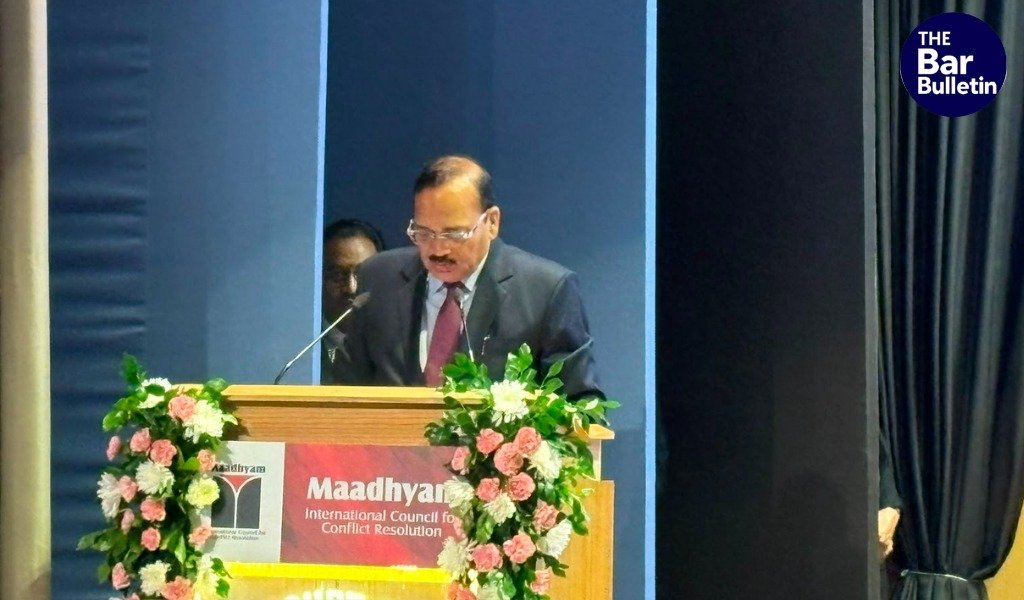

Addressing the inaugural ceremony of the International ADR Conference 2026, organised by the Maadhyam International Council for Conflict Resolution on the theme “ADR Pathways to Legal Harmony”, the Chief Justice of India, Justice Surya Kant, highlighted the growing importance of mediation in India’s justice delivery system and emphasised that its greatest strength lies in giving parties ownership over the resolution of their disputes.
Recounting an incident witnessed early in his career, he recalled two friends-turned-business partners who had been locked in a decade-old partnership dispute and had arrived in court as adversaries. A senior member of the Bar suggested that they first step into a smaller room and speak to each other. The conversation eventually resulted in the two former friends resolving their differences and themselves drafting the terms of their settlement.
“
“The two men who had arrived as adversaries left as partners once again, having drafted, in their own hand and their own words, terms that no order of any court could have given them.”
The CJI said the episode captured the essence of mediation because parties who participate in framing the terms of their resolution are more likely to honour them. In contrast, a party handed a judicial verdict may retain incentives to challenge, delay or otherwise resist its implementation. The address referred to research indicating that voluntary compliance with mediated settlements can be as high as 90 per cent, substantially higher than compliance with adjudicated outcomes.
Mediation Asks a Different Question
Drawing a distinction between adjudication and mediation, the CJI observed that litigation and arbitration primarily determinewho is right and what the law requires, whereas mediation asks what the parties can themselves accept and build upon.
While acknowledging the important role of arbitration in complex commercial disputes involving engineering, valuation and cross-border contracts, the address noted that a binding arbitral award does not necessarily translate into finality in practice, as parties may still pursue challenges and execution proceedings.
The speech also traced the modernisation of mediation, contrasting contemporary institutional mediation centres with trained professionals, case managers, encrypted digital files and online dispute resolution platforms, with the older perception of mediation as an informal process that could involve pressure towards reluctant compromises. It also highlighted emerging hybrid models such as med-arb-med, which combine mediation with targeted arbitral intervention before parties return to mediation.
India Can Become Global Mediation Centre
Turning to India’s mediation framework, the speaker highlighted the Mediation Act, 2023, describing it as India’s first standalone statutory architecture for mediation. The address noted that the legislation recognises party autonomy in choosing the mediator and procedure, gives mediated settlement agreements a status close to that of a decree and incorporates timelines aimed at balancing thoroughness with urgency. He also referred to Section 12A of the Commercial Courts Act, which had already made pre-litigation mediation mandatory for a wide category of commercial disputes.
The CJI said India had the potential to emerge as a global centre for mediation and highlighted that the country’s rapidly expanding economy required dispute-resolution infrastructure capable of handling increasingly complex domestic and cross-border disputes.
“
“There is no reason why India cannot establish herself as a genuine centre of mediation for the global community. Considering the momentum at which our economy is expanding, it is not enough to merely have adequate dispute resolution infrastructure, rather, it is essential that we develop it into a state-of-the-art framework that keeps pace with our astronomical growth. It is therefore heartening that the institutions in India capable of realizing this ambition are already beginning to take shape, and there is every reason to believe they can facilitate complex, cross-border mediations with the same confidence that international parties employ in commercial dispute resolution worldwide.”
He also credited the Indian judiciary for strengthening the institutional credibility of mediation through court-annexed mediation centres, judicial training, Mediation and Conciliation Committees within the High Courts and Supreme Court, and judicial precedents encouraging parties to explore mediation before proceeding deeper into litigation.
Concluding the address, he called for the legal fraternity to strengthen India’s existing ADR framework and help the country become one of the leading jurisdictions in the field of mediation worldwide.
Book Releases
In the inaugural session, CJI Surya Kant also released Maadhyam publications’ Book Vikalp, which was co-edited by Sakshi Vijay and Nisha Bhambhani.
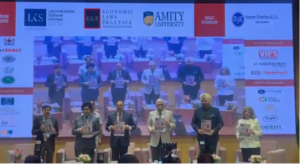
CJI also released the book Cross Cultural Intelligence.