
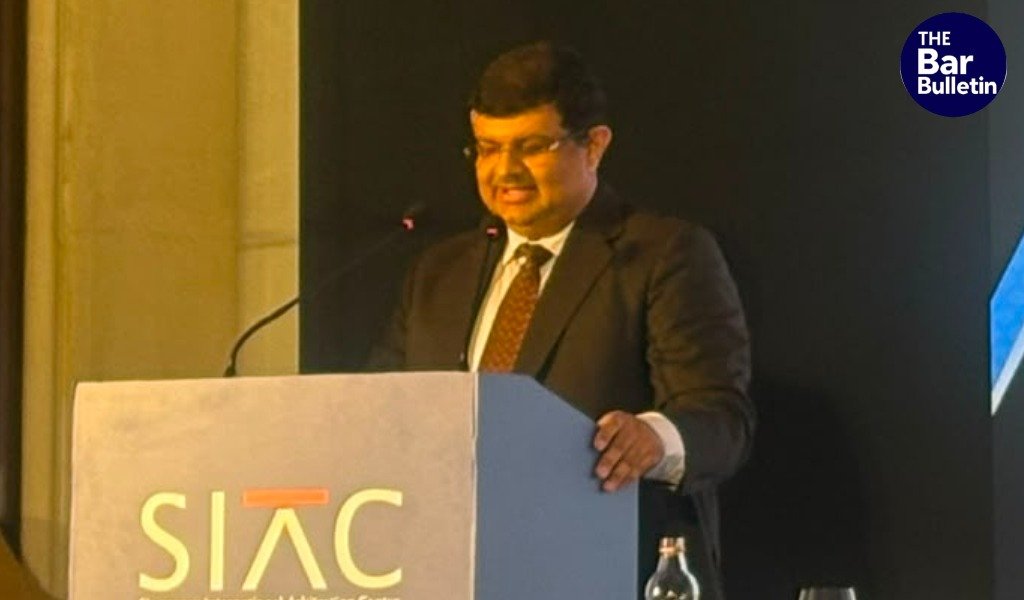
The opening of the Singapore International Arbitration Centre’s (SIAC) Delhi office marks a significant milestone in India’s emergence as a global arbitration hub and reflects the country’s growing role in shaping international arbitration, Justice Tejas Karia said while delivering the valedictory address at the SIAC India Conference.
Describing the inauguration as “more than a ceremonial event”, Justice Karia said SIAC’s Delhi office symbolises deeper engagement with India’s legal and commercial ecosystem.
“
“SIAC’s presence in Delhi is not merely about opening another office…. Setting up an office in Delhi will bolster SIAC’s institutional footprint in India. It is about building a closer bridge between an international institution and one of the world’s most dynamic legal and commercial communities,” he said.
Tracing SIAC’s engagement with India, he noted that after establishing its first overseas representative office in Mumbai in 2013, the Delhi office represents the next phase of that relationship. He added that Delhi, as India’s legal and policy capital, provides an ideal platform for sustained engagement with law firms, in-house counsel, arbitration practitioners, academic institutions and the judiciary.
Citing SIAC’s 2025 Annual Report, Justice Karia noted that India remained SIAC’s third-largest foreign user with 178 parties arbitrating at SIAC in 2025. Indian law was the third most frequently chosen governing law in SIAC arbitrations in 2025, while Indian arbitrators and members of the SIAC Court of Arbitration continue to play an active role in shaping the institution.
“
“India is not merely using international arbitration; it is helping shape it,” he remarked.
Reflecting on the conference theme, Justice Karia observed that arbitration is evolving alongside global commerce, with disputes increasingly involving artificial intelligence, cybersecurity, digital assets and geopolitical uncertainty. While users expect arbitration to be faster and more efficient, he cautioned that innovation should never come at the expense of procedural fairness.
Highlighting the SIAC Rules 2025, he referred to the Streamlined Procedure for disputes up to SGD 1 million and the newly introduced Protective Preliminary Order mechanism as examples of reforms balancing efficiency with fairness.
Concluding, Justice Karia said the long-term success of international arbitration depends on preserving confidence in arbitral institutions, emphasising that procedural reforms must remain anchored in impartiality, independence, enforceability and fairness. He expressed confidence that SIAC’s Delhi office would further strengthen collaboration between Indian and international arbitration communities while reinforcing India’s growing stature in global dispute resolution.