
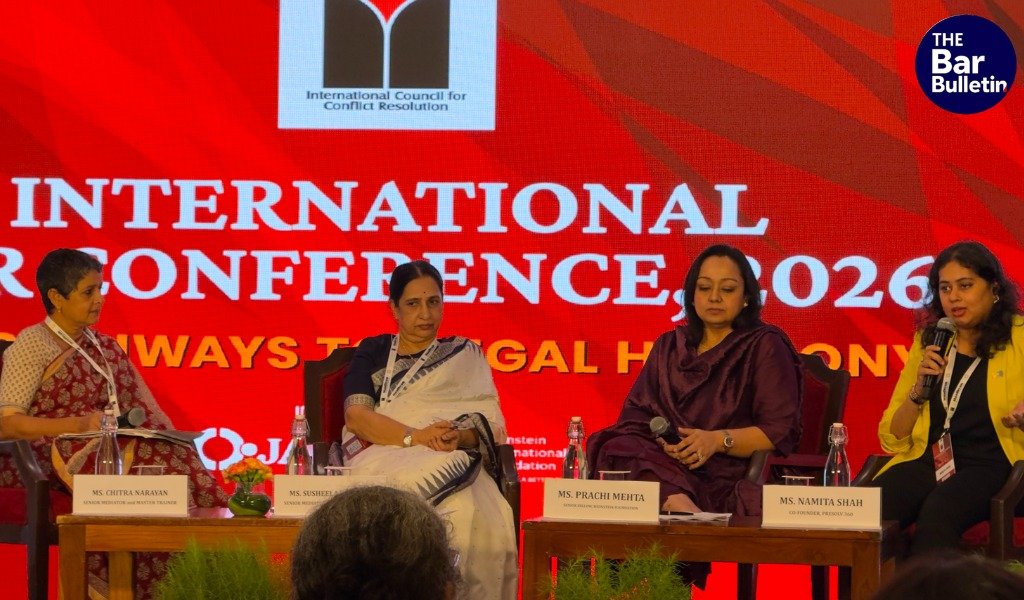

The importance of the Singapore Convention on Mediation in facilitating the enforcement of cross-border mediated settlement agreements took centre stage at a dedicated session on “Enforcing Cross Border Mediation Settlements”, where an all-women panel of leading mediation experts underscored the need for India to ratify the Convention and strengthen its position as a global dispute resolution hub.
Moderated by Ms. Chitra Narayan, Senior Mediator & Master Trainer and Senior Fellow, Weinstein International Foundation, the panel featured Senior Advocate Ms. Susheela Sarathi, Ms. Prachi Mehta, Founder of The ADR Group (TAG), and Ms. Namita Shah, Co-founder of Presolv360.
Opening the discussion, Chitra Narayan provided an overview of the Singapore Convention on Mediation, explaining its key provisions and limited grounds for challenging mediated settlement agreements. She noted that while India has enacted the Mediation Act, 2023, it is yet to ratify the Singapore Convention, and drew parallels between the Convention’s framework and the domestic legislation.
Highlighting the practical implications, Susheela Sarathi cautioned that the public policy exception could continue to pose interpretational challenges in the enforcement of mediated settlements. She stressed that India should move towards early ratification of the Convention to provide greater certainty to businesses engaged in cross-border commerce.
Prachi Mehta emphasised that ratification would significantly enhance international commercial confidence in India. She observed that the Singapore Convention would complement India’s Mediation Act by providing an internationally recognised enforcement mechanism for cross-border mediated settlements.
Discussing the present legal landscape, Mehta pointed out that businesses must carefully consider the choice of seat while structuring cross-border dispute resolution mechanisms. In response, Susheela Sarathi explained that until India ratifies the Convention, parties largely depend upon contractual arrangements and the existing legal framework under the Indian Contract Act and the Arbitration and Conciliation Act for enforcement. She remarked that without an effective enforcement mechanism, mediated settlements risk becoming little more than “paper decrees” for commercial parties.
Illustrating the competitive implications, she observed that countries such as Turkey and Sri Lanka, having ratified the Convention, could emerge as preferred venues for international mediation if India delays its accession.
Addressing technological developments in dispute resolution, Namita Shah noted that one of the Convention’s strengths is its technology-neutral framework, allowing mediated settlements to be conducted online or physically without affecting enforceability. At the same time, she stressed the importance of introducing safeguards relating to electronic signatures, confidentiality and authentication in digital mediation processes.
Looking ahead, Shah remarked that mediation may eventually evolve into formats using augmented reality, observing that the Convention is intentionally non-prescriptive and flexible enough to accommodate future technological innovations. Summing up the challenge for regulators, she observed:
“
“Policy will always have to play catch up with technology.”
The discussion also stood out for featuring an all-women panel, a relatively uncommon sight at major international dispute resolution conferences, bringing together diverse perspectives on the future of mediation and cross-border dispute resolution.