
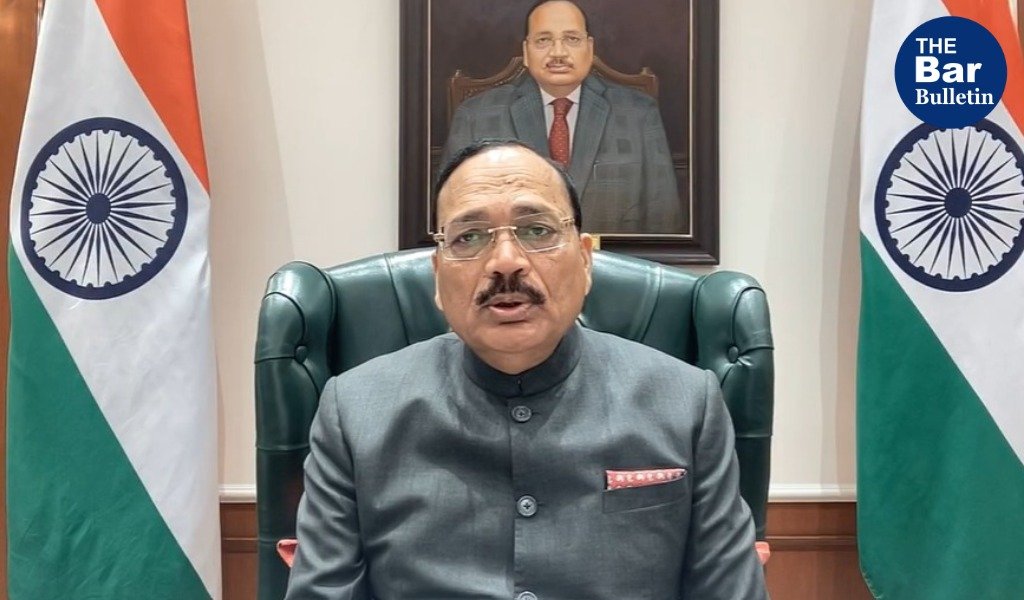

Chief Justice of India on Friday called for strengthening legal cooperation between India and Singapore through a two-way exchange of expertise, professional opportunities and institutional knowledge, emphasising that the partnership must be based on reciprocity and respect for the distinctiveness of both legal systems. Addressing the Symposium on “India-Singapore: From Shared Legal Foundations to the Future”, organised by the Indian Council of Arbitration (ICA) in Singapore, the CJI said that as trade, investment, technology and professional services increasingly crossed national borders, dependable legal institutions and effective dispute resolution mechanisms were essential to building commercial confidence.
In his keynote address, the CJI traced the historical legal links between India and Singapore, referring to the Charters of Justice of 1774, 1807 and 1826. He emphasised that their present relationship must be viewed as a partnership between sovereign equals, rather than a continuation of colonial arrangements.
He noted that bilateral trade had grown to USD 34.3 billion in 2024-25, with Singapore accounting for around 24% of India’s cumulative FDI inflows between April 2000 and March 2025. He also highlighted the importance of predictable dispute resolution mechanisms in facilitating cross-border commerce.
India-Singapore Legal Cooperation
The CJI referred to the 2024 Memorandum of Understanding between India and Singapore on cooperation in law and dispute resolution, which covers international commercial dispute resolution, alternative dispute resolution, exchange of expertise and information, and capacity building.
He also highlighted the first meeting of the India-Singapore Joint Consultative Committee on Cooperation in Law and Dispute Resolution in 2025, as well as the MoU exchanged between the ICA and the Law Society of Singapore during the India-Singapore ADR Conclave held in New Delhi on September 10, 2026. Emphasising the importance of sustained institutional engagement, the CJI stated:
“
“This relationship must rest on reciprocity and complementarity. India offers a large and dynamic market, a substantial pool of legal professionals and a growing ADR ecosystem. Singapore brings an established international commercial and dispute resolution environment and a strategic position in Asia. Neither needs to replicate the other’s institutional model. The opportunity is to learn from each other. The Corridor must be a two-way channel for expertise, professional opportunities and institutional knowledge, measured by the confidence it creates on both sides.”
Arbitration And Mediation
The CJI stressed that both arbitration and mediation must have an important place in the India-Singapore legal cooperation framework. While arbitration provides a structured process for resolving disputes through a neutral tribunal, mediation allows parties to pursue consensual settlements with the assistance of a neutral facilitator. He observed that in ongoing commercial relationships, preserving the relationship could be as important as resolving the immediate disagreement.
He further highlighted India’s growing engagement with mediation, including the establishment of the Mediation Council of India, as an opportunity for the two countries to exchange experiences on institutional design, professional standards, training and technology. The CJI also encouraged the early use of mediation, including through multi-tiered dispute resolution clauses, to ensure that the process adopted is proportionate to the nature of the dispute and the relationship between the parties.
The CJI said that courts remain an essential part of the dispute resolution framework and arbitration and mediation cannot operate in isolation from the judicial system. He observed that courts sustain the legal framework for alternative dispute resolution, while fairness, procedural discipline and appropriate judicial intervention reinforce confidence in dispute resolution mechanisms. He said:
“
“Courts remain an essential part of this framework. Arbitration and mediation do not operate in isolation: courts sustain the legal framework for ADR, while fairness, procedural discipline and appropriate judicial intervention reinforce confidence in dispute resolution. Courts and ADR institutions are complementary parts of a broader justice ecosystem, sharing the purpose of ensuring that disputes are resolved fairly, efficiently and in accordance with law.”
Concluding his address, the CJI said that the initiatives already underway between the two countries must translate into accessible procedures, professional exchanges and dispute resolution mechanisms that command confidence.
Referring to Singapore marking 200 years since the Second Charter of Justice of 1826, he said that the greater responsibility was to build legal institutions suited to an increasingly interconnected and technology-driven world.
He expressed confidence that India and Singapore could give renewed substance to their partnership by developing a legal corridor that facilitates not only dispute resolution but also the exchange of ideas, expertise, talent and institutional experience.