
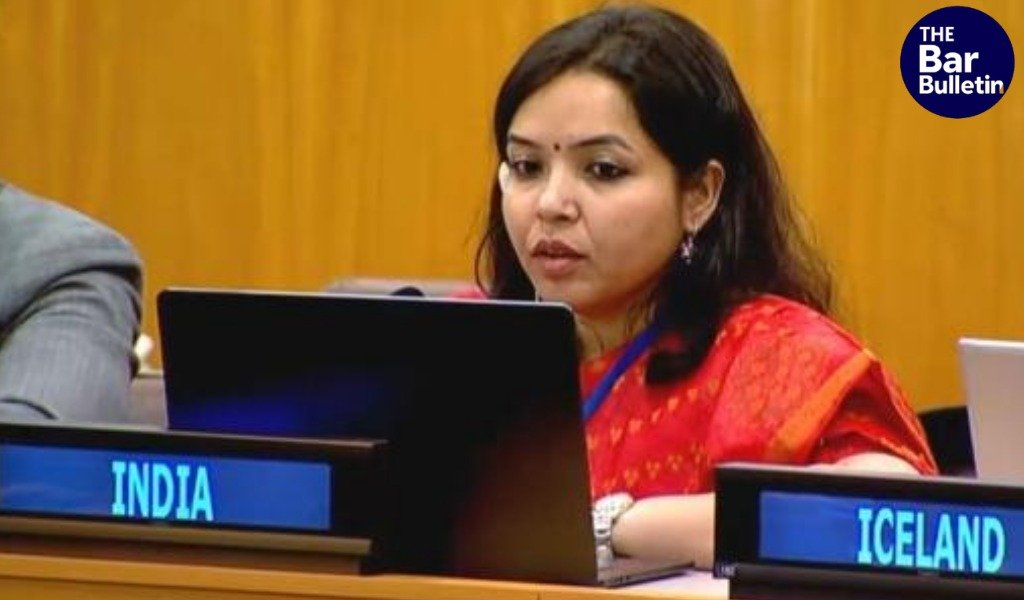

India has defended its constitutional safeguards against enforced disappearances before the United Nations, citing Article 21, the writ of habeas corpus and human rights commissions, amid international scrutiny over the police response to youth-led protests in Delhi and allegations of mass detentions and ill-treatment.
Barkha Tamrakar, Deputy Secretary in the Ministry of External Affairs, delivered India’s statement at the United Nations General Assembly’s Third Committee during a discussion on the Working Group on Enforced or Involuntary Disappearances. Her remarks came as more than 20 UN human rights experts raised concerns over what they described as a repeatedly heavy-handed police response to peaceful youth-led demonstrations in New Delhi and other parts of India. The experts flagged allegations of arbitrary detention, excessive force and restrictions on peaceful assembly.
Addressing the UN, she highlighted the constitutional protection of life and personal liberty and the judiciary’s power to intervene where a person’s detention is unlawful.
“
“India is a vibrant democracy anchored in the rule of law. Article 21 of our Constitution guarantees the right to life and personal liberty. Our independent judiciary is fully empowered to issue the writs of habeas corpus, thus providing a strong and readily accessible safeguard against any alleged disappearance.
The law enforcement authorities in India are fully bound to act within the framework of law. The National Human Rights Commission and State Human Rights Commissions offer effective avenues for complaint and redressal mechanisms. The Right to Information Act has further strengthened transparency and accountability in governance, further supplemented by the presence of independent media and dynamic civil society.”
The Indian statement came amid concerns raised by UN human rights experts over the handling of recent protests. The UN Human Rights Office had also expressed concern over reports of mass detentions of demonstrators, protest leaders, civil society members, lawyers and journalists in Delhi before and during large-scale demonstrations.
The concerns included allegations of excessive police force, arbitrary detention and restrictions on peaceful assembly. The UN experts called for accountability for reported violations and urged Indian authorities to respect the right to peaceful protest. These remain allegations raised by the experts and do not, by themselves, establish that the detained protesters were subjected to enforced disappearance.
India has previously rejected the UN Human Rights Office’s criticism of its handling of the Delhi protests, describing the concerns as unwarranted interference in the country’s internal affairs.
India called on states to prevent enforced disappearances and ensure accountability. Ms Tamrakar said that India’s engagement with international human rights mechanisms must be guided by dialogue, cooperation, transparency and non-selectivity, warning against using human rights as an instrument of political pressure or selective country targeting. She urged UN delegations to cite reports faithfully and not treat humanitarian communications as verdicts, asserting that unverified allegations and incomplete statistics should not be used to negatively characterise India.
“
“India has signed the International Convention for the Protection of All Persons from Enforced Disappearance. India engages with international human rights mechanisms, but such engagement must be based on dialogue, consultation, cooperation with non-selectivity and transparency as guiding principles, human rights not to be used as an instrument of political pressure or selective country targeting.
We call on delegations to cite the report faithfully, not to inflate a humanitarian communication into a verdict. India remains prepared to clarify specific properly documented cases through established channels, but India firmly opposes any attempt to convert unverified allegations, incomplete statistics or a report that contains no India country observation into a negative characterisation of the world’s largest democracy.”