
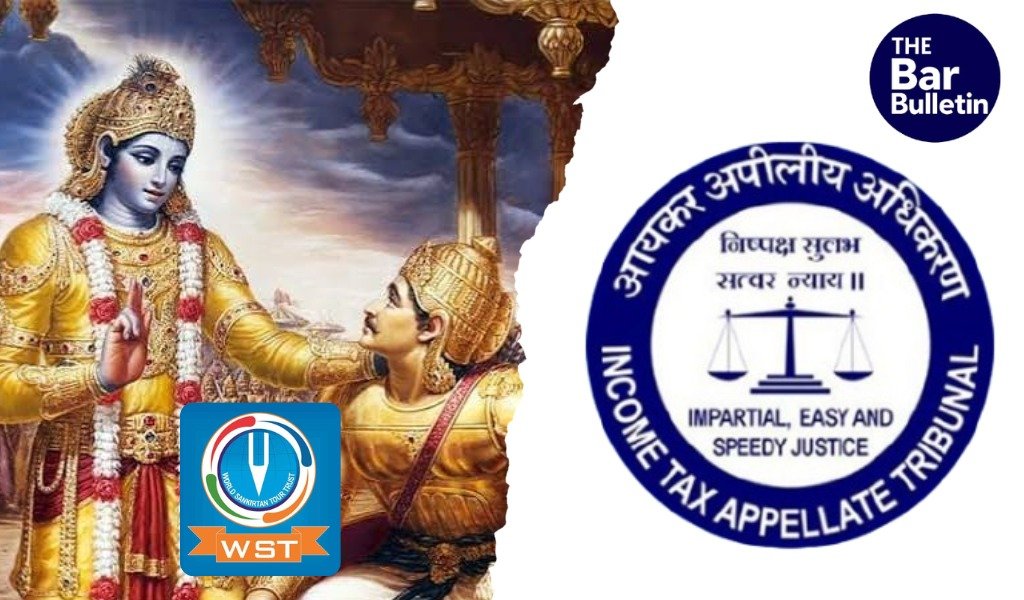

The Chandigarh Bench of the Income Tax Appellate Tribunal (ITAT) has clarified that the true character of a trust is determined by its dominant objects and actual activities, not by a dormant incidental clause in the trust deed. The Tribunal held that dissemination of the Bhagavad Gita’s universally recognised ethical and philosophical teachings does not amount to propagation of religion within the meaning of Explanation 3 to Section 80G(5) of the Income Tax Act, as the Gita expounds universal principles of duty, selfless action, and moral conduct without prescribing any exclusive ritual or worship.
Furthermore, the ITAT held that even if any activity were assumed to be religious, Section 80G(5B) operates as an independent statutory bar against denial of approval where religious expenditure remains below the five-percent ceiling. Accordingly, the ITAT directed the CIT(E) to issue fresh registration as a charitable institution under Section 12AB and grant approval under Section 80G of the Income Tax Act.
The Division Bench comprising Laliet Kumar (Judicial Member) and Manoj Kumar Aggarwal (Accountant Member) reaffirmed that the true character of a trust must be assessed from its predominant objects coupled with actual activities, not from an isolated trust-deed clause that has never been acted upon. Since the assessee’s temple-renovation object remained wholly unimplemented since inception and the Revenue failed to rebut a categorical undertaking to that effect, classifying the trust as a religious entity was unsustainable.
Emphasising that Bhagavad Gita teachings are universal ethical philosophy, not religious propagation, the Tribunal distinguished between religion and ethical-philosophical instruction, holding that the Gita’s core themes, Karma Yoga, selfless action, equanimity, Lokasangraha, and moral responsibility, prescribe no exclusive ritual or form of worship. Reliance on the Gita by Tilak, Gandhi, and Vinoba Bhave as a guiding force for the freedom movement underscored its transcendence beyond denominational religion.
Constitutional provisions reinforce charitable character of cow-welfare activities. Article 48 (preservation of cattle breeds), Article 51A(f) (preserving composite cultural heritage), and Article 51A(g) (compassion for living creatures) collectively frame gaushala maintenance and cattle protection as matters of public welfare and animal welfare, not religious activity, even if certain religious traditions revere cow protection.
Section 80G(5B) provides an independent statutory safe harbour. The non obstante clause in Section 80G(5B), effective from 01.04.2000, prohibits denial of 80G approval merely because an institution incurs religious expenditure, provided it does not exceed five per cent of total income. Since the assessee’s alleged religious expenditure was undisputedly below this threshold, the CIT(E)’s failure to even consider this provision was a fatal error, added the Tribunal.
Briefly, the assessee-trust, World Sankirtan Tour Trust, was constituted with its principal objects being the protection and preservation of stray cattle, cows and their progeny, establishment and maintenance of gaushalas, providing shelter, food and veterinary care to abandoned, old and infirm cows. The assessee was granted provisional registration under Section 12AB of the Income-tax Act. Later, though the CIT(Exemptions) accepted the genuineness of the objects and activities of the assessee, however, granted the registration by categorising it as a ‘Religious Entity’.
Consequently, while considering the application under Section 80G, the CIT(E) observed that the assessee was engaged in religious discourses on the Bhagavad Gita and their broadcasting and telecasting, and therefore held that the activities were religious in nature. The CIT(E) rejected the application for approval under Section 80G.
