
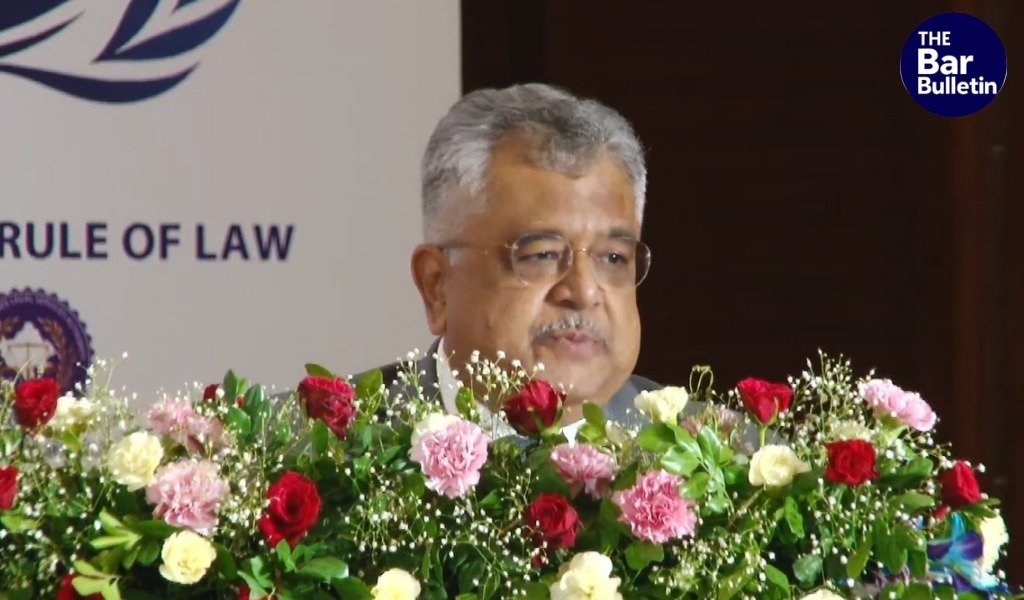
Solicitor General Tushar Mehta on Friday highlighted the need to strengthen conciliation as an effective alternative to litigation, observing that while court battles often leave “even a winner” wounded, conciliation enables both parties to walk away with dignity. He also stressed that the government, being the country’s largest litigant, requires a structured institutional mechanism to meaningfully participate in conciliation proceedings. He remarked:
“
“When I represent the Government of India, I always find it difficult as to how you ensure that the Government itself participates in conciliation, because Government is not an individual who can take a decision. It is a body of collective individuals, each having its own rules of functioning and its own jurisdiction. Can something be done to ensure that Government officers are trained in the art of conciliation—not as mediators, but as participants? Can some mechanism be evolved which authorises an officer of a particular rank to take decisions on behalf of the Government? The Government is the largest litigant. It should not function under the fear of future consequences for taking a bona fide decision. That can happen only if there is a structured and authorised institutional mechanism. At least in matters of some significance, there should be a mechanism to consider conciliation rather than litigation.”
Speaking at the inaugural session of the three-day Commonwealth Peace Mediation Conference 2026 on the theme “Commonwealth Peace Mediation and the Rule of Law”, Mr Mehta said conciliation differed fundamentally from litigation in both its process and outcome. He highlighted the fundamental distinction between litigation and conciliation,
● First, it is inclusive; nobody is separated.
● Second, it is long-lasting, once and for all.
● Third, and most important, in case of litigation, it is like a battle. Even a winner leaves the court with wounds. In case of conciliation, both leave with healing. That, perhaps, is the real role of a conciliator.
Rejecting the notion that conciliation is a concept borrowed from the West, Solicitor General argued that it has always been an integral part of India’s civilisational ethos. Drawing from Indian epics, he said Lord Rama first sent a message of peace to Ravana before attacking Lanka, while Lord Krishna made repeated efforts to persuade Duryodhana to avoid the Kurukshetra war by accepting a peaceful settlement.
Congratulating Senior Advocate Aruneshwar Gupta on the launch of his autobiography, Death of My Mistress “The Law”, Birth of My Love “Justice”, Solicitor General Tushar Mehta humorously reflected on how the titles of autobiographies often have fascinating backstories. Recalling the anecdotes behind Amrita Pritam’s Raseedi Ticket (Revenue Stamp) and former US President Ronald Reagan’s Where’s the Rest of Me?, Mehta quipped that he was now eager to discover the story behind Gupta’s “bold” title.
He concluded by thanking the organisers and expressing his pleasure at participating in the seminar.