
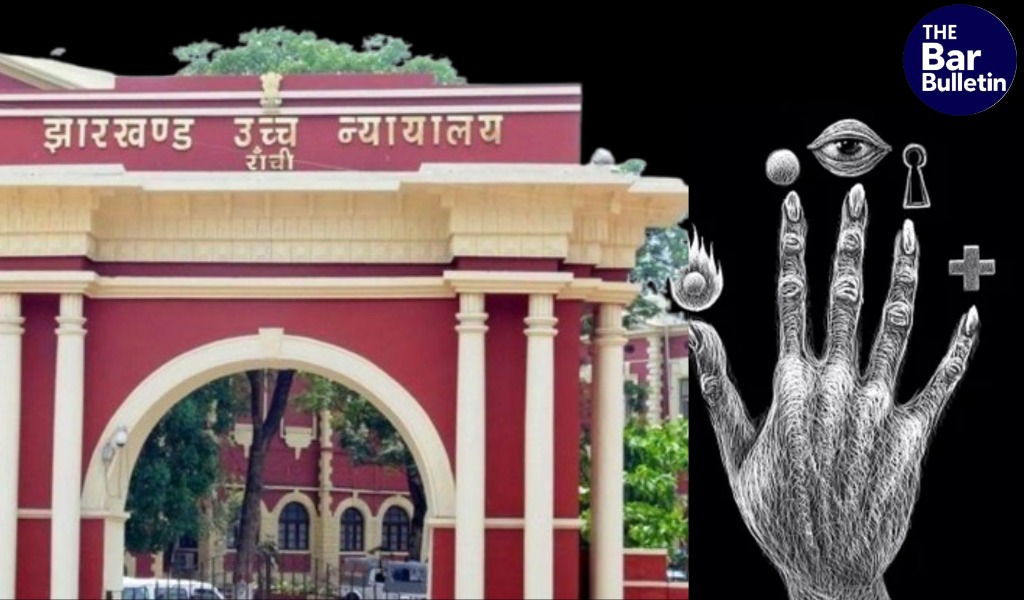

The Jharkhand High Court has acquitted a man convicted for the 1996 murder of a woman allegedly branded a “witch”, holding that the prosecution failed to establish the charge beyond reasonable doubt as the conviction was founded on the testimony of an unreliable sole eyewitness.
A Division Bench of Justice Sujit Narayan Prasad and Justice Pradeep Kumar Srivastava allowed the criminal appeal filed by Mansu Manjhi, setting aside the trial court’s judgment convicting him under Section 302 IPC and sentencing him to life imprisonment.
The prosecution alleged that the appellant, along with another accused, attacked the deceased in a paddy field because they believed she was a “Dain” (witch). While the co-accused had been acquitted by the trial court, the appellant’s conviction rested primarily on the testimony of the deceased’s son, who claimed to have witnessed the assault.
Examining the evidence, the High Court found material contradictions between the informant’s testimony and that of his wife. While the informant claimed he had witnessed the assault, his wife deposed that she and her husband reached the spot only after hearing cries and found the deceased already lying dead. The Court held that this contradiction struck at the very root of the prosecution’s case and rendered the informant’s claim of being an eyewitness doubtful.
The Bench also noted another significant inconsistency regarding the weapon allegedly used in the assault. The informant’s initial statement referred to an axe, whereas during trial he stated that the appellant had assaulted the deceased with a sword. According to the Court, this was a material contradiction affecting the credibility of the prosecution version.
Reiterating the settled principle that a conviction can be based on the testimony of a solitary eyewitness only if such evidence is wholly reliable and inspires confidence, the Court held that the informant’s testimony failed to meet this standard.
The High Court further observed that the Investigating Officer had not been examined during trial, resulting in the prosecution’s failure to establish the place of occurrence. It also noted that several prosecution witnesses, including the inquest witnesses, had turned hostile, further weakening the prosecution case.
Holding that the prosecution had failed to prove the charge under Section 302 IPC beyond reasonable doubt, the Division Bench extended the benefit of doubt to the appellant, quashed the conviction and sentence, and allowed the appeal.
