
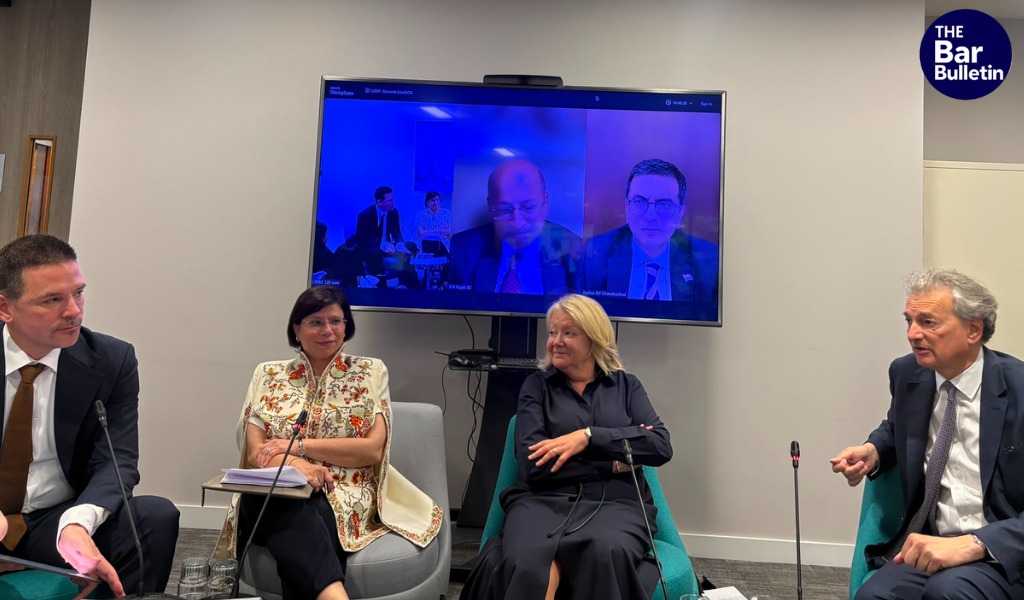

Speaking at an event organised by Stewarts Law during LIDW, Former Chief Justice of India Justice D.Y. Chandrachud said India has made significant progress in developing an arbitration-friendly legal framework but remains on a continuing journey towards becoming a leading global arbitration jurisdiction.
Justice Chandrachud was speaking during a panel discussion moderated by Sherina Petit, Head of International Arbitration at Stewarts, and Kevin Nash, Director General of the London Court of International Arbitration (LCIA), alongside leading international arbitration practitioners and jurists including V.K. Rajah SC, Paula Hodges KC and David Joseph KC.
Opening the discussion, Sherina Petit asked Justice Chandrachud to reflect on his unique journey from counsel and senior advocate in Mumbai to Chief Justice of India and now full-time arbitrator. Responding, Justice Chandrachud highlighted the fundamental distinction between courts and arbitration, observing that while courts exercise sovereign authority and create public precedent, arbitration derives its legitimacy from party consent and autonomy.
“
Arbitration has been less a departure from judging and more a continuation of adjudication in a different register
Justice Chandrachud said, adding that fairness, reasoned decision-making and procedural integrity remain common to both systems.
He noted that arbitration has evolved dramatically since he joined the Bench in 2000, transforming from an extension of civil litigation into a specialised field supported by institutions and expert practitioners. He also emphasised that courts and arbitration should be viewed as complementary systems rather than substitutes.
Kevin Nash then invited V.K. Rajah SC, former Attorney-General of Singapore and former Judge of Appeal, to discuss Singapore’s emergence as a global arbitration hub. Rajah attributed Singapore’s success to deliberate policy choices, judicial consistency, institutional investment and an early commitment to international best practices.
“
Singapore’s rise was not accidental. It was the product of a coordinated state strategy,” Rajah said, highlighting the country’s adoption of the UNCITRAL Model Law, support for international practitioners and sustained investment in arbitration infrastructure.
Turning to Paula Hodges KC, Sherina Petit asked what had surprised her most about arbitration’s evolution over the past three decades. Hodges described the transformation of arbitration from a niche practice dominated by a handful of jurisdictions into a truly global dispute resolution mechanism.
She pointed to increasing diversity among practitioners, the growth of arbitration centres around the world and the continued importance of party autonomy and procedural flexibility.
Kevin Nash then asked David Joseph KC whether arbitration was becoming too similar to litigation. Joseph challenged the notion that arbitration and litigation are competing systems, arguing instead that each has lessons to offer the other.
He identified procedural management, document production and the drafting of arbitral awards as areas where arbitration could benefit from greater efficiency and clearer reasoning.
In a follow-up exchange with Sherina Petit, Joseph advocated for more robust and analytical arbitral awards, suggesting that arbitrators should be prepared to engage directly with legal arguments and explain their reasoning in a manner similar to courts.
The discussion later returned to India when Kevin Nash asked Justice Chandrachud how Indian courts have balanced judicial oversight with arbitral autonomy. Reflecting on India’s arbitration journey, Justice Chandrachud acknowledged both progress and remaining challenges. He said:
“
While India has indeed travelled a long distance, we are still short of the destination.
He noted that legislative reforms and landmark judicial decisions have helped restore confidence in India’s arbitration framework by reinforcing party autonomy, limiting unnecessary judicial intervention and encouraging institutional arbitration.
Justice Chandrachud also emphasised the need to make arbitration more accessible for MSMEs and smaller businesses, while continuing to strengthen institutional capacity and user confidence.
“
During the life of an arbitration, courts should function primarily as facilitators
he said, stressing that judicial intervention should support rather than supplant arbitral decision-making.
In the final segment, Sherina Petit invited both Justice Chandrachud and V.K. Rajah SC to address the relationship between international arbitration and national courts.
Rajah described the interaction as a necessary feature of the global arbitration system, noting that enforcement of awards ultimately depends on national legal frameworks. Justice Chandrachud agreed, observing that arbitration works best when courts provide principled support while respecting arbitral autonomy.