
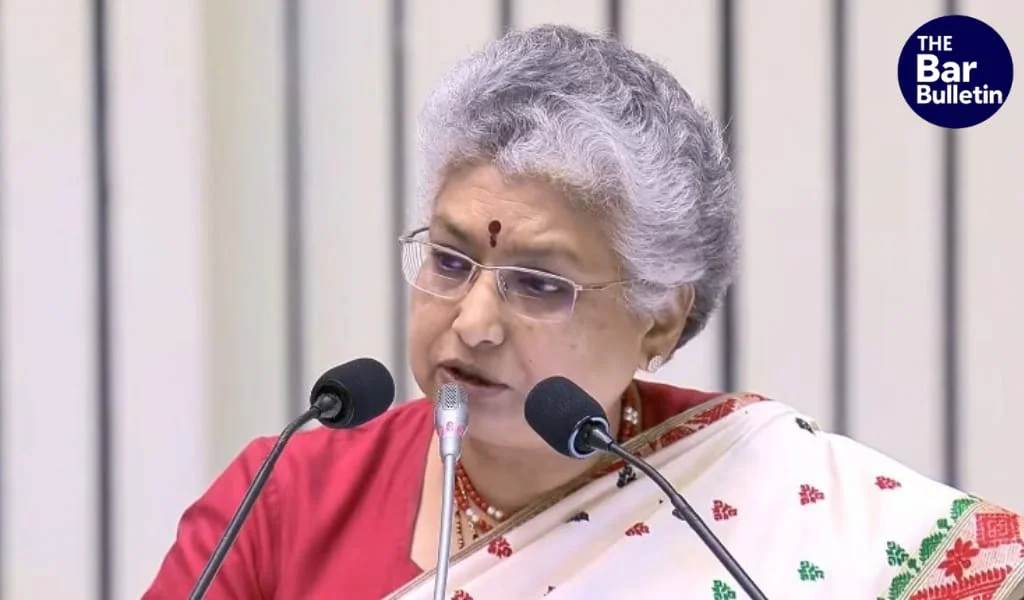

Justice BV Nagarathna, Judge, Supreme Court of India, has called upon Indian society, particularly men, to introspect on the barriers that continue to prevent women from exercising their constitutional rights, including the right to education, marital choice, career, property and safety. Calling for a change in social attitudes, she said:
“
“Indian society, particularly the male society, needs to introspect on this critical aspect if the cherished goals of our Constitution are to be achieved by the women of India. The right to be born as a girl child, the right to education, marital choice, to pursue a career of one’s choice, the right to inherit property and safe conditions for women both at home as well as in the workplace and most importantly on the public street are salient aspects which would empower women to a large extent in India.”
Delivering the inaugural Cornelia Sorabji Memorial Lecture titled, “The Doors She Opened: Cornelia Sorabji and the Progress of Women’s Rights in India”, at Somerville College, University of Oxford, Justice Nagarathna reflected on the evolution of women’s rights in India and the continuing challenges in achieving substantive equality.
Recalling Cornelia Sorabji’s struggles, she highlighted how Sorabji was denied a government scholarship because she was a woman and, despite passing her Oxford examination in 1892, received her degree only in 1922. She also referred to Regina Guha, whose application for enrolment as a pleader was rejected by a five-judge bench of the Calcutta High Court in 1916. The legal barrier was subsequently removed through the Legal Practitioners (Women) Act, 1923.
She reiterated her call for at least one-third reservation for women lawyers in government panels, public sector organisations and legal aid, stressing that women’s participation in the legal profession must extend beyond mere entry to professional advancement and institutional leadership. Advocating greater representation of women in the legal profession, Justice Nagarathna stated:
“
“I have consistently advocated for at least one-third reservation for women lawyers as government advocates on government panels in public sector organizations and in the sphere of legal aid. If women are to participate equally in the administration of justice, their representation must extend beyond the right to enter the profession. It must encompass opportunities to represent the state, advise public institutions and participate in the exercise of legal authority. The door of the legal profession must after all remain open not only to entry but to professional advancement and institutional leadership.”
She said that while constitutional guarantees and judicial interventions have significantly advanced women’s rights, structural inequalities continue to restrict their effective exercise. Highlighting the challenges that remain, she pointed to women’s safety, economic inequality, the disproportionate burden of unpaid domestic work and the social barriers preventing women from accessing justice.
Justice Nagarathna further emphasised that the mere presence of women in high public offices cannot be treated as evidence that gender equality has been achieved across society. She also called upon Indian society, particularly men, to introspect on the barriers preventing women from exercising their constitutional rights.
Concluding her address, Justice Nagarathna stressed that women are seeking their basic constitutional entitlements, including the right to education, marital choice, employment, inheritance and safety, rather than any special favour from society.