
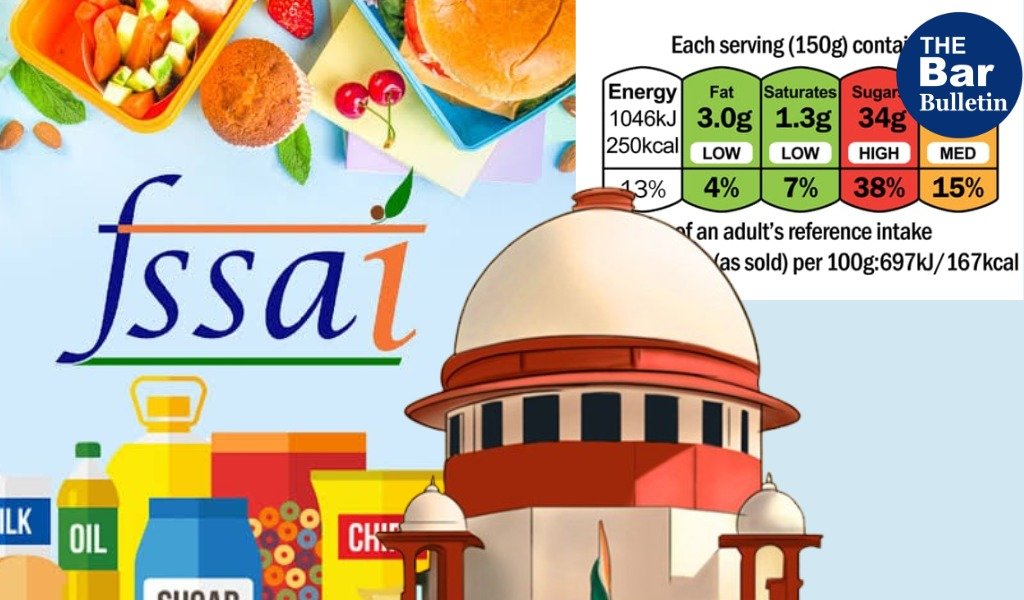

Placing the constitutional right to health at the centre of India’s food regulation framework, the Supreme Court has delivered a landmark public health ruling holding that the right to health under Article 21 is not confined to access to medical treatment. It also includes the right to a healthy food environment and the right to make informed dietary choices.
Recognising the growing burden of obesity, diabetes, hypertension and other non-communicable diseases, the Court directed FSSAI to implement a stronger Front-of-Pack Nutrition Labelling (FoPNL) regime for packaged foods. Among other directions, the Court mandated prominent warning labels for foods high in total sugars, saturated fat and salt, required separate warning symbols for each nutrient of concern, and emphasised the use of pictorial warnings to ensure that labelling remains understandable across literacy and language barriers.
Importantly, the Apex Court treated food labelling not merely as a regulatory exercise but as a constitutional tool for advancing the rights to health, safe and nutritious food, and informed consumer choice. The Court also made it clear that public health considerations cannot be subordinated to commercial interests or prolonged regulatory indecision.
Briefly, the petition was filed by 3S and Our Health Society, a public health organisation, seeking implementation of an effective Front-of-Pack Nutrition Labelling (FoPNL) regime for packaged foods in India. The petitioner argued that excessive consumption of foods high in sugar, salt and fat, as well as ultra-processed foods, is contributing to rising cases of obesity, diabetes, hypertension, cardiovascular diseases and other non-communicable diseases (NCDs), and that consumers require simple warning labels to make informed food choices.
The Food Safety and Standards Authority of India (FSSAI) had earlier proposed a star-rating system known as the Indian Nutrition Rating (INR). However, after receiving about 14,000 stakeholder comments and considering the recommendations of its Expert Committee, the proposal failed to achieve consensus and was eventually abandoned. The Expert Committee noted that interpretive warning labels were more effective than numerical or non-interpretive disclosures in helping consumers understand health risks.
Thereafter, FSSAI proposed alternative approaches, including merely displaying recommended daily allowances and later introducing red hexagonal warning labels. Since several aspects of the proposal remained disputed, the matter again came before the Supreme Court for final directions.
A Two-Judge Bench comprising Justice J.B. Pardiwala and Justice K. Vinod Chandran significantly expanded Article 21 jurisprudence by holding that the State’s obligation is not confined to providing healthcare facilities. It must also address the root causes of disease by regulating unhealthy food environments, particularly the growing consumption of HFSS and ultra-processed foods linked to India’s NCD epidemic.
Emphasising that food labelling is a constitutional obligation, not merely a regulatory choice, the Bench recognised that effective Front-of-Pack Nutrition Labelling (FoPNL) is a constitutionally justified public-health measure that furthers the rights to health, safe food and informed decision-making. The judgment treats nutrition labelling as a tool for enforcing fundamental rights rather than a matter of administrative policy alone.
The Court held that dignity and autonomy require consumers to receive clear, accessible and understandable nutritional information. Labels designed only for literate or nutritionally aware consumers defeat the constitutional goal of informed choice, particularly in a diverse country with varying literacy and language levels.
Rejecting weaker disclosure models, the Court directed FSSAI to proceed with warning-style labels that separately identify foods high in total sugars, saturated fat and salt. It mandated pictorial warnings, separate hexagons for each nutrient-of-concern, meaningful size requirements and prominent visibility standards so that warnings can be understood instantly at the point of purchase.
Further, the Apex Court expressed concern over prolonged delays and stakeholder deadlocks, emphasising that commercial interests cannot override public health objectives. Where consensus cannot be achieved, FSSAI must prioritise consumer protection, health outcomes and constitutional rights rather than industry convenience.
