
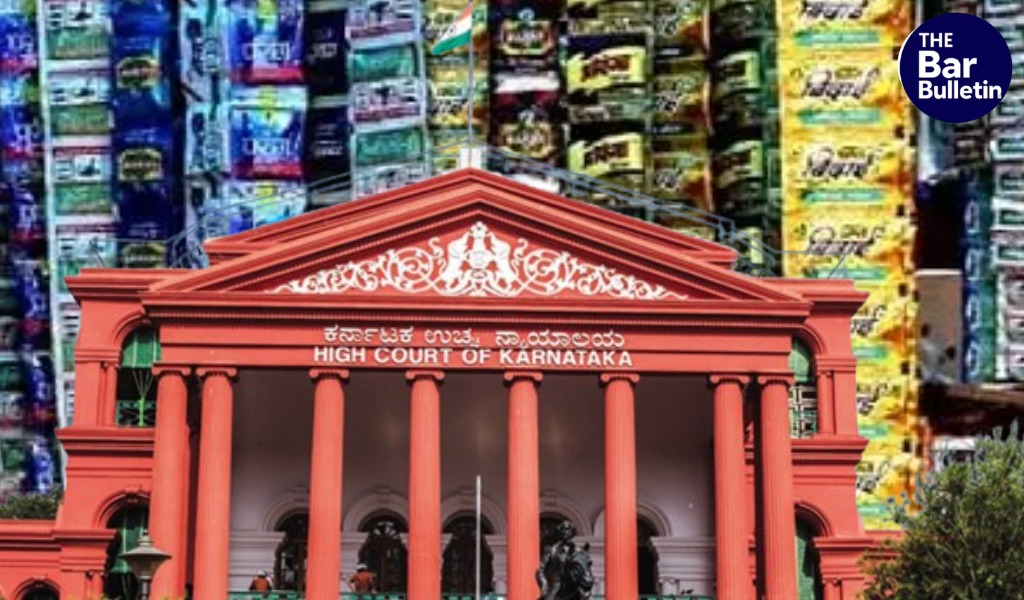

The Karnataka High Court (Bengaluru Bench) has held that while Parliament is competent to impose a cess under its residuary powers, the Health Security se National Security Cess Act, 2025 and the 2026 Rules failed Article 14 because the levy was based on assumed machine capacity and deemed production rather than actual output. The Court therefore upheld the Union Government’s legislative competence to enact a cess law on pan masala manufacturers, holding that the impugned levy was neither GST nor a surcharge under Article 271, but a separate impost traceable to Parliament’s residuary power.
Nevertheless, the Court struck down the Health Security se National Security Cess Act, 2025 and the Health Security se National Security Cess Rules, 2026 because the levy was structured on machine ownership, rated speed and assumed production capacity, not on actual production. The Court clarified that Parliament does have legislative competence to enact a cess law of this nature under Article 246(1) read with Entry 97 of List I, because the impugned levy is neither GST under Article 246A nor a surcharge under Article 271. But even where legislative competence exists, the levy must still satisfy Article 14.
Here, the impugned Act and Rules failed that test because the cess was structured on assumed or deemed production based on machine capacity slabs rather than actual production, resulting in arbitrary and discriminatory treatment of manufacturers who were not similarly placed in terms of real output.
The Court further held that the abatement framework was also unconstitutional because it allowed relief only when the machine remained shut for at least fifteen continuous days, without accommodating shorter but genuine periods of non-operation. This made the Rules oppressive and arbitrary. Therefore, the vice in the legislation was not the Union’s power to levy cess as such, but the unreasonable manner in which the cess was designed, quantified and enforced.
Also Read Accused Spouse’s Status as Co-Borrower Not Enough to Attach Entire Property: Bombay HC
A Single Judge Bench of Justice M. Nagaprasanna first examined the constitutional background after the 101st Constitutional Amendment, including Articles 246A, 269A, 270, 271 and 279A, and the shift of indirect taxation into the GST framework. It noted that GST laws already governed the levy of tax on supply of goods and services, including pan masala. The Court then examined the impugned Act and Rules in detail, particularly the provisions defining taxable person, levy of cess, computation based on machine speed and weight, and the abatement mechanism.
On the issue of legislative competence, the Court rejected the petitioners’ argument that Parliament lacked power to enact such a cess law. It held that the impugned cess was not GST because the taxable event under the Act was ownership or possession of the installed machine, and not supply of goods or services. The Court also accepted that the levy was not a surcharge under Article 271. Since the levy did not fall within Article 246A and was not barred as a surcharge on GST, Parliament could legislate under Article 246(1) read with Entry 97 of List I, which confers residuary legislative power including power to impose taxes not mentioned in List II or List III.
However, after upholding legislative competence in principle, the Court held that the actual design and operation of the Act and Rules were arbitrary and discriminatory. The Court found that the levy was effectively on deemed production, not actual production. A machine capable of producing 500 pouches per minute attracted the same cess even if it produced only 250 or even 100 pouches per minute. Likewise, manufacturers with very different actual capacities within the same slab were treated identically. In the Court’s view, this absence of rational differentiation meant that unequals were being treated equally, which directly attracted Article 14.
The Court specifically noted that the petitioners’ machines in many cases operated at less than 500 pouches per minute, but the cess structure presumed a uniform slab-based capacity. This, according to the Court, had no rational nexus to actual manufacture. The Court also referred to the petitioners’ computation table and observed that the cess burden imposed on machinery could produce a grave discrepancy between tax incidence and the MRP/value of goods, which bordered on arbitrariness under Article 14.
The Court also found Rule 15 of the Rules arbitrary because abatement was permitted only if the machine remained non-operative for a continuous period of at least fifteen days. The Rule ignored genuine business interruptions of shorter duration caused by machinery breakdown, shortage of labour, shortage of raw materials or maintenance shutdowns. The Court held that denying relief in all such genuine cases merely because the stoppage was shorter than fifteen days was arbitrary and violative of Article 14. It rejected the Union’s defence that the fifteen-day threshold was necessary as an anti-evasion measure, holding that administrative convenience or suspicion of evasion could not justify such an inflexible and harsh rule.
Briefly, the batch of petitions challenged the constitutional validity of the Health Security se National Security Cess Act, 2025, and the Health Security se National Security Cess Rules, 2026. The petitioners were manufacturers of pan masala falling under Tariff Item 2106 90 20, who used pouch packing machines for production and sale of pan masala in retail packs. Before the impugned law came into force, pan masala was already subject to GST under the post-2016 GST regime, including levy under the CGST and IGST framework. The challenge arose after Parliament enacted a fresh cess law in 2025 to levy cess on machines installed or processes undertaken for manufacture of specified goods such as pan masala.
The petitioners argued that the Constitution did not permit the Union Government to impose such a cess on presumed or deemed manufacture, especially when pan masala was already subject to GST. Their case was that the levy was not based on actual production, but on machine capacity and assumptions about quantity manufactured. They also challenged the scheme as arbitrary, vague and violative of Articles 14 and 19(1)(g) of the Constitution. In substance, their grievance was that cess was being demanded merely because a person owned or operated a machine, regardless of what was actually produced.
The Union of India defended the law by saying that the impugned cess was not GST and not a surcharge under Article 271, but a separate fiscal impost enacted in public interest to address revenue leakage and public health concerns in the pan masala sector. The Government’s stand was that pan masala was a tax-evasion-prone sector and that transaction-based taxation had failed, so the cess was structured around machine ownership and production capacity, which according to the Union could not be easily suppressed. The Union relied on Parliament’s residuary legislative power under Article 246(1) read with Entry 97 of List I.
