
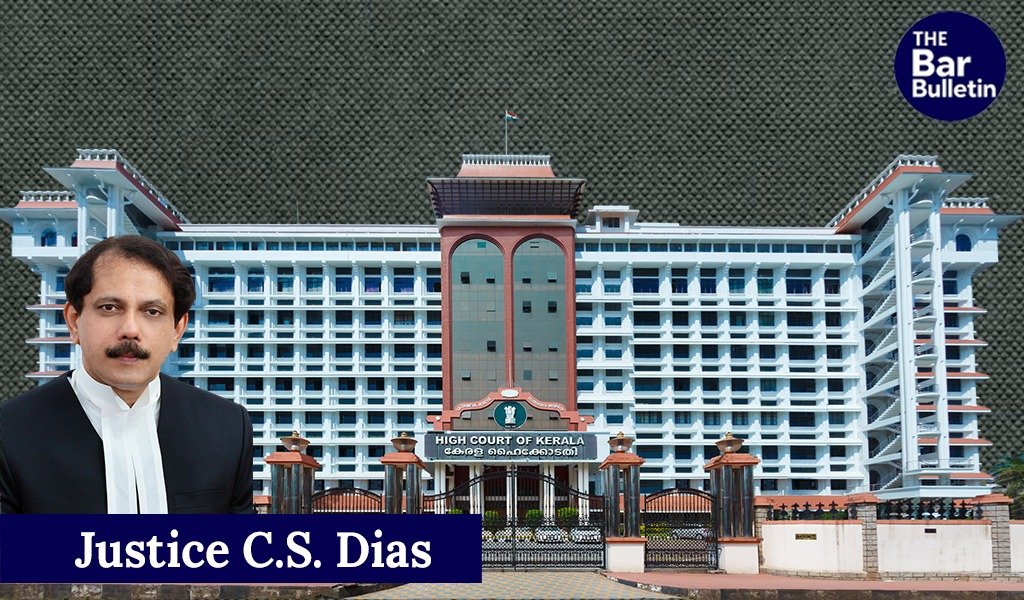

The Kerala High Court (Ernakulam Bench) has held that a defect in the form of the cause title, where the name of the authorised representative precedes that of the Society or Company, is merely technical and cannot defeat an otherwise maintainable prosecution, particularly where the complaint read as a whole makes it clear that the proceedings have been instituted by the Society through its duly authorised officer, and where the bye-laws and a resolution of the Managing Committee establish the competence and authority of the person who instituted the complaint.
The Court also clarified that a hyper-technical objection founded solely on the form of the cause title, and not on the competence or authority of the person who filed the complaint, cannot be permitted to defeat a legitimate prosecution. The complaint was therefore held to have been filed by the Society, the payee of the cheque, represented by its duly authorised Secretary
A Single Judge Bench of Justice C.S. Dias noted that a plain reading of the averments in the complaint distinctly shows that the transaction was between the petitioner and the Society, that the cheque was admittedly drawn in favour of the Society, and that the statutory notice was also issued by the Society. The agreement produced with the complaint was executed between the petitioner and the Society. Along with the complaint, the first respondent had produced the dishonoured cheque, the agreement, the registration certificate of the Society, the bye-laws and amended bye-laws, and the resolution of the Managing Committee authorising the Secretary to institute the proceedings.
The Court observed that the principal plank of the petitioner’s argument rested on the decision in Jose P.P. v. M.M. Abdulkhader [[2020 (3) KHC 545], which held that a power of attorney holder or authorised representative can only represent the principal and cannot maintain a complaint in his own name. However, the Court found the decision of the Supreme Court in Bhupesh Rathod v. Dayashankar Prasad Chaurasia [(2022) 2 SCC 355] to be directly on point, wherein the Supreme Court held that there cannot be a fundamental defect merely because the name of the Managing Director is stated first in the cause title followed by the post held in the Company, and that it would be too technical a view to defeat the complaint merely because the body of the complaint does not elaborate upon the authorisation.
The Court also reiterated that where the complainant is an incorporeal body represented by one of its employees, the employee acts in the discharge of his official duties in signing and presenting the complaint. The Court further reiterated that when there is a legal presumption under Section 139 of the Negotiable Instruments Act, it would not be judicious to carry out a detailed enquiry on a disputed question of fact at the pre-trial stage to quash the complaint. The Court found that a holistic reading of the complaint explicitly reveals that Ratheesh K. instituted the proceedings in his capacity as the Secretary of the Society and not in his individual capacity, and that the ground of attack was solely with respect to the manner in which the cause title had been drafted, namely, that the Secretary’s name precedes the name of the Society.
Briefly, the petitioner, T. Unnikrishnan, is the accused in case pending before the Judicial First-Class Magistrate-I, Kannur, registered on a complaint filed by Ratheesh K., the Secretary of the Educational Empowerment & Welfare Co-operative Society, Kannur. The complaint alleges that a cheque for Rs. 3.16 crores issued by the petitioner in favour of the Society in discharge of a legally enforceable liability was dishonoured due to insufficiency of funds, and that despite service of the statutory demand notice, the petitioner failed to make payment.
The petitioner moved the High Court of Kerala under Section 482 CrPC seeking quashing of the complaint, principally contending that the complaint was not filed by the payee Society but by its Secretary in his personal capacity, and that the cause title merely describes the first respondent as an employee of the Society rather than as a representative of the payee. It was argued that an authorised representative or power of attorney holder cannot maintain a complaint in his personal capacity merely by referring to his designation.
The first respondent filed a counter affidavit asserting that the Society is registered under the Kerala Co-operative Societies Act, 1969, that its bye-laws expressly empower the Secretary to institute legal proceedings on behalf of the Society, and that the Managing Committee had by resolution dated Sep 29, 2021 specifically authorised the Secretary to file the complaint. It was further contended that the challenge, raised nearly four years after institution of the complaint, was purely technical and intended to protract the proceedings.
