
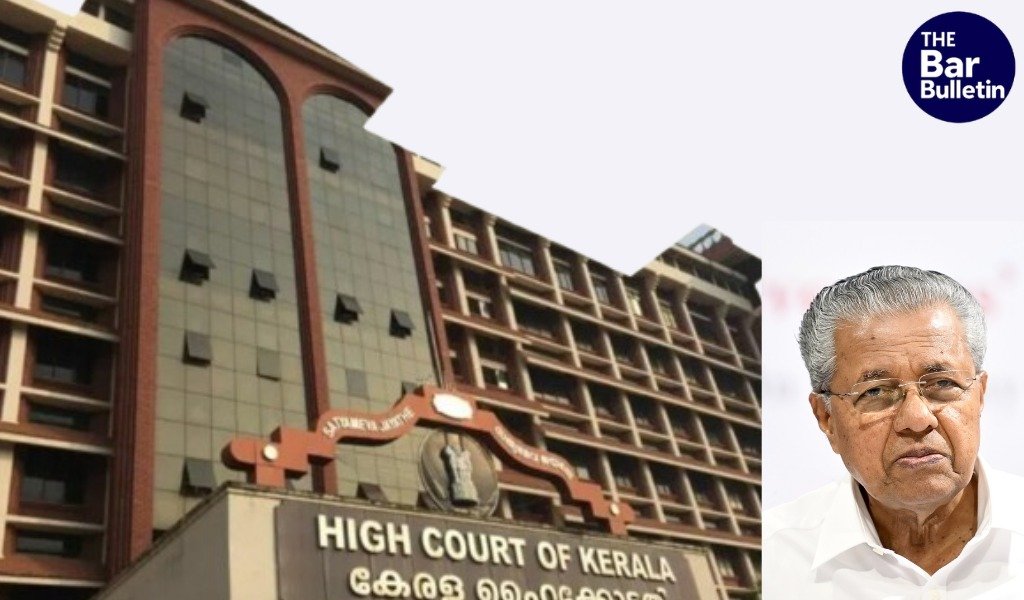

The Kerala High Court on Monday stayed the FIR and further investigation against former Chief Minister Pinarayi Vijayan, his daughter Veena T and son-in-law and MLA Mohammed Riyas in the CMRL-Exalogic alleged pay-off case.
A Division Bench of Justice K Natarajan and Justice Johnson John passed the interim order while hearing appeals challenging a Single Judge’s October 9 direction to register an FIR under the Prevention of Corruption Act based on information shared by the Enforcement Directorate (ED).
The case concerns alleged irregularities in financial transactions between Cochin Minerals and Rutile Limited (CMRL) and Exalogic Solutions Private Limited, a company owned by Veena. The ED had shared information with the Kerala Police alleging that CMRL paid money to Exalogic without receiving corresponding services.
On October 9, Justice A Badharudeen had directed the Vigilance and Anti-Corruption Bureau to register an FIR against Vijayan, Veena, Riyas and others, holding that the material shared by the ED warranted registration of a case. The Single Judge had also set aside the State government’s decision to constitute a Special Investigation Team to conduct a preliminary inquiry instead of registering an FIR.
During Monday’s hearing, counsel for the appellants argued that the Single Judge had passed an order affecting them without hearing them, despite the consequences for their rights. They also contended that the petitioner, advocate K M Shajahan, had bypassed the procedure prescribed under criminal law and that the Single Judge had exceeded jurisdiction by directing registration of an FIR.
The State government submitted that it had initially constituted an SIT to conduct a preliminary inquiry into the ED’s communication but subsequently registered the FIR in compliance with the Single Judge’s order. The ED, meanwhile, argued that the State was required to register an FIR when information disclosing a cognisable offence was received.
The High Court’s order follows the Supreme Court’s intervention last week, when it directed the Division Bench to hear the appeals on merits after setting aside an earlier refusal to permit the appeals to proceed. The Supreme Court had also granted temporary protection against the investigation to enable the appellants to approach the High Court.