
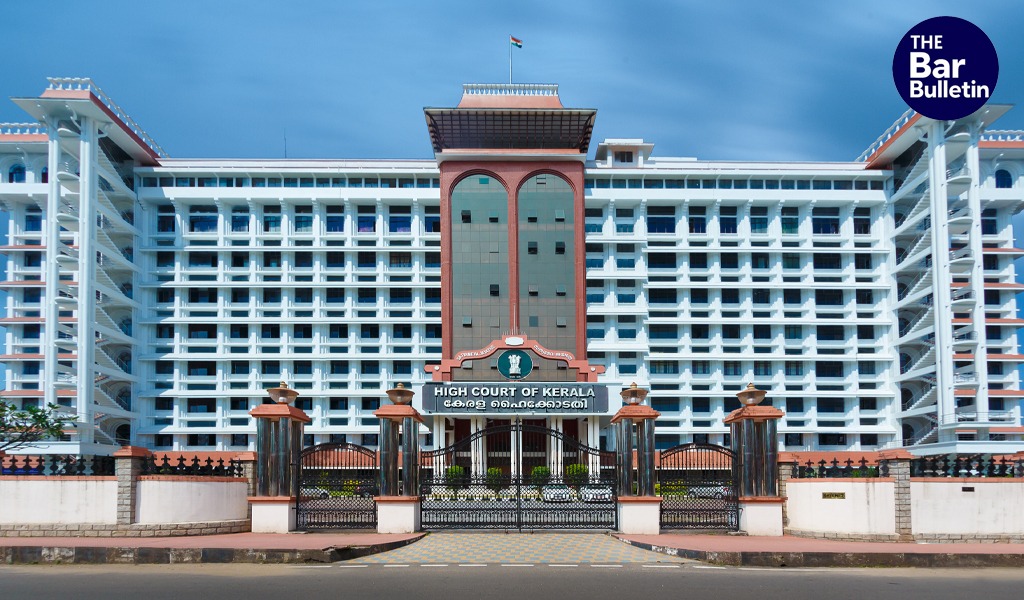

While denying hostel subsidy for child studying at Sainik School, Kazhakkoottam, the Kerala High Court (Ernakulam Bench) has asserted that hostel subsidy under the Children Education Allowance Scheme is available only where the employee is compelled to place the child in hostel accommodation because the residential school or institution is located beyond 50 kilometres from the employee’s residence and there is no practical alternative due to distance. The Court also clarified that such benefit cannot be extended to cases where hostel stay is mandatory only because the parent has chosen a particular school within that radius, and the Court cannot expand or modify the terms of a policy scheme through judicial interpretation.
The Court reinforced that reimbursement-based service benefits governed by departmental schemes will be interpreted in line with their express conditions, particularly where the scheme operates in the realm of administrative policy. Even in the case of welfare schemes, courts will not extend monetary benefits to situations not clearly covered by the text. For claims relating to hostel subsidy, the decisive factor is not merely whether hostel stay is compulsory in the chosen institution, but whether the child’s placement in a hostel is necessitated by the prescribed distance criterion under the Scheme itself.
The Division Bench comprising Justice Devan Ramachandran and Justice Basant Balaji observed that noted that the Tribunal had accepted the respondents’ interpretation after analysing the provisions of the Scheme, and the Bench recorded its agreement with the impugned order. It observed that although the Scheme is a welfare measure intended for the benefit of employees, it remains a policy decision of the competent authority, and the Court, while exercising jurisdiction under Articles 226 or 227 of the Constitution, cannot impose its own wisdom or rewrite its terms in the manner sought by the petitioner.
The Bench further observed that, on a proper reading of the Scheme, the provision for hostel subsidy is intended solely to save and offset the burden on a parent who has to provide education to a child in a school situated far away from the residence, where hostel accommodation becomes necessary because of the distance involved. The benefit is thus aimed at employees who are forced to put their children in hostels because there is no practical alternative due to the large distance to be travelled.
The Bench distinguished such cases from the petitioner’s situation, holding that where a parent voluntarily opts to admit a child to a particular school knowing that mandatory hostel accommodation is one of its conditions, the resulting expense arises from the parent’s own choice. The Bench added that Sainik School is not the only institution with such a requirement, and the Scheme is not intended to cover all cases of mandatory boarding imposed by a selected institution.
The Bench expressly stated that the purpose behind the Scheme could not be expanded to cover the personal choice of a parent to admit a child in a school with peculiar or singular requisites, including compulsory hostel admission. While acknowledging the petitioner’s submission regarding purposive interpretation, the Bench held that the object of the Scheme can legitimately be confined to the limited manner indicated by the text and structure of the Scheme itself.
Briefly, the case concerns the Children Education Allowance Scheme issued by the Department of Personnel and Training, Government of India, under which employees of the Department of Posts could claim several education-related components for their children, including a separate “Hostel Subsidy” capped at Rs.3,000 per child for a maximum of two children. The Scheme defined hostel subsidy as expenses incurred for keeping children in the hostel of a residential school or institution located beyond 50 kilometres from the employee’s residence.
The petitioner, a Postal Assistant at Thiruvananthapuram GPO, had admitted his child to Sainik School, Kazhakkoottam, where hostel stay was stated to be mandatory for every student. He claimed that since hostel accommodation was compulsory in that school, he was entitled to hostel subsidy even though the school was situated within 50 kilometres of his residence at Thiruvananthapuram. His claim was not accepted by the respondents, leading him to approach the Central Administrative Tribunal, Ernakulam Bench. Though the Tribunal had initially allowed the matter, that order was set aside by the High Court in an earlier round and remitted for reconsideration, after which the Tribunal rejected the claim.
The petitioner argued that the object of the Scheme was to facilitate the best possible education for the children of employees and that the benefit of hostel subsidy should extend to cases where the parent is compelled to bear hostel fees, whether because of distance or because the chosen school mandates boarding. He submitted that Sainik School made hostel residence compulsory, and therefore the benefit under the Scheme ought to be interpreted benevolently so that the subsidy would not be denied merely because the school was within 50 kilometres of his residence.
The respondents contended that the hostel subsidy was intended only to offset the burden of parents who were compelled to place their children in a hostel because the school was beyond 50 kilometres from the residence and daily travel was impracticable. They argued that the petitioner had several schools available within a 50-kilometre radius that did not require hostel accommodation, and that his decision to choose Sainik School, with its mandatory boarding condition, was therefore a matter of personal choice rather than necessity contemplated by the Scheme.
