
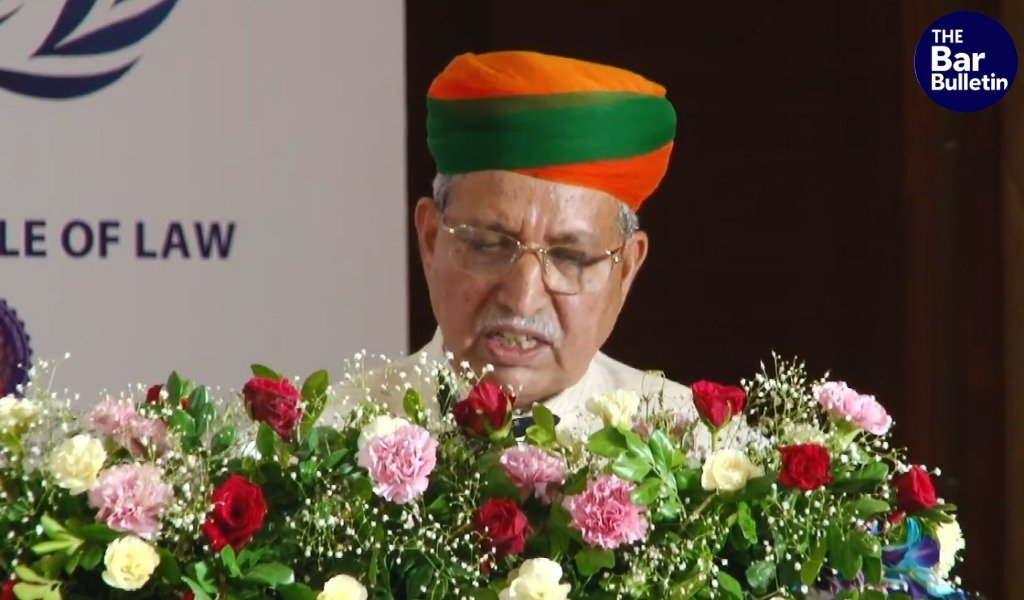

Law Minister Arjun Ram Meghwal on Friday said mediation has assumed unprecedented significance in an era shaped by rapid technological advancement, economic integration and geopolitical shifts, asserting that it offers a humane and sustainable model of justice by rebuilding relationships rather than merely adjudicating legal rights. Speaking at the inaugural session of Commonwealth Peace Mediation Conference 2026, Law Minister said the conference’s theme, “Peace, Mediation and the Rule of Law,” reflected one of the defining global necessities of the present time.
The Law Minister observed that the world was witnessing profound transformations driven by artificial intelligence, blockchain technology, digital assets, cross-border data flows, global supply chains and evolving commercial relationships. These developments, he said, had generated increasingly complex legal disputes that demanded dispute resolution mechanisms capable of preserving commercial confidence, strengthening governance and ensuring long-term social stability.
“
“The theme of this conference, ‘Peace, Mediation and the Rule of Law’—is not merely the subject of a conference. It reflects one of the defining global necessities of our times. At a time when the world is undergoing unprecedented economic, technological and geopolitical transformation, peace, mediation and the rule of law are no longer merely concepts. They have become the foundational pillars of global sustainability, economic stability and good governance.”
Tracing India’s mediation tradition from community-based dispute resolution to institutional mechanisms, he said the country had steadily modernised its justice delivery system while remaining rooted in its civilisational ethos of dialogue and consensus. He noted that India’s recent legislative and institutional reforms reflected a conscious effort to make justice more accessible, efficient and responsive to contemporary needs.
Highlighting the Mediation Act, the Minister said the legislation had established a comprehensive statutory framework for institutional mediation, pre-litigation mediation, enforceability of mediated settlement agreements and the development of a robust mediation ecosystem. He added that the reform complemented initiatives such as commercial courts, arbitration reforms, the India International Arbitration Centre and the e-Courts project, all aimed at creating a technology-enabled and investment-friendly legal environment.
“
“In such a scenario, mediation has emerged as one of the most effective mechanisms because it does not merely deliver a decision, it rebuilds relationships. It does not merely determine legal rights, it builds trust. The Mediation Act has provided a comprehensive legal framework for institutional mediation, pre-litigation mediation, enforceability of mediated settlement agreements and the development of a robust mediation ecosystem. It is not merely a legislative measure but India’s commitment to fostering a culture of consensus-based justice.”
Emphasising the importance of international cooperation, he said the Commonwealth’s shared common law heritage provided a strong foundation for collaboration in mediation through capacity building, exchange of best practices and cross-border enforcement of mediated settlements. He expressed confidence that the deliberations over the three-day conference would contribute meaningfully to advancing global peace, strengthening the rule of law and expanding access to justice through mediation.