
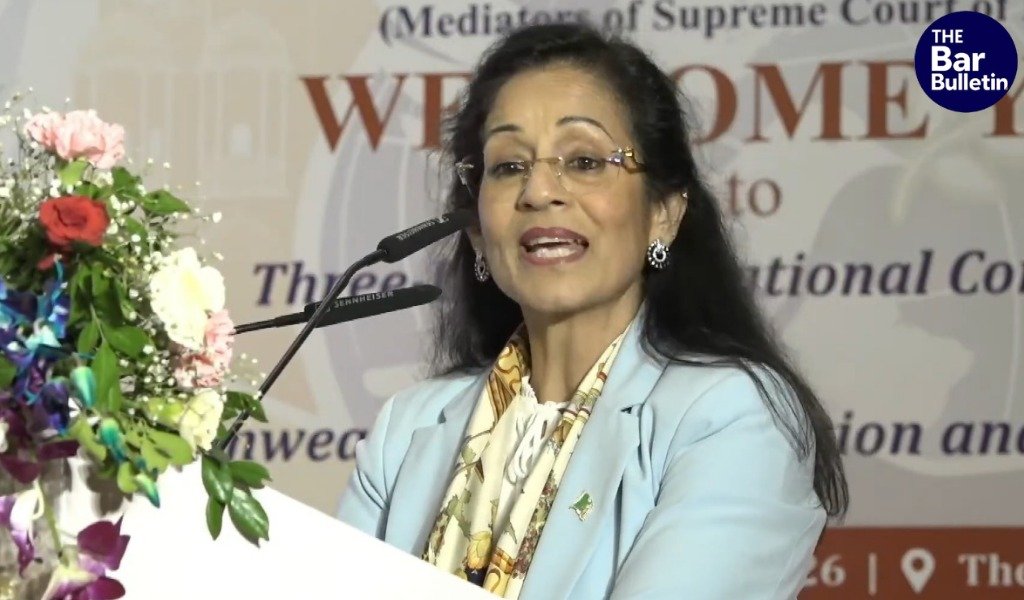

Justice Abha Patel, Judge, Supreme Court of Zambia, on Friday said mediation possesses a transformative power that extends beyond legal adjudication, observing that while litigation resolves disputes, mediation has the ability to restore relationships, dignity and trust. Speaking at the the inaugural session of the three-day Commonwealth Peace Mediation Conference 2026 on the theme “Commonwealth Peace Mediation and the Rule of Law”, she said peace, mediation and the rule of law together form the foundation of a just and humane society.
Beginning her address with a note of gratitude, Justice Patel described it as an honour to speak at the conference in Jaipur and thanked the organisers and the Indian judiciary for the invitation. She also reflected on her journey to the Supreme Court of Zambia, saying her appointment as the first woman of Indian origin to serve on the country’s apex court carried with it a profound sense of responsibility rather than personal pride.
“
“I have the privilege, and I say this with humility rather than pride, of being the first woman of Indian origin to serve on the Bench of the Supreme Court of Zambia. I received this honour not with pride, but with deep reverence, a profound sense of responsibility and humble service. This is not merely a personal milestone. It is an open door so that others may walk through it. It reminds us that grace does not discriminate and that purpose and service know no boundaries.”
Reflecting on her judicial career, Justice Patel said years spent serving across different levels of the judiciary had reinforced that recognition of a judge was never an individual achievement alone but a tribute to the institutions, traditions and constitutional values they were entrusted to uphold.
Speaking on the conference theme, “Peace, Mediation and the Rule of Law,” she observed that the subject was not an abstract concept for judges but one rooted in their daily experience of resolving human conflict. She noted that while courts adjudicate rights, mediation often succeeds in healing fractured relationships and rebuilding confidence between disputing parties.
“
“The theme of this conference, ‘Peace, Mediation and the Rule of Law’, is not an abstraction to those of us who have sat in judgment, who have watched disputes fester into division, and who have seen how a well-timed act of mediation can restore what litigation alone cannot—relationship, dignity and trust. The Commonwealth has always understood that law without reconciliation is incomplete, and that reconciliation without the rule of law is fragile. In this difficult world, torn by conflict, this conference sits precisely at that intersection.”
Drawing from Zambia’s own experience, Justice Patel highlighted the country’s long-standing tradition of community-based dispute resolution through local courts and chieftaincy-led mediation, saying these indigenous practices had much to contribute to global conversations on peacebuilding. She added that Commonwealth nations shared a common legal heritage founded on fairness, due process and the peaceful resolution of disputes, creating valuable opportunities for mutual learning.
Concluding her address, Justice Patel observed that the rule of law survives only because judges, lawyers and public institutions consciously choose every day to uphold it. She expressed confidence that the conference would strengthen cooperation among Commonwealth jurisdictions and inspire participants to carry forward the values of peace, mediation and justice in their respective legal systems.