
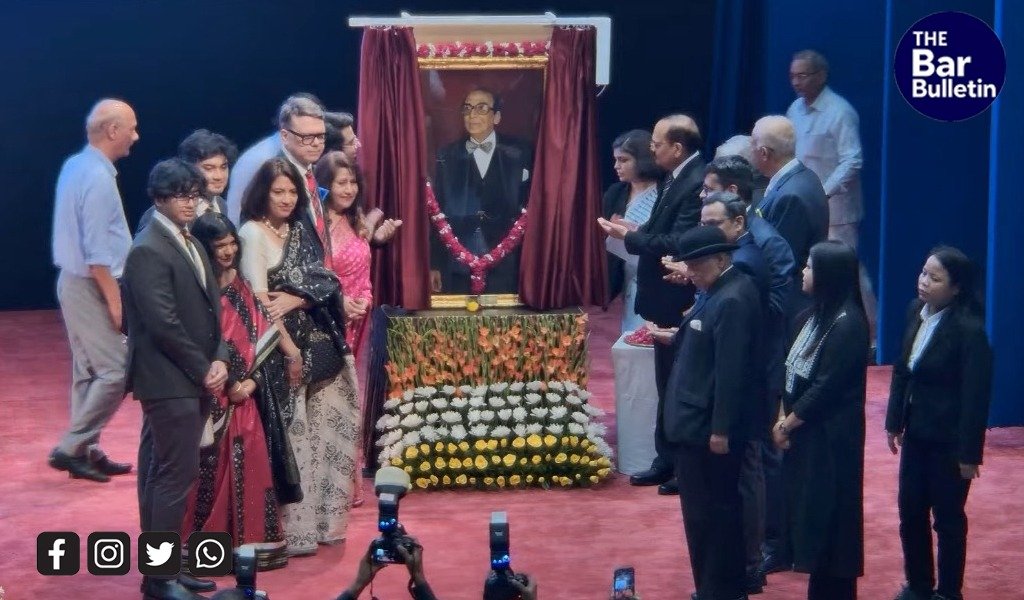

Chief Justice of India Justice Surya Kant on Wednesday said the portrait of late senior advocate Ashoke Kumar (A.K.) Sen would serve as a lasting reminder to generations of lawyers that the legal profession transcends personal ambition and that the practice of law and the stewardship of justice are “sacred trusts in service of the Republic.”
Speaking at the unveiling of A.K. Sen’s portrait at the Supreme Court Bar Association, the CJI described Sen as an “illustrious son of India’s judicial and legislative heritage” whose life embodied legal excellence, public service and unwavering commitment to the nation. He said the ceremony was not merely about honouring an individual but about preserving the ideals that define the legal profession.
Emphasising the significance of the portrait, Justice Kant said the corridors of Library 1, adorned with portraits of legal luminaries, are meant not only to memorialise distinguished personalities but also to inspire those who walk through them.
“
“For every Advocate who passes through the Library, seeking wisdom among the volumes, this portrait would be a silent reminder: that our calling transcends personal ambition, that the practice of law and the stewardship of justice are sacred trusts in service of the Republic.”
The Chief Justice observed that the Supreme Court’s institutional memory is shaped not only by its judgments but also by the lives of those who have strengthened its traditions. Referring to portraits of former Chief Justices and eminent jurists displayed across the Court, he said they stand “guard, as much as they commemorate lives of exceptional service.”
Reflecting on A.K. Sen’s remarkable career, Justice Kant said he occupied a unique place in Indian legal history, having excelled both as an advocate and as a statesman.
“
“He was equally at home with the brief and the Bill, with precedent and policy, with the discipline of the courtroom and the demands of public life. While most lawyers spend a lifetime trying to master one institution, he helped shape more than one.”
The CJI also recalled anecdotes illustrating Sen’s extraordinary legal acumen. He referred to the legendary incident where, when questioned by a judge about his interpretation of a statutory provision, Sen famously replied, “Because, My Lords, I drafted it,” drawing laughter in the courtroom while reflecting his mastery over the law. Justice Kant further noted that even judges were said to have borrowed from Sen’s vast personal library to trace elusive precedents, and recalled Justice Dipankar Datta’s remark:
“
“You had Palkhivala in Bombay, and Mr. Sen in Kolkata.”
Addressing young members of the Bar, the CJI said he hoped the portrait would inspire self-reflection rather than admiration alone. Instead of asking how many offices A.K. Sen held, he said, young lawyers should ask themselves whether they had prepared sufficiently, treated the Court and their opponents fairly, and used the law to clarify rather than complicate disputes.
Concluding his address, Justice Kant said A.K. Sen’s legacy should remind both the Bench and the Bar that enduring institutions are built not merely by landmark judgments or historic legislation but by everyday virtues.
“
“May his presence here remind us that brilliance without balance is incomplete; that office without service is transient; and that law without humanity is barren. May it remind the Bench and the Bar alike that institutions are strengthened not only by grand judgments and historic statutes, but also by the daily habits of preparation, restraint, humour and respect.”