
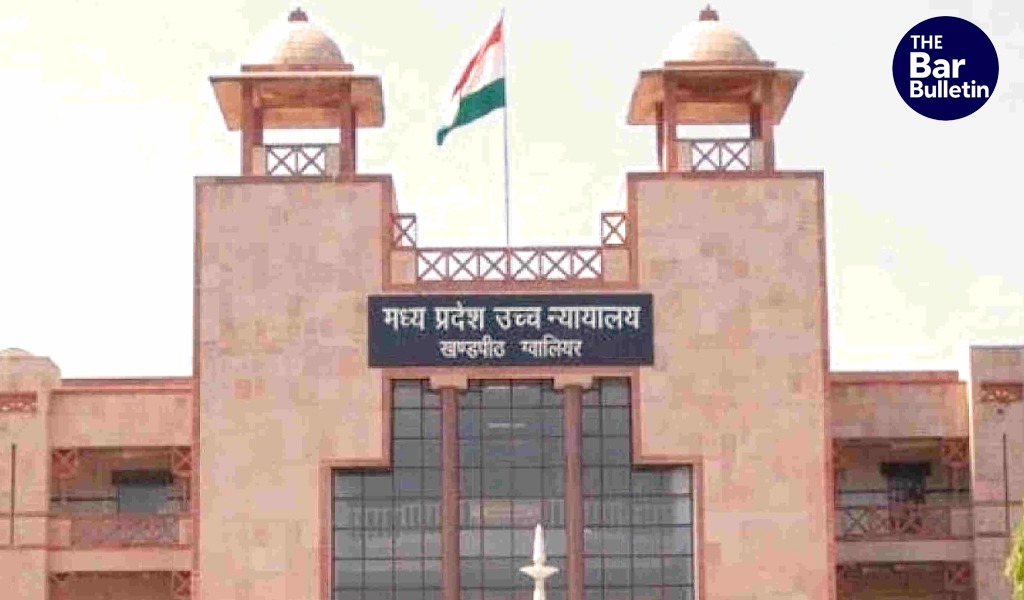

In a second appeal filed before the Madhya Pradesh High Court under Section 100 of the Code of Civil Procedure, 1908 (CPC) by the Distt. Education and Training Centre to challenge a judgment and decree dated 02-12-2003 by the District Judge, Datia, a Single Judge Bench of Justice Ashish Shroti refused to condone the delay, rejected the applications, and dismissed the appeal.
The appeal was filed with a delay of 1202 days on 18-06-2007 and an application was filed in 2007 seeking condonation of delay. Subsequently, the appellants also filed another application for the same relief in 2026. The appellants averred that the Government Advocate appearing for the government in the first appeal, did not inform about the disposal of the appeal to the officers concerned. The respondents also did not produce any judgment copy before the appellants.
It was asserted that the passing of the impugned judgment and decree came to the appellants’ knowledge only when in December 2006 the respondent started construction work over the subject plot. The appellants submitted that after obtaining permission on 08-05-2007, they had filed the appeal on 18-06-2007.
From the order sheets of the execution case by respondent 1, it was found that the assertion made in the application for condonation of delay that the appellants gathered knowledge of the impugned judgment and decree in 2007, was incorrect as they were aware about the same on 21-09-2005, i.e., when they entered appearance in the execution case.
Another important aspect was that the Court took a serious view of the lethargic approach of government officials and passed a detailed order on 15-01-2026, noting that the Collector or officers superior to him are completely negligent in prosecuting civil cases before the High Court and issued directions to the Chief Secretary of the State of M.P. to file his personal affidavit. In his affidavit, the Chief Secretary stated that the Collector, Datia had constituted a three member committee and had issued show cause notices demanding explanation within 3 days.
Thereafter, in the said matter, the Government Advocate informed the Court that a preliminary enquiry had been conducted and the persons who were prima facie found guilty, had been shortlisted. It was also mentioned that the Collector, Datia, had already forwarded his recommendation for taking departmental action against the erring offices and sought 2 days time to place necessary information on record.
The Court stated that the action taken report by an application had been filed on 28-02-2026 according to which, disciplinary action against certain erring officers had been recommended. It was noted that even at the time of the present matter, the Government Advocate could not inform the Court as to whether any action had been taken against the said officers. Hence, the Court stated that the appellant’s intention to take action against the erring officers was only an eyewash.
It was stated that the Supreme Court has repeatedly held that the government cannot claim any special privilege in the matter of condonation of delay. The Court said that the State could not be allowed to take advantage of its status as government, unless it gives an explanation for the inordinate delay in filing the appeal. The Court held that the appellant’s stand was false and incorrect.
Stating that it had given an opportunity to the appellants to show their bonafide by acting against the erring officers on 15-01-2026, the Court stated that despite a lapse of 6 months, no action had been taken by them. Thus, finding no ground to condone the delay, the Court rejected the applications and also dismissed the appeal.
